


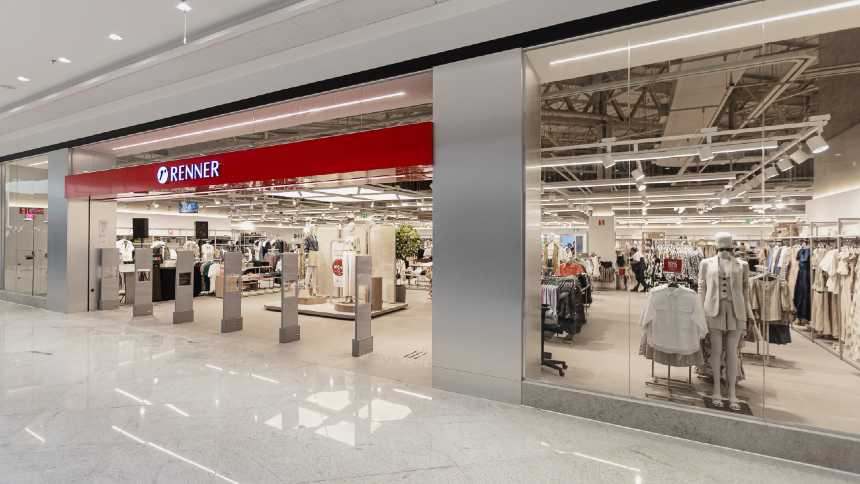
Lojas Renner closed 2025 with record profits in the fourth quarter and for the year, and with margin growth, a performance seen by executives as a validation of the adjustments made in recent years and a positive prelude to the cycle projected for the period from 2026 to 2030 , with growth and profitability going hand in hand.
The retailer closed the fourth quarter with a net profit of R$ 552.6 million, a 13.4% increase compared to the same period of the previous year, according to the balance sheet published after the stock market closed on Thursday, March 5th. With this, the company ended 2025 with a profit of R$ 1.4 billion, a 22% increase.
Net operating revenue rose 5% in the last three months of last year, to R$ 4.8 billion, closing the year at R$ 15.8 billion, an increase of 4.8%.
Adjusted retail EBITDA totaled R$1 billion in the fourth quarter, a 9.3% increase, reaching a margin of 24.2%, 1.1 percentage points higher than the previous year. For the year, it reached R$2.7 billion, a 10.2% increase, resulting in a ROIC of 14.7% in the quarter, a 2.3 percentage point increase compared to 2024.
“It was a year in which we showed that the company has growth potential, with even greater gains in profitability and efficiency, being able to increase gross margin and sales, reduce inventory, decrease expenses, distribute value to shareholders, invest in growth and maintain robust cash generation,” says Fabio Faccio , CEO of Renner, to NeoFeed .
The last three months of 2025 were marked by a more complex scenario for the retail sector. Net revenue in the segment reached R$ 4.3 billion in the fourth quarter, a growth of 4.3% compared to the same period of the previous year.
Same-store sales, which consider the performance of units that have been operating for more than 12 months, rose 3.3%, a slowdown compared to the 8.9% increase recorded in the fourth quarter of 2024.
According to Faccio, the results were as expected, given the dynamics that were emerging at the beginning of 2025, with a stronger first half of the year for sales, followed by six weaker months.
The company also felt the effects of lower-than-usual temperatures , a situation that affected customer traffic in stores, hurting sales volume for the Renner brand.
Faccio states that there is still room for improvement in how to deal with the climate issue, but highlighted that the current business model, with inventory management and less promotional activity, was able to ensure that the situation did not harm profitability.
In the fourth quarter, the consolidated gross margin increased by 0.7 percentage points, reaching 56.5%, a record level in the last six years. Faccio also highlights the 0.7 percentage point dilution of expenses in relation to net retail revenue. Operating expenses rose by 2% in the quarter, to R$ 1.4 billion.
“Even in a quarter with slightly lower growth than the year's average, which was already expected, we had expense dilution; it was also the lowest expense growth of the year. It was a year that demonstrated the consistency of our model,” says the CEO.
At Realize , the financial arm of Renner, the year was marked by capturing the work of recovering the loan portfolio, which began in 2024, while maintaining a more conservative stance in granting credit.
The total portfolio grew 11.3%, to R$ 6.4 billion. The share of non-performing loans increased by 7.8 percentage points, due to Resolution 4,966 of the National Monetary Council (CMN), which changed the deadlines for recognizing overdue interest and writing off overdue assets. Excluding this effect, the non-performing loan portfolio fell by 0.3 percentage points.
In the quarter, the result of financial services totaled R$ 63.6 million, a 3.7% increase. “Throughout the year, compared to 2024, we saw both an improvement in profitability and even an improvement in the portfolio profile. So we close the year with a low-risk portfolio,” says Daniel Santos, CFO of Renner.
With these results, and most of the structural investments in its business model completed, Renner is launching its expansion plan for the next five years. The company aims to reach the end of 2030 with a ROIC of around 20% and annual net revenue growth between 9% and 13%.
Faccio points out that, even without all the planned initiatives, Renner has already begun to meet the goals of the plan in 2025. He cites the 9.2% increase in revenue and the opening of 34 stores, 23 of which were opened in the fourth quarter alone, with the plan forecasting an opening rate of approximately 28 to 34 units by 2030.
By 2026, Renner plans to open 50 to 60 new stores. To achieve this, it will invest R$ 1 billion, with a significant portion of the resources going towards stores, exceeding the R$ 858 million capital expenditure (capex) of 2025, which already represents a 29.6% increase compared to the amount invested in 2024. "The 2025 results show that the plans for the period from 2026 to 2030 that we have announced are quite feasible and concrete, because they have already begun to materialize," says Faccio.
LREN3 stock has risen 10% this year on the B3. In 12 months, Lojas Renner shares have increased 31.4%, to a market value of R$ 14.8 billion.