

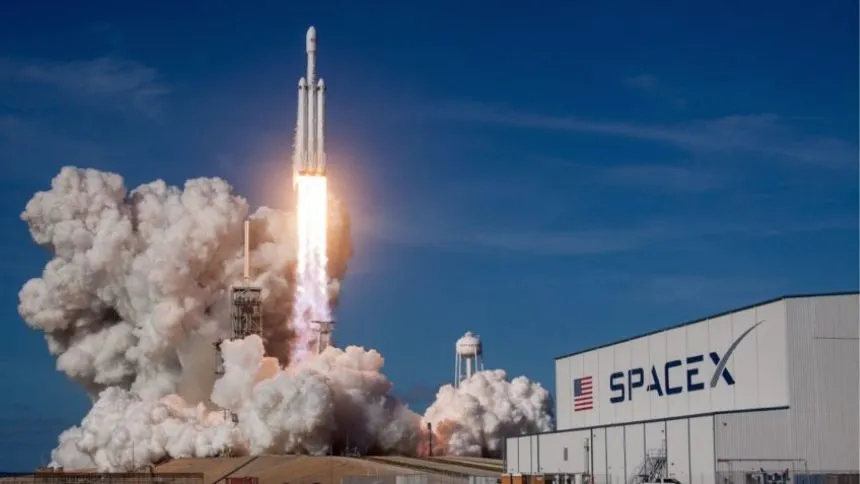
After months of speculation, SpaceX has made public the data of its operations in the preliminary prospectus for its IPO, which promises to be the largest in human history.
The document does not specify the company's intended funding goals, but The Wall Street Journal (WSJ) reports that the rocket manufacturer, led by Elon Musk, aims to raise $80 billion or more, at a valuation of $1.5 trillion.
If these figures are confirmed, the operation would far surpass that of Saudi Aramco , which raised US$26 billion when it went public in 2019. To carry out the IPO, SpaceX relies on a "constellation" of banks – the syndicate has 23 institutions, led by Goldman Sachs and with the participation of BTG Pactual .
Although the size of the IPO has not yet been revealed, the prospectus provides transparency regarding the company's current situation and long-term plans, with superlative figures and ambitions that extend beyond Planet Earth, demonstrating how much everything will revolve around Musk.
SpaceX writes in the document that its mission is "to build the systems and technologies necessary to make multiplanetary life possible, to understand the true nature of the universe, and to extend the light of consciousness to the stars."
To that end, the company continues, it has created “the most ambitious vertically integrated innovation engine on Earth (and in space), with unparalleled capabilities to rapidly manufacture and launch space communications that connect the world, harness solar energy to power truth-seeking artificial intelligence that drives scientific discovery, and ultimately build a base on the Moon and cities on other planets.”
Founded in 2002, SpaceX has two business areas. The first is space, which operates reusable rockets , having carried out approximately 650 launches since 2023. The second area is called connectivity and operates the Starlink telecommunications network, which has more than 9,600 satellites in low Earth orbit and 10.3 million subscribers in 164 countries.
Last year, SpaceX reported a loss of $4.9 billion, reversing a profit of $791 million in 2024. The company's revenue, on the same basis of comparison, grew 33% to $18.6 billion.
A large part of the losses are related to the new segment that SpaceX is developing: artificial intelligence (AI), following the acquisition of xAI this year.
In its initial stages, the unit recorded an operating loss of US$6.3 billion, given the size of the investments needed to develop and scale the technology. It is expected that this area will weigh heavily on SpaceX's results for some time.
"Our AI business is in a relatively early stage, being integrated into our organization. Its business strategy is still under development and will require significant investments to fund computing, infrastructure and power generation, model training and product development," says an excerpt from the prospectus.
SpaceX sees an addressable market of around US$28.5 trillion, the largest ever seen in human history. AI accounts for the largest share of this value, with a market estimated at US$26.5 trillion, considering infrastructure and service subscriptions. This is followed by connectivity, at US$1.6 trillion, and space, at US$370 billion.
The prospectus also shows that Musk will be the CEO, CTO, and chairman of the board of directors of SpaceX. The IPO foresees a dual-class structure, with broad powers for Class B shares, the majority of which will be held by the entrepreneur, shaping the composition of the board.
"As a result, Mr. Musk will have the power to control the outcome of matters requiring shareholder approval, including the election of all our directors, and to control our business and affairs," reads an excerpt from the prospectus.
The situation is even cited as a risk factor. SpaceX admits that it is "highly dependent on the continued services of Mr. Musk," and does not have life insurance for him.
Furthermore, despite all the positions he holds at SpaceX, he doesn't dedicate "all of his time and attention to our business," with the company highlighting that Musk currently acts as a "technoking" (a title he created for himself in 2021) and CEO of Tesla , in addition to being involved in other ventures, such as Neuralink , a neurotechnology company, and The Boring Company , which aims to build low-cost, high-speed underground tunnel networks.
"Any loss or reduction of your involvement in our business could result in a significant adverse impact on our business, financial condition, operating results and future prospects," says an excerpt from the prospectus.