

Years were entirely dedicated to strengthening its operation. But, at the end of 2024, faced with a less than inviting macroeconomic scenario, Wine understood that it needed to focus on delivering on a different label: preserving cash flow and profitability.
After completing part of this path during 2025, the wine group reserved the end of the year to take another step in this strategy with the issuance of a receivables investment fund (FIDC), worth R$ 100 million.
The FIDC (Investment Fund in Receivables) closes a larger account, totaling R$ 250 million, towards restructuring Wine's debt . This batch also included two commercial notes . The first, for R$ 60 million, in June, with Banco do Brasil. And the second, for R$ 90 million, in November, with Itaú, Bradesco, and Banco ABC.
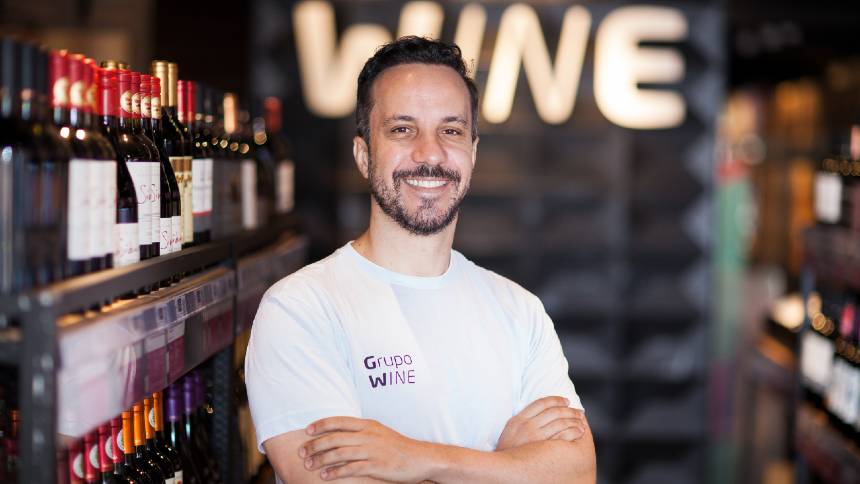
“We had a very good year from a profitability standpoint,” says Alexandre Magno, CEO of Wine, to NeoFeed . “The only remaining step was to balance the company's capital structure.”
The FIDC (Investment Fund in Credit Rights) had its senior shares acquired by Itaú and Bradesco, representing 80% of the value. The junior share went to Vert, which will also operate the fund, based on invoices from hotels, bars and restaurants, and clients of Wine's B2B arm.
According to Magno, Wine's debt – which stood at R$225.7 million at the end of the third quarter of 2025 – will now be 30% short-term and 70% long-term. Previously, this equation was around 60% and 40%.
“This gives us peace of mind that, in 2026, we will have less pressure from paying interest and amortizing debt,” he says. “And we will have more financial breathing room so that our team can focus much more on operational matters, as we still have some issues to address.”
Up to this point, from an operational standpoint, Wine's change of course has involved areas such as adjustments to its commercial and pricing policies, streamlining marketing investments, reducing staff, and centralizing logistics contracts.
Some of these initiatives were reflected in the group's balance sheet. EBITDA, for example, grew 49.1% in the period from January to September 2025, to R$ 92.8 million. During this period, net profit was R$ 21.8 million, reversing the loss of R$ 18.3 million recorded a year earlier.
Conversely, there were impacts – as expected – on lines such as net revenue, which fell 3.7% in the first nine months of the year, to R$ 555.3 million, largely due to the loss of volume directly linked to the price adjustment carried out throughout the year, of around 12%.
“We don’t think it will be necessary to make an adjustment of that magnitude in 2026, so we’re going to sit down with our partners again and occupy a little more shelf space,” says Magno. “It will be possible to combine some revenue growth with profitability, which, however, remains the focus.”
Along these lines, the CEO states that Wine, which closed four physical stores in its network, does not expect to resume opening new units in 2026. Currently, the retail operation has 13 points of sale.
“We see potential for at least five or eight more stores, but we won’t expand precisely because of the resources involved,” he says. “A store costs around R$ 500,000 and has a payback period of just over 12 months. So, it’s time to prioritize other investments.”
Mexico, premium positioning and private labels.
Within this agenda, one of the spaces is reserved for Mexico , where Wine landed at the end of 2021, but only began investing in earnest in 2023. Today, this operation represents only about 2% of total revenue, but the company understands that there is significant potential to grow this share.
In the short term, the company is expanding its investments in the country at the end of this year. The idea is to take advantage of the winter period to attract more subscribers to the local version of Clube Wine, which has around 30,000 users. And, in 2026, to "surf" on top of a larger base.
Today, Clube Wine is Wine's only arm in Mexico. But, in the medium term, the plan is to replicate the operating model in Brazil, which also includes e-commerce, physical stores, and B2B.
“We see room to create this entire ecosystem there and eventually have two or three physical stores in the main cities,” Magno notes. “But, at the moment, we are prioritizing the club because, for that, we need a slightly higher level of investment.”
This doesn't mean Wine is standing still. The company is already in talks to find a local partner – either financial or strategic – to accelerate these investments. The goal is to raise around US$3 million to US$4 million.
“With these resources, the idea is to invest more in marketing to position the brand and bring in new subscribers,” says the executive. “And, in B2B, to hire professionals, run positioning and sales campaigns for large supermarkets and specialty chains.”
In Brazil, one of Wine's priorities, a company well-known for its entry-level products, is to move up the shelf a bit, seeking a more premium positioning, a process that began this year.
Future efforts in this direction include a restructuring of the Wine Club, which currently has over 350,000 subscribers, as well as initiatives in the B2B arm. "We gained significant space in airport VIP lounges this year and hope to replicate this work for restaurants in 2026," says Magno.
Another area that will receive attention is private label wines, a strategy that Wine also began implementing this year with three original brands – Metropolitano, Entre dois Mundos, and Dínamo Wines. And the plan is to expand this portfolio.
“Our idea is to continue with this strategy, and the trend is towards more entry-level products,” says Magno. “We have a plan, perhaps for next year, to expand into Argentina and Portugal, which, given the size of their markets, would be the countries where it would make the most sense for us to work now.”