




One of the most influential venture capital firms in Silicon Valley, Andreessen Horowitz (a16z), along with Sequoia Capital, has been leading the boom in investments in artificial intelligence (AI) startups. In this context, a Brazilian startup is the recipient of one of the American firm's newest investments.
Operating stealthily for the past two years, Segura, owner of an AI platform for the insurance sector, is officially emerging from its "hideout" with a seed investment of R$ 45 million, co-led by a16z and Kaszek , another leading player in the venture capital industry. In this case, from Latin America.
The funding round also includes Big Bets and prominent angel investors such as Assaf Wand, founder of the American company Hippo; Anderson Thees , partner at Redpoint Ventures; Fersen Lambranho , chairman of the board of GP Investments; Marcelo Blay, founder of Minuto Seguros; and the Almeida Braga clan, which controls Icatu.
“All of these names are highly respected and very selective when it comes to making investment decisions,” says Luís Alberto Nogueira, co-founder and CEO of Segura, to NeoFeed . “So, entering the market with these endorsements is a sign that we are on the right track.”
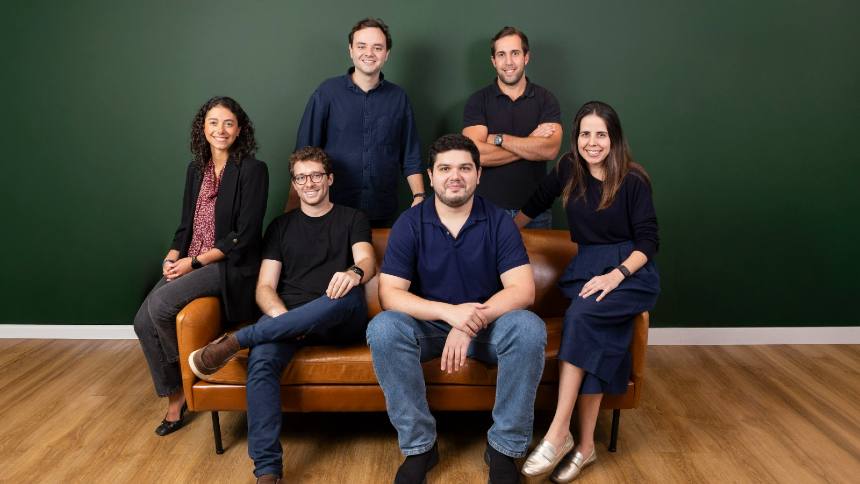
The thesis that attracted this group was developed by Nogueira, Lucca Buffara, and Pedro Nobrega. Friends from their engineering course at PUC-Rio, they began to have contact with AI in 2018 at Cyberlabs, a company that was already focused on this area and which, in 2021, merged with PSafe, a cybersecurity firm.
The insurance market, in turn, came onto the trio's radar in 2022, when Nogueira and Buffara moved to Akad Seguros, an operation that originated from Argo Seguros and was renamed after its acquisition that same year by Cyberlabs and GP Investments.
The decision to unite these two worlds came in May 2024, when the three founded Segura. The proposal? To maintain brokers as the essential link in this chain – the channel accounts for 80% of the sector's sales. But, at the same time, to boost the work of these professionals with AI resources.
“AI will bring a new paradigm for this broker, because with it, they can delve into the details of issues that are not structured,” says Nogueira. “But for this to happen, it is necessary to build an infrastructure to help them interact with both insurance companies and the end customer.”
To improve these dialogues, Segura starts from a universe currently comprised of approximately 150,000 brokers operating in the country. And from the premise that these professionals deal, daily and manually, with an extremely complex dynamic.
This routine involves, on one hand, a tangled web of systems from different insurance companies, with all the nuances of products, coverage, quotes, and constant changes in conditions. And, on the other hand, the challenge of finding the offers that best suit each client's budget and needs.
Segura's model is based on two AI platforms. Launched a year ago, Helena is the channel with insurance companies that, among other features, streamlines access to policy data, coverage, and quotes. It also verifies daily changes in the conditions of each offer or in industry regulations.
A second, more recent tool, launched two weeks ago, is Conversations, through which the broker interacts in real time with end customers, supported by a framework of information about products, policies contracted, and interaction history.
The idea is that the two platforms, integrated with WhatsApp, will help eliminate bureaucratic tasks and provide support for more efficient and, at the same time, more personalized service. And with considerable autonomy for the broker to define their level of participation in each stage of this process.
“The broker configures how these AI agents work,” says Nogueira. “They can choose for the assistants to answer everything automatically, without needing their interaction, or put a guardrail so that they only answer certain questions.”
Among other things, the platforms also allow brokers to access information such as which clients in their database have upcoming insurance renewals, or which of them have car insurance but not home insurance.
In this model, the startup is paid by the insurance companies, and access to the platforms is free for brokers. In operation for a year now, Segura already has a base of over 3,000 brokers, most of whom consist of two to seven professionals.
Looking to capture a larger share of a market that annually moves around R$ 250 billion in premiums, the company aims to reach 10,000 brokerage firms in its portfolio by the end of 2026.
On the path to making this number a reality, Segura has already clearly defined how the funds raised will be used. A primary goal will be to strengthen its team, currently composed of 25 professionals. More than just quantity, the focus will be on further qualifying the team.
“The goal is to continue bringing in the best talent, but not necessarily to significantly expand the team,” says Nogueira. “Our initial plan was to reach 50 people by the end of the year, but with everything that’s happening in AI, what we’re seeing is that teams are going to be increasingly leaner.”
The second will be the technology infrastructure. “It’s one thing to do some coding and launch a product. It’s quite another to scale it up, accurately and effectively, which requires a very expensive setup,” he says. “And this is an industry of trust. So, a large portion of the resources will be directed to this area.”