

The Chinese government has ordered Meta to undo its acquisition of Manus, an Artificial Intelligence (AI) startup with Chinese roots and headquarters in Singapore, in a transaction valued at US$2 billion. The move surprised the market because the deal was not just in its early stages.
The decision was made by China 's National Development and Reform Commission (NDRC), the country's state planning agency. In a brief statement released on Monday, April 27, the authority stated that the ban on foreign investment in Manus was taken "in accordance with laws and regulations" and requested that the parties involved withdraw the transaction.
According to Bloomberg , the transaction was practically complete: Manus employees had already joined Meta, executives from the startup had joined the big tech company's artificial intelligence team, resources had been transferred, and investors such as Tencent, ZhenFund, and HongShan had already received the proceeds from the operation.
Beijing's order, therefore, doesn't just block an acquisition. It attempts to undo a deal that had already progressed from a financial, corporate, and operational standpoint. Meta viewed the move as a shortcut to gain strength in one of the most competitive areas of artificial intelligence.
Manus develops general-purpose AI agents capable of performing complex tasks such as market research, programming, data analysis, and creating business presentations.
The company launched its first agent in March 2025 and quickly came to be seen in the market as a kind of "new DeepSeek ," in reference to the Chinese startup that became a symbol of Beijing's ambition in the sector.
Growth accelerated. In December, eight months after the product launch, Manus said it had surpassed $100 million in annualized recurring revenue, and claimed to be, at that time, the fastest startup in the world to go from zero to that milestone.
In April 2025, the company had raised US$75 million in a round led by the American venture capital firm Benchmark.
For Meta, the acquisition would serve to accelerate its AI strategy in consumer products and enterprise solutions. When it announced the deal at the end of last year, the company said it intended to integrate advanced automation features into the Meta AI assistant and its products aimed at businesses.
It is still unclear how Meta will be able to undo the transaction given the employees already integrated into the company and the resources already transferred. Co-founders Xiao Hong and Ji Yichao have also reportedly been prevented from leaving China.
On Monday, Meta's shares were down 0.2% in early US pre-market trading.
Business deals blocked by geopolitics.
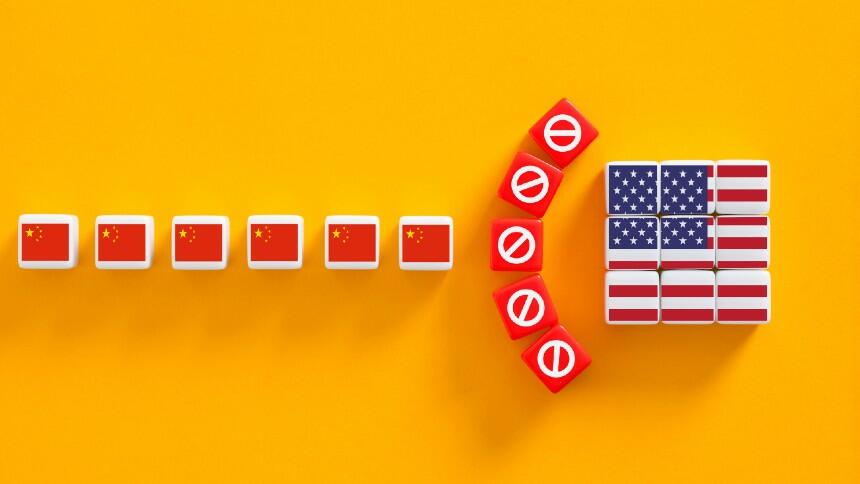
The problem is that the transaction has started to bother both sides of the geopolitical dispute.
In the United States, lawmakers had already been restricting direct American investment in Chinese artificial intelligence companies. In China, the government has intensified pressure to prevent Chinese founders from transferring technology, talent, and business structures out of the country.
The acquisition of Manus became the most visible case of this tension. Although the startup was incorporated in Singapore and transferred a significant portion of its team to the city-state, its Chinese origins were enough to attract intervention from Beijing.
International media are describing the case as a warning about so-called "Singapore-washing," a strategy by which Chinese startups relocate their headquarters, corporate structure, or key teams to Singapore in order to reduce regulatory scrutiny from Beijing and Washington and facilitate access to foreign capital, international buyers, and global markets.
The Chinese investigation had already been underway since January. At the time, the Chinese Ministry of Commerce said it would assess whether the acquisition complied with rules related to import and export controls on technology and overseas investment. According to the Associated Press, the review also involved issues such as national security, data transfer, and foreign investment.
Meta has maintained that the acquisition complied with applicable laws. In March, a company spokesperson told CNBC that the transaction was in compliance with the law and that the company expected an "appropriate resolution" to the investigation.
China's decision also comes at a sensitive time in the relationship between Beijing and Washington. The blockade was announced weeks before a planned high-level meeting between Donald Trump and Xi Jinping in May.
According to analysts, the move shows that China is trying to protect local AI technology and talent while simultaneously seeking to expand its bargaining power in the dispute with the United States.
The Manus case also appears to be having broader effects on the Chinese technology ecosystem. Chinese authorities have begun instructing major AI companies, such as Moonshot AI and Stepfun, to reject US-sourced capital in new funding rounds unless they have explicit approval. Similar restrictions have also reportedly been imposed on ByteDance, the owner of TikTok .
This move could further reduce Chinese startups' access to international venture capital, especially from American funds, foundations, endowments, and pension funds, which have played a significant role in financing the Chinese technology sector over the past two decades.
Beijing's concern is to prevent the outflow of local technology in sectors considered strategic to national security. In the case of Manus, Chinese academics and critics complained about the loss of a valuable asset to an American rival and feared that the transaction would encourage other startups to follow the same path.
The blockade raises a red flag for other Chinese AI companies that have been trying to build an international presence without completely breaking with their origins. The message from Beijing, in the Manus case, is that changing the formal headquarters may not be enough when technology, data, and talent considered strategic are at stake.
In the artificial intelligence sector, this message arrives in a particularly sensitive area. AI agents are seen as the next frontier after chatbots: systems capable of performing end-to-end tasks, operating software, analyzing information, and making multi-step decisions.
It was precisely this capability that made Manus attractive to Meta and too strategic for Beijing to let go without resistance.