




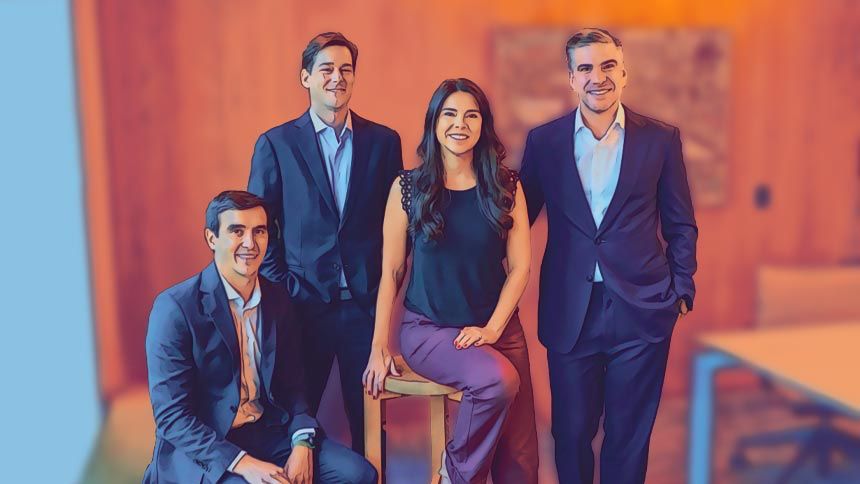
Volpe Capital, a venture capital firm whose partners are André Maciel, Milena Oliveira, Gregory Reider, and Gabriel Marcassa, has completed the first closing of its second venture capital fund, raising US$50 million, during a challenging time for the venture capital industry in Brazil.
The goal of the second fund is to reach US$100 million, the same amount as the firm's first fund, which invested in 13 startups – and still has capital for two more investments.
“We launched the fund basically with the current investor base. This endorsement was crucial for raising capital,” says André Maciel, partner at Volpe Capital, exclusively to NeoFeed .
BTG Pactual, which was already the anchor investor for Volpe Capital's first fund, is anchoring the new fund. The new development is the arrival of Desenvolve SP, the development agency of the São Paulo state government, which is investing R$ 35 million after a public call for proposals in which the asset manager was chosen.
The first fund, which has already invested 70% of its capital in startups such as Caju, UOL Tech, Zippi, and VTEX, is showing a net return of between 15% and 20% in dollars, according to Maciel. The impairment ratio (an indicator that measures how much of the invested capital has been lost or devalued) is approximately 16%, well below the market average, which is around 40%.
The fund manager already exited CRMBonus in the round that brought Bond , Mary Meeker's venture capital firm, to the cap table of the startup founded by Alexandre Zolko . Maciel says it was a good return, without revealing the figures. Sequoia, a logistics and transportation company, is part of the only write-off from this round.
The new fund should follow the same thesis as the first one, launched in 2021, but with a more intensive focus on artificial intelligence. “Today, every company that comes through here needs to have some kind of artificial intelligence strategy. We no longer believe in competitive technology without a clear acceleration via AI,” says Gregory Reider.
The checks should be a bit larger – previously they were in the range of US$5 million to US$10 million – and the investments focused on Series A and B, companies that Volpe Capital calls "early growth," that is, those that already have product-market fit and are beginning to gain traction.
Due to the larger checks, Volpe Capital is expected to invest in fewer startups in its second fund – somewhere around 10 to 12 companies.
“We will be even more focused in order to be closer to the founders and have an even clearer focus on early growth , where we can reduce risk and add more value,” says Milena Oliveira.
The focus will be on startups in Brazil, which are expected to receive 50% of the new fund's resources. The remainder will go to other Latin American countries where Volpe Capital was already investing. In its first fund, the firm invested in the fintech Aplazo and the healthtech Welbe , both based in Mexico.
“Brazil will remain the central focus, but we will broaden our scope to include Latin America, especially Mexico and Colombia, where there are companies in a more mature stage of growth and with more rational valuations ,” says Gabriel Marcassa.
Business models based on fintech and SaaS should receive more attention from the asset manager. However, all of them need to have an artificial intelligence layer.
The fund manager's argument is not that "software is dead," as some Wall Street analysts have been saying because of artificial intelligence. For Volpe Capital, this discourse is a typical exaggeration during times of technological disruption.
"What will happen is that only those who manage to incorporate artificial intelligence into the core of their business model will survive," says Reider.
Good for investing, bad for raising capital.
Volpe Capital's fundraising is happening at a time when many venture capital managers say it's a good time to invest – because the market has become more rational with valuations – but a bad time to raise capital, due to high interest rates and a certain disappointment among some investors with the results of the 2020 and 2021 harvest.
During those two years, the venture capital market experienced a period of euphoria. With low interest rates and abundant liquidity, Brazil became a breeding ground for unicorns, as startups valued at over US$1 billion are called.
But the excesses of that time took their toll later on. The changing tide led to what became known as the venture capital winter. Investments in startups decreased, and it became more difficult to raise capital for those who ran out of funds.
Volpe Capital, whose first fund was raised in 2021 at the height of this euphoria, says it invested 35% of the fund in the first two years, when the average venture capital firm spends at least twice that amount during that period.
“This protected the fund very well. We didn't spend everything at once and were able to invest more aggressively in 2023, 2024, and 2025, when prices became more rational,” says Maciel.
The "aftermath" of this period of euphoria is clear: it has become much more difficult to raise capital for new funds. According to NeoFeed , there are over 40 venture capital firms in the Brazilian market raising capital. However, most of them have either failed to raise funds or have closed their funds below their fundraising targets.
Even so, asset managers with a track record and tradition in the market have managed to attract investors to their new funds. Examples include Astella, Canary, Valor Capital, OneVC, and Big Bets. And now, Volpe Capital.