














People who drop out of a consortium before being selected typically take years to recoup their investment. Núclea saw this problem as an opportunity to create a business and, in partnership with Santander, launched a secondary market for these quotas.
Núclea's platform connects investors interested in selling these canceled consortium shares with investment funds willing to buy them. All financial settlement occurs using BRLN, the stablecoin created by the company.
In this process, the investor gains liquidity and receives the funds in advance, the financial settlement occurs through a stablecoin, and a market that practically did not exist before emerges.
This type of infrastructure solution helps explain the transformation of a company that, although practically invisible to the consumer, is present in a large part of the operations of the national financial system.
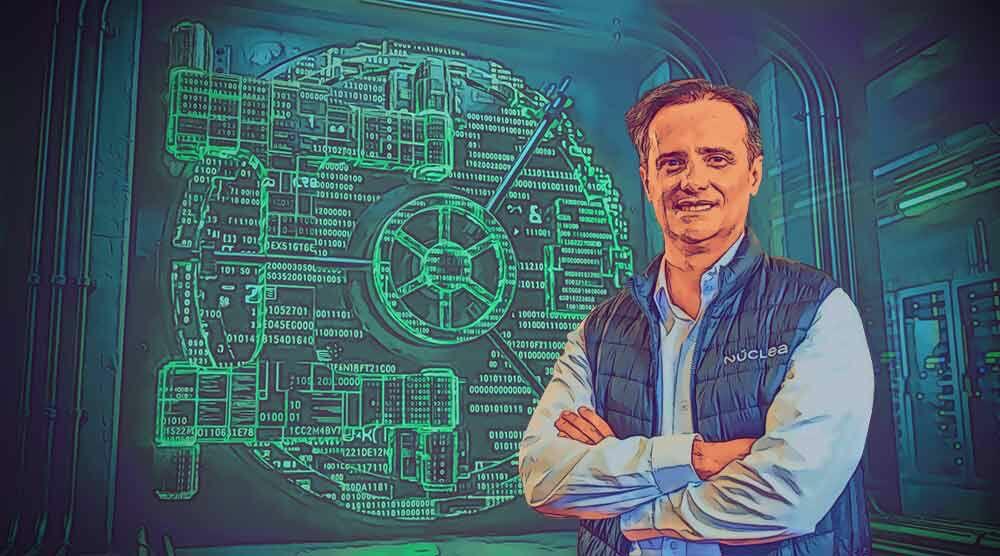
"Every Brazilian is a Núclea customer and doesn't know it. If Núclea stops operating, bills will stop being paid and credit card payments will cease to be processed," says André Daré, CEO of Núclea, in an interview with Números Falam , a production of NeoFeed and CNN Brasil.
Responsible for processing around R$ 18 trillion per year, Núclea is behind the settlement of bank slips, credit cards, wire transfers, positive credit history, salary portability, among other services.
Until 2022, Núclea was known as the Interbank Payments Chamber (CIP), an entity created by banks to operate a shared infrastructure of the financial system, organized as a non-profit association. Its mission was to ensure that transactions functioned securely, efficiently, and at low cost.
With demutualization, the former association transformed into a company – with 48 financial institutions as partners – and adopted the new brand, using the infrastructure built over more than two decades to develop new products and open new revenue streams.
"Until 2022, we processed a lot of information, but we practically didn't use that data to generate market intelligence," says the CEO on the program, which airs bi-weekly on Fridays at 7:45 PM on CNN Money .
This change led Núclea to view the data generated by billions of financial transactions as an asset. From this data, intelligence services were born for credit granting, fraud prevention, debt collection, digital identity, and payment behavior analysis.
At the same time, the company began to leverage virtually the same technological infrastructure to enter new markets.
Núclea, for example, has become a registrar of credit operations guaranteed by private pension plans. The company handles R$ 1.5 billion per month and, according to Daré, already holds approximately 95% of the market share.
The idea is to expand its operations in infrastructure for digital assets and new means of financial settlement. The company, for example, entered the insurance policy registration market, where it achieved approximately 30% market share in 11 months.
"Each new service shares the existing infrastructure. This makes the cost of transactions increasingly lower and allows us to launch solutions that would previously have been unfeasible," says Daré.
While diversifying its business, Núclea continues to operate one of the most critical gears in the financial system. It handles approximately 3 billion transactions per month and R$ 18 trillion annually. An interruption to its systems would affect everything from bill payments to card settlements and various banking operations.
To sustain this "weight," the company maintains approximately R$1.3 billion in equity capital—almost 10 times the minimum required by the Central Bank—and invests around R$40 million annually in cybersecurity . The next goal is to surpass R$20 trillion in transactions by 2026.


