











Brazilian banks are turning to Jusbrasil's artificial intelligence to uncover risks that their traditional systems failed to identify. Among the cases found are clients who opened accounts while incarcerated and individuals with pending cases indicating possible links to criminal organizations.
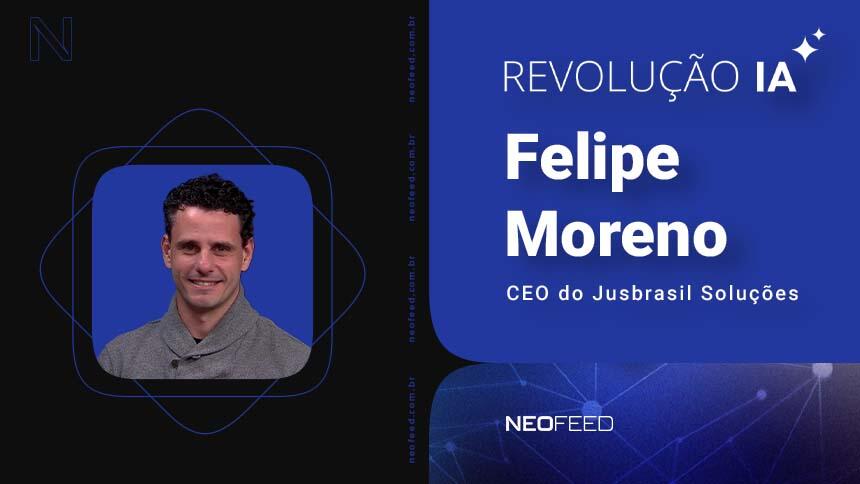
In an interview with Revolução IA, a NeoFeed program supported by Casas Bahia, Felipe Moreno, CEO of Jusbrasil Soluções, stated that in tests conducted with financial institutions, Jusbrasil identified up to four times more risks than the suppliers previously used by the banks.
“You ended up having a relationship with someone who is in prison and you didn’t know it. Or you didn’t realize that he was a risk, but we were able to find a case that shows that this person has ties to the PCC or Comando Vermelho,” says Moreno.
Widely known as a legal case management website, Jusbrasil is expanding its operations to support companies in the areas of risk management, compliance, fraud prevention, and combating money laundering.
According to Moreno, the company already serves virtually all digital banks, as well as institutions like Itaú, Bradesco, and Santander—although he did not reveal which of them were involved in the aforementioned cases.
At a financial institution, technology has reduced the volume of manual work in analyses by more than 80%. Previously, employees had to open cases, verify their relevance, identify the accusation, and check if there was a conviction.
Now, much of this screening is done automatically. AI analyzes processes and tries to determine, for example, if there has been a conviction, what the nature of the accusation is, and whether that information should be considered in the decision to initiate or maintain a relationship with the client.
The new initiative relies on the 8 billion documents accumulated by Jusbrasil over 18 years. The platform receives 30 million monthly visits and has more than 1 million clients, ranging from citizens and lawyers to legal departments, banks, and public agencies.
JusBrasil's solutions are already present in over 70% of the country's Courts of Justice, as well as public defenders' offices, public prosecutors' offices, and Public Ministries. In these cases, AI can organize and analyze large volumes of cases and support the work of judges and court staff.
“It’s not AI that will decide Mrs. Maria’s case. Today it’s the judge, but increasingly, a judge supported by artificial intelligence is able to do things more quickly,” says Moreno.
On the other hand, the advancement of AI has opened up space for new manipulation attempts. One of them is the so-called prompt injection: lawyers insert hidden commands into petitions, often written in the same color as the document's background, to try to influence the systems that will read them.
The instructions might ask the AI to grant free legal aid or to superficially refute the arguments presented, for example. A human reader doesn't see the message, but an artificial intelligence agent can interpret it as an order. After identifying the problem, Jusbrasil developed an agent capable of locating these commands in two days.



