

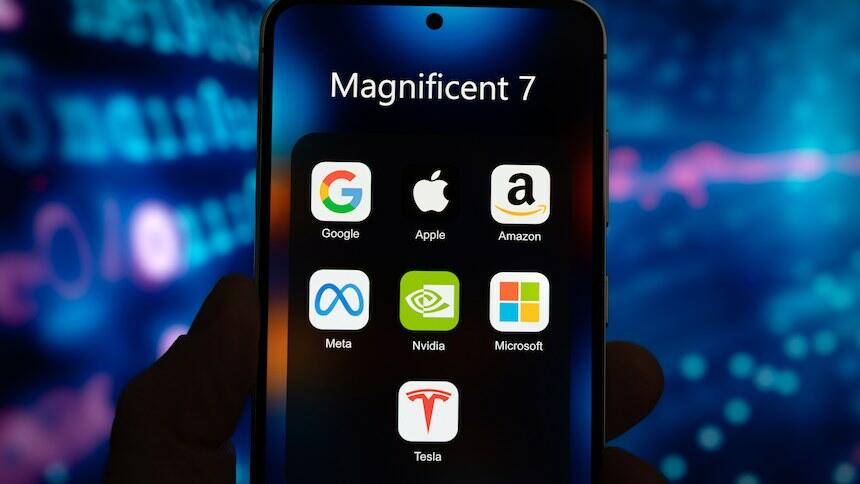

For the past three years, the Magnificent Seven have stood out as a symbol of the major shift in the American stock market. Apple, Microsoft, Alphabet, Amazon, Meta, Nvidia, and Tesla were the stocks that explained the transformation of artificial intelligence in the growth of the S&P 500.
The problem is that the concentration of value in large technology companies is ceasing to work – at least in Citi's view.
In an analysis distributed to clients, strategists at the American bank wrote that the "Magnificent 7 has died as a construct for evaluating growth dynamics among the largest companies by market capitalization."
At first glance, it might seem that Citi is suggesting that the Magnificent Seven are dead. But the idea is different: AI is neither finished, nor have the seven companies lost their relevance, nor should investors abandon their stock.
According to Citi analysts, AI has become too big to continue being represented by only these seven companies, as shown by the performance of the American stock market.
In 2026, the Roundhill Magnificent Seven ETF was up about 1%, while the S&P 500 advanced 9%, by the end of the first half of July. The difference doesn't necessarily mean that tech giants have ceased to be the big winners of the transformation, but that the market has begun to find other winners in the AI race.
As the investment cycle progresses, the chain spreads to manufacturers of equipment used in chip production, memory companies, networks, storage, energy, physical infrastructure, and automation.
Next, we move on to companies that use artificial intelligence to increase productivity, reduce costs, and expand margins.
Nvidia can sell the chips, but someone needs to manufacture the equipment to produce those chips. There's also the memory supplier. The one who builds the network. The electricity supplier. And, in the end, someone who transforms all this investment in the technology sector into revenue and profit in other segments of society.
Therefore, Citi does not propose expanding the Magnificent Seven to Mag 8, Mag 9, or Mag 10. The bank works with the so-called " growth cluster ," a broader basket of growth companies distributed across six sectors of the economy.
This group represents approximately half of the market value of the S&P 500 and about 48% of the index's expected earnings over the next 12 months.
In the second quarter of this year, for example, the " growth cluster " rose 24.7%, compared to a 14.9% increase in the S&P 500. Year-to-date, the basket has advanced 11.8%, compared to 10.1% for the indicator.
This growth basket created by Citi contains the 25 stocks that have contributed most to the S&P 500's performance this year. They accumulated gains of approximately 7%, compared to about 2% for the "Magnificent Seven."
“Even a Mag 10 would leave out companies that contribute significantly to the result,” the strategists wrote, citing companies such as Intel, Applied Materials, and Lam Research.
This basket of 25 companies presents a more attractive price-to-growth-to-earnings ratio than Mag 7. Citi states that the PEG multiple — the price paid for a stock relative to its expected growth — is at a 15-year low for the group.
Citi estimates that approximately 55% of the S&P 500 is directly exposed to headwinds or tailwinds related to artificial intelligence.
According to the analysis, almost half of the index's return can be attributed to the group of companies identified by the bank as a " growth cluster" .
If the first phase of this great technological shift created the Magnificent Seven, the second has become too big to be limited to just them. And it's showing that the winners are those who can leverage the productivity, profitability, and growth brought about by AI.