

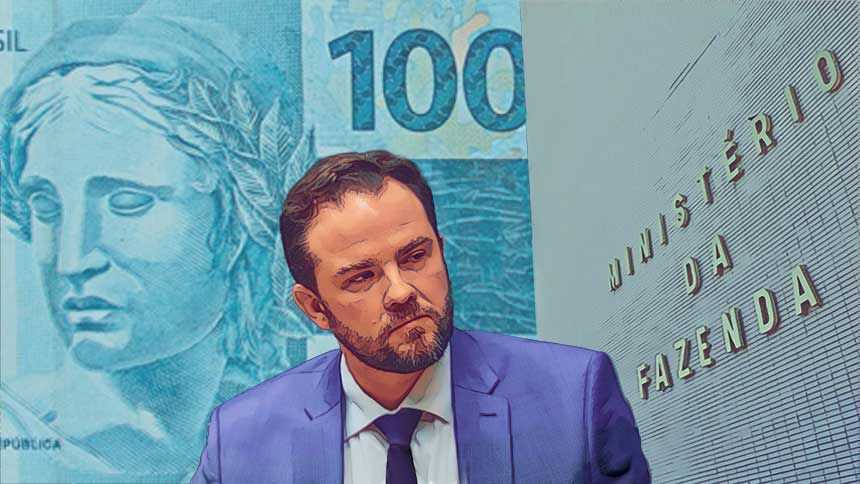
Brasilia – With only one experience in the private sector, as director of public policy at WhatsApp, part of Meta, the new Finance Minister, Dario Durigan , 41, was the expected ace up the sleeve to replace Fernando Haddad at the head of the most feared ministry in the Esplanade of Ministries in Brasilia.
He is also considered the ideal "02" (number two in the hierarchy, below only the minister) to take on the mission, without the burden or pressure of proposing structural measures, engaging in internal political battles, or causing problems for the government in an election year.
That's the assessment of sources consulted by NeoFeed , following the announcement by President Luiz Inácio Lula da Silva (PT) this Thursday, March 19, that Durigan will leave his post as executive secretary of the ministry to assume the position of Minister of Finance, replacing Haddad, who will run for governor of São Paulo for the PT.
A classic example of a "stopgap minister," a nickname given in Brasília to secretaries who usually assume a ministry in the last year of a government on the eve of elections, Durigan is seen as an ally of Lula who will lead ongoing agendas, such as the regulation of tax reform.
And, at most, to take a position regarding the end of the 6x1 work schedule , a controversial topic that is already facing difficulties in Congress and could stall amidst the election calendar.
"He won't get into controversies, he'll go about his day-to-day work without trying anything new or making any mistakes," says a source close to Durigan. "He was number two; number one is a political figure."
Only time will tell. On the other hand, sources from the business and political sectors of the federal capital consider it unlikely that Durigan has the political profile, with the necessary "partisan political" experience, to continue as minister in a possible fourth term for President Lula, should he be re-elected. "Zero chances at this moment," says one source.
A source from the Ministry of Finance, however, suggests that Durigan's administration will not be a "stopgap" term, merely to continue Haddad's style.
Even though the most challenging agenda items are behind us (taxation, framework), the new minister and his team will still have the task of discussing various topics this year.
Among them are the approval of a bill on Redata (a tax incentive program for the data center sector); the regulation of big tech companies; and the government's environmental agenda (Ecoinvest auctions, TFFF fund, carbon market, etc.).
"The fiscal issue is a major concern for us in an election year. And it's possible to prepare the ground for what might happen next year," says the source. "Haddad's approach will be the same now."
This source recalls that Durigan also had a "fundamental" experience in the Civil House during the first term of former President Dilma Rousseff (PT), whose objective was to carry out the political articulation of projects of interest to the Executive Branch not only with Congress but also within the government itself. This trajectory qualified him for negotiations in Congress.
A lawyer by training, with a career more frequently in public life (São Paulo City Hall during Haddad's administration; Attorney General's Office (AGU), Civil House and Finance Ministry in PT governments), Durigan is seen as a technician aligned with the developmentalist agenda of the Lula government, but he is not exactly a PT militant, according to people who know him and interact with him in Brasília.
"He's a watchdog for Haddad's agenda," says a source in the financial market who has participated in several meetings with Durigan during his time as executive secretary.
Moreover, Durigan is well-regarded in the financial market, as someone more "open" to listening to and receiving executives from banks and funds compared to Haddad, for example. The fact that the new minister is not a politician also makes things easier for him, according to sources in that sector.
Overall, he is considered cordial and patient, with political savvy (despite not being a professional politician), even in dealing with government ministers with whom Haddad had conflicts, such as Glieisi Hoffmann (then Minister of Institutional Relations).
With experience already gained in the always delicate and sensitive battles with Congress in defense of issues dear to the government, Durigan is considered a government technician who knew how to stand firm in debates with parliamentarians that were crucial for the economic team, such as tax reform.
A source recalls that, two months after taking over as executive secretary of the Treasury in place of Gabriel Galípolo, who left to become a director of the Central Bank, Durigan already had to get involved in the negotiations for the approval of the fiscal framework in 2023 – before that, Galípolo was considered Haddad's right-hand man at the Treasury, a position later assumed by Durigan.
Now, however, at a time when the framework is under pressure to be revised or to cease to exist in its current form, market sources do not see him as the "seasoned" political figure Lula would prefer to engage in debates like this, according to sources in Brasília.
However, Durigan is known for his great negotiating skills, especially with the National Congress. In other words, his nomination to replace Haddad was received in the same way as when Durigan was called to fill Galípolo's position.
In fact, his well-known profile as a negotiator could be an asset to the government in an election year – and with several pending issues in the Legislature, such as the end of the 6-day work week, the reform of payroll taxes, the review of social benefits, the drafting and voting on the 2027 Budget, and several pending items of the tax reform, such as the regulation of the selective tax, known as the sin tax.
Thus, in assuming a short-term, interim mandate as Finance Minister for just a few months, Durigan's role would be more important as a negotiator than as a formulator of economic policy.
Complex challenges
Economists and analysts interviewed by NeoFeed pointed out the challenges he faces leading the ministry. The fact that Durigan does not have a background in economics, apparently, should not interfere with his performance.
Economist José Francisco de Lima Gonçalves , a professor at FEA-USP with extensive experience in the financial market, for example, states that it is not necessary to be an economist to head – and do well – the ministry, citing the examples of Dilson Funaro (in the Sarney government) and Antonio Palocci (in Lula's first government).
"The essential thing is to assemble a competent team, have the ability to dialogue, good access to the president, and party support," he says.
Although he acknowledges that Durigan does not possess these characteristics to the same extent as the examples cited, Gonçalves affirms that the new minister is suitable for the position due to his negotiating skills and because he inherits a cohesive team. According to him, the main challenge of the new minister's interim term will be budget management for the coming year.
According to Felipe Salto , chief economist at Warren Investimentos, Durigan played a central role in the set of actions approved during Haddad's administration. "The executive secretary is a kind of 'internal' minister, so things only really move forward with good work on that front," he says.
Therefore, he considers Lula's selection appropriate. "We are talking about a period of transition, and the prospect of maintaining the same approach as Haddad is good; after all, it was a government with many achievements."
Tax and labor experts, however, foresee difficulties and a strong need for political coordination. João Henrique Gasparino, executive director of the tax consultancy Nimbus Tax , sees Durigan as a continuation of the economic agenda.
"From a business perspective, this tends to mean maintaining a policy marked by increased tax burdens, expanded regulatory requirements, and a tougher stance from the tax authorities," he states.
Raquel Rizzardi, labor coordinator at the law firm Guarnera Advogados, believes that progress on this agenda will be limited in the short term due to the interim mandate and the electoral environment, but will require a high capacity for coordination.
"The debate about ending the 6x1 work schedule and reviewing social benefits involves highly sensitive issues, with direct impacts on labor relations, business costs, and operational predictability," he states.
However, reviewing social benefits faces an even greater challenge. "Any attempt at adjustment, even a technical one, risks being perceived as a reduction of rights, which significantly increases political resistance, especially in an election year," says Rizzardi.