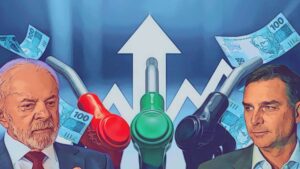



With the post -Carnival hangover over, 2026 kicks into gear with "cards on the table." Major themes intertwine and challenge short-term predictions. The economy remains "hijacked" by politics, and certainly, the perception prevails that, from now on, Brazil will be exposed to a double risk – fiscal and electoral – that will exact its price.
Flávio Bolsonaro is currently consolidated as President Lula's main opponent in the election, suggesting extreme polarization in the battle for the Planalto Palace; the " Master Case " is far from over, despite the replacement of Minister Dias Toffoli by André Mendonça as rapporteur of the matter in the Supreme Federal Court (STF), where ministers and relatives have become the target of leaked tax data from the Federal Revenue Service, mobilizing the Federal Police.
The banks are in dire straits. They must anticipate years of contributions to the Credit Guarantee Fund ( FGC ) due to the "collapse" of Master – an estimated bill, in guarantees alone, of R$ 40.6 billion, which exceeds R$ 50 billion when adding the liquidation of Banco Pleno and Will Bank by the Central Bank (BC). Two institutions that were part of the conglomerate.
Banco do Brasil , the country's largest bank and a contributor to improving public finances through dividends, reported a drastic drop in profits in 2025: R$ 20.7 billion, 45.4% less than in 2024. The reason? The explosion in defaults in agribusiness – the main driver of the national GDP.
Amidst the murky scenario surrounding the legal and electoral consequences of the tribute paid to Lula by the Acadêmicos de Niterói samba school – possibly without practical effects other than the school's relegation – the president, ministers, and a large delegation of businesspeople are on a tour of India and South Korea. The trip began on Tuesday the 17th and is scheduled to end on Tuesday the 24th, when the delegation will return to Brazil.
Next, Lula will begin the countdown to his meeting with Donald Trump in Washington in March – although the date is still to be determined. In April, the president is expected to attend the Hannover Fair in Germany, the world's largest industrial technology event. In June, he may participate in the G7 Summit in France.
Amid Lula's intermittent absences from Brazil , Congress will have to dedicate its limited time, due to the electoral calendar, to issues of broad impact. The market, in turn, will continue to account for adjustments in asset prices observed in the first 50 days of the new year. Positive adjustments, but with a tendency to slow down – just like inflation.
From the beginning of January until February 18th, following the reopening of the B3 stock exchange after Carnival, interest rates fell in the futures market; the dollar retreated 4.37% against the real. The Ibovespa stock index appreciated 15.44%, driven by foreign investors who poured more than R$ 35 billion into Brazil this year up to "Fat Friday".
“The positive momentum at the start of 2026 should be seen as an opportunity to realize gains, reduce positions, and buy protection in the face of the prospect of greater volatility from the second quarter onwards,” warns Alexandre Mathias, chief strategist at Monte Bravo Corretora .
According to Mathias, the massive inflow of foreign currency has supported prices, but it does not solve the fiscal equation nor mitigate political uncertainty. “We see the recent rise not as a structural trend, but as an exit opportunity. From March onwards, fiscal mathematics and the electoral calendar will once again dictate the risk premium,” the strategist assesses in the February Monthly Letter.
"Musical chairs"
Between March and April, the election race will be in the "musical chairs" stage – a period when ministers resign from their posts to run for election. The tickets for Lula and his opponents will be under construction, and the merger of the Ministry of Management and Innovation with the Ministry of Planning could be confirmed – Esther Dweck is expected to lead the "new" Ministry.
In Congress, the agenda is diverse with controversial topics: the end of the 6x1 work schedule; the Public Security Amendment; the EU-Mercosur agreement ; and the Redata bill, which went from a provisional measure, expiring on February 25, to a bill.
The proposed amendment to the Constitution regarding the Central Bank's financial autonomy is currently under review by a Senate committee that is expected to unblock the matter and, in a new report, grant the Central Bank the power to intervene in the securities market when funds and institutions exhibit dysfunction or lack of liquidity. The CVM ( Brazilian Securities and Exchange Commission) will retain its powers.
Still pending are the formal nomination of the Attorney General of the Union, Jorge Messias, for a vacancy on the Supreme Federal Court and Lula's nominations for two director positions at the Central Bank – succession in all these positions is subject to Senate approval.
Within the scope of the parliamentary commissions of inquiry, the one investigating the activities of organized crime in the country intends to summon lawyer Viviane Barci, wife of Supreme Court Justice Alexandre de Moraes, for clarifications regarding the multi-million dollar contract signed by her firm with Banco Master for the provision of legal services over three years.
The “Master Case” will gain more prominence on the 23rd and 24th, reserved for, respectively, the testimony of Daniel Vorcaro to the INSS Parliamentary Commission of Inquiry, where payroll loans are the target of investigations; and the testimony of the interim president of the CVM, João Accioly, to the group of senators who are following the investigations into the Master frauds.
In the economic arena, which is taking shape with the updating of indicators, February will end with reports from the Central Bank on external operations, credit, and fiscal policy in January; sectoral confidence indices from Ibre FGV; and the IPCA-15 for February, which should accelerate during the month and fall to around 3.8% over 12 months due to a statistical effect.
On the international agenda, officials from the Federal Reserve, the US central bank, will make pronouncements, continuing the agenda of recent days, when the Fed Boys spoke without consensus on an interest rate cut in March, while the minutes of the monetary policy meeting threatened a rise in the benchmark rate – a signal that, added to the tension between the US and Iran, recommends caution regarding the behavior of assets in the international market.