

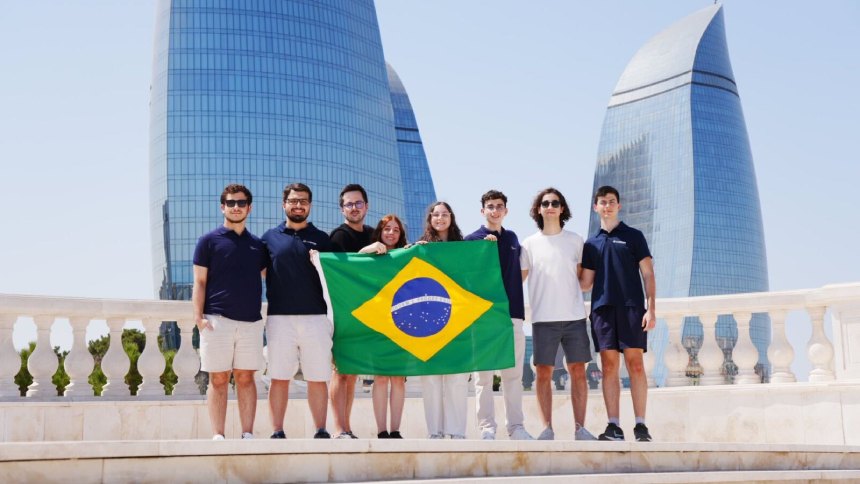
In Brazil, 55% of the population claims to understand little – or nothing – about economics and financial education , according to a study by the Institute for Social, Political and Economic Research (IPESPE). At the same time, in an almost parallel world, a group of young Brazilians this year became the global winner of the International Economics Olympiad (IEO), ahead of 54 other countries.
The achievement may seem isolated, but it is not. This is the fifth time the country has won a gold medal in the competition, thanks to a specific project, the Brazilian Economics Olympiad (Obecon). Created eight years ago, the non-profit organization has already impacted more than 70,000 students, 35% from public schools and 65% from private institutions, in all states of Brazil.
“Our goal is to generate social impact and financial education for society, as well as help develop great talent and keep them in Brazil,” says Raphael Zimmermann, president of Obecon and creator of the project, to NeoFeed.
To achieve this goal, the competition is divided into five phases, ranging from general knowledge, in a free online test, to an in-person group assessment that selects the 15 best performers. These students undergo five months of training and tests so that, in the end, the five outstanding students are selected to represent Brazil in the world competition.
For the Olympic students, as those selected for the international event are called, Obecon goes beyond the championship and becomes a facilitator for other projects. This is because, over the years, the group has built partnerships with universities such as FGV , Insper, and Ibmec, for the admission of students through Olympiads, something unprecedented in Brazil.
Furthermore, due to the high level of knowledge required by the Olympiad, participation has also become a guarantee for renowned international universities, such as Duke University in North Carolina and the Wharton School at the University of Pennsylvania.
Career opportunities
These were the cases of Lucas Rivelli and Manuela Buesa. Rivelli recounts that he studied at one of the worst schools in his city, Varginha , in Minas Gerais, where he had almost no access to academic opportunities. With the discovery of Obecon, through online research, he saw an opportunity to access places that were previously improbable.
“Obecon caught my attention because it was a genuinely meritocratic process: all I had to do was study hard and dedicate myself to do well,” says Rivelli.
In his first participation, in 2023, he was selected for the IEO and was part of the gold medal-winning team. “It was a turning point in my life. The competition exposed me to a new world: I changed schools, met extraordinary people, from other students to leaders like Roberto Campos Neto (former president of the Central Bank) and Roberto Sallouti (CEO of BTG Pactual), and I began to see possibilities that I didn't even know existed,” he says.
He cites the Olympiad as the main factor in his acceptance to Duke. "The Olympiad not only transformed my academic trajectory but also broadened my vision for the future," he adds.
Manuela Buesa, from São Paulo, went through a similar situation. She was the second woman in history to represent Brazil in a world science olympiad, winning bronze in 2023 and gold in 2024.
Through the competition, the young woman secured a winter internship at Dahlia Capital, an asset management firm founded by Sara Delfim , Felipe Hirai, José Rocha, Felipe Leal, and Alessandro Arlant. Sara ended up becoming a mentor and role model for Buesa.
“This experience at Obecon was so important to my educational journey that it motivated me to later conduct independent research, supervised by a PhD from Harvard . The research was about the impact of Pix on credit accessibility for low-income Brazilians, recently published in the Harvard International Review ,” says the young woman.
Currently, she is studying economics at Wharton and continues to support Obecon, which today has 52% female participants.
Companies fund project
According to the president of Obecon, nothing would be possible without the support of private sponsoring institutions. The list includes names such as B3 , BTG Pactual , Verde Asset , Ripple, Dahlia Capital, and Bain & Company.
In addition to funding, these companies actively participate in the in-person events, and some even hire top performers from the competition for job opportunities.
In the case of B3, the support comes as an opportunity to help empower future generations of professionals. “The results of the competition, especially in international olympiads, inspire students to dedicate themselves and dream big,” says Marina Naime, educational projects manager at B3.
Despite the support, funding remains Obecon's biggest problem. According to Zimmermann, there is an increase in the number of people interested in the Olympiad, but the organization always faces cash flow issues, ending the year at break-even. "This is, without a doubt, our biggest challenge. And it's not likely to be solved anytime soon," he says.
For him, Obecon's impact is huge, not only in Brazil but also abroad, which makes the business increasingly efficient: "At the end of the day, we are showing that we can play at the same level as the rest of the world, despite not having the same tradition of teaching economics that countries like the United States and China have."