


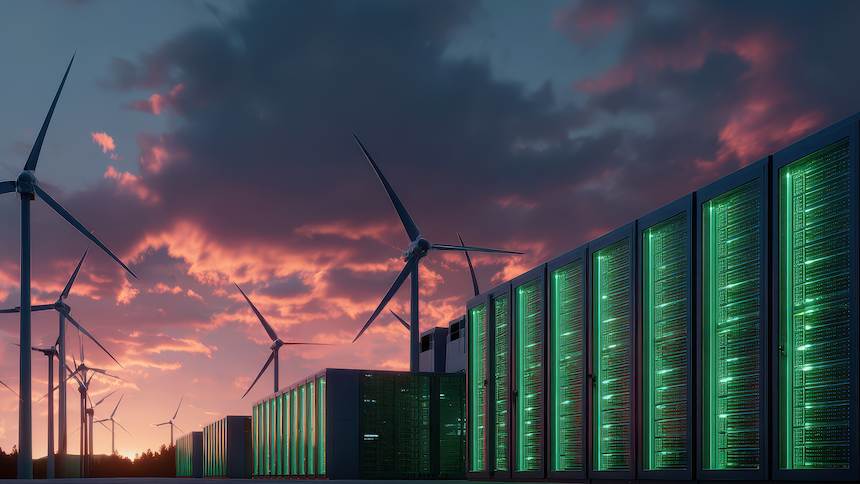

A report released this week exposed a contradiction between the United States and Brazil, showing that the bottleneck in electricity generation in the United States threatens to burst the 'bubble' of AI data center construction in the country.
According to a survey by the real estate brokerage CBRE Group, the number of AI data center projects slowed down at the end of last year in the US due to licensing issues and delays in connecting to the power grid due to a lack of energy supply.
A key cog in the current AI investment boom , hyperscale data centers – designed to operate at massive scale to process gigantic volumes of data for AI servers – require vast amounts of power, 24 hours a day, seven days a week, which the country's electricity sector may not be able to deliver.
While there is a power shortage to feed AI data centers in the US, Brazil faces the opposite problem – an oversupply of renewable energy due to low consumption, which has led to curtailment , the reduction in generation from centralized renewable power plants controlled by the ONS, the regulatory body for the electricity system.
To avoid collapsing the system, the excess energy injected into the distribution network without any technical restrictions by distributed generation (DG) – especially by solar panels installed on rooftops – led the ONS (National System Operator) to discard 20% of the energy produced by centralized power plants last year.
The problem in Brazil, therefore, is not in generation, but in the network infrastructure, since AI data centers require, in addition to continuous load, more substations and transmission lines to carry the renewable energy produced in the Northeast to the Southeast, where the data centers are more concentrated.
The consulting firm Volt Robotics estimates that parallel investments of R$100 billion to R$120 billion are needed by 2030 to improve the Brazilian electricity sector and adapt the grid. Even so, big tech companies foresee massive investments in AI data centers in the country, due to the ample supply of energy and its low price on the international market.
The U.S. Department of Energy predicts that data centers will consume about 12% of the country's generated energy by 2028, an increase from 2% before 2020. Another estimate, from the International Energy Agency (IEA), indicates that global electricity demand for data centers is expected to double by 2030, with even greater increases in the U.S. and China.
The issue prompted President Donald Trump to demand that big tech companies build their own power plants to power AI data centers.
“Many Americans are also concerned that the energy demands of AI data centers could unfairly increase their electricity bills,” Trump said during his State of the Union address this week.
The White House had already been discussing this requirement with 13 governors from the Mid-Atlantic and Midwest regions, so that big tech companies can operate new data centers. If they don't want to do this, the companies would have to pay significantly higher electricity rates.
Nuclear bet
To meet energy demand, big tech companies are studying the implementation of alternative generation methods that had been discarded in recent years. Microsoft , for example, intends to reopen the deactivated nuclear power plant on Three Mile Island, in Pennsylvania. Meta has announced agreements with advanced nuclear energy startups to supply power to its data centers.
The race for more energy for AI is also leading China to use fossil fuels to expand its electricity grid, especially coal. The Asian country put more than 50 new large-scale coal-fired power plants into operation last year, compared to about 20 per year in the previous decade.
To give you an idea, China's installed coal-fired power generation capacity in 2025 was greater than India's throughout the entire previous decade. This return to coal use comes after a decade of the Chinese government investing in clean energy sources such as wind, solar, and hydroelectric power – which accounted for more than half of the electricity growth during that period.
Since 2021 alone, China has installed an impressive 1,500 gigawatts (GW) of new energy capacity, bringing its total to 3,891 GW. The US has made very little progress in the same period, and its current capacity is around 1,373 GW—less than China has added in just four years.
Brazil has 217 GW of installed capacity, but expects a major expansion in the coming years to meet the demand for AI data centers - the load required by these advanced data centers is expected to grow from 2.5 GW (2024 data) to 9 GW by 2037, according to the Ministry of Mines and Energy.
This projected increase in demand is due to several competitive advantages of the country: our energy matrix, which is 90% renewable, and the low cost of energy compared to other countries, in addition to the idle capacity of the Brazilian electricity grid, which produces more energy than it consumes.
Another decisive factor – which led to the forecast of R$ 1 trillion in investments in AI data centers in the country by 2030 – was the announcement, in May of last year, of the Special Tax Regime for the Data Center Area ( Redata ), by the federal government. The program, which reduces the cost of capital by 50% by exempting taxes on IT assets, stimulated announcements of large-scale projects (500 MW to 1.5 GW), with benefits valid until December 31, 2026.
Legal limbo
A political blunder in the National Congress this week, however, threatens to cancel most of the planned projects. Due to Congress's delay in voting on the Redata provisional measure, the solution found was to transform the provisional measure into a bill – to speed up the voting process – and vote on it before the provisional measure expired last Wednesday, February 25th.
The Chamber approved the Redata bill on the deadline, but the president of the Senate, David Alcolumbre (União Brasil-AP), refused to include the bill on the day's agenda – he wanted to retaliate politically against the government because of the Federal Police investigation against politicians from União Brasil in the Banco Master case.
Since legislation prohibits the creation of new tax incentives in an election year, the benefits foreseen by Redata are at risk of being lost – the government and business owners in the data center sector are still seeking a legal solution to resolve the problem.
“We have entered a legal limbo, and the practical result is zero predictability for multi-year cloud and AI investments, which were already stalled since May with the announcement of Redata and remained paralyzed due to the lack of legal certainty,” laments Luis Tossi, vice-president of the Brazilian Association of Data Centers ( ABDC ), who did not hide the perplexity with which the sector received the news of the non-approval of the Redata bill.
According to him, global investors demand stable regulatory frameworks to undertake multi-billion dollar commitments of up to 20 years. Without a quick solution to approve Redata and take advantage of its benefits, he says, investments are likely to migrate to neighboring countries with security and support, such as Chile, Mexico, and Uruguay.
“The impact will be critical for the country, with a loss of investments in renewable energy and gas, sources chosen by contractors, in connectivity, such as fiber and submarine cables, and technological base (software/hardware), with talent draining abroad,” warns Tossi, including Redata among the contradictions surrounding the Brazilian electricity sector – with surplus energy at low prices and potential for international investments swallowed up by political interests.