

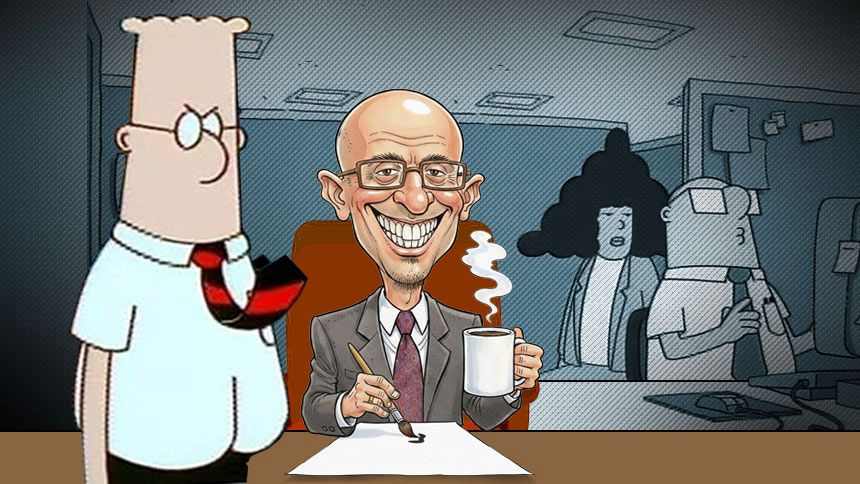
Since its debut in American newspapers on April 16, 1989, the grumpy Dilbert has become one of the most popular comic strips in the country – and later, the world – because its adventures are set in a place that never seemed funny: the company, where modern corporate culture is lived with all its intensity and rules.
In his early thirties, wearing a white shirt and tie without a suit, thick glasses, and a sarcastic manner that resonates with many readers who experience oppressive corporate environments, Dilbert works as an engineer at a technology company and has to deal daily with the bureaucracy and challenges typical of a modern office.
His character's personality is usually defined as cynical, frustrated, and resigned to the incompetence of the company he works for. His irritation almost always stems from objectively absurd situations, explored in four-panel comic strips: incapable bosses, illogical decisions, empty jargon, and useless bureaucracy.
Therefore, his "bad mood" is justified and transforms his grumpiness into humor of identification and empathy, not antipathy. The strip also became a great international success by highlighting leadership failures, process inefficiencies, excessive useless meetings, and the worker's feeling of powerlessness in the face of the corporate machine. Laughing at his little stories seemed to make the day lighter. What company hasn't nicknamed someone Dilbert?
This universe seems to have come to an end today, as its creator, cartoonist Scott Adams, died at age 68 after a long battle with metastatic prostate cancer, drawing inspiration from his own corporate experiences to bring Dilbert to life.
Adams was born on June 8, 1957, in Windham, New York. From a young age, he tried drawing cartoons, although he did not attend art school and chose to be self-taught. He graduated with a degree in economics from Hartwick College in 1979 and later obtained an MBA from the University of California, Berkeley, in 1986.
Before dedicating himself to comic strips professionally, he worked for years in the business and financial sectors, for example at Crocker National Bank and especially at the telecommunications company Pacific Bell. It was from this corporate environment that he drew the satirical perspective on office culture that would shape his famous comic strip.
The turning point in his life came in 1989 when he launched Dilbert and gradually began working full-time as a cartoonist as the strip gained popularity. According to him, the idea for the character originated from doodles he made at work, during moments when he was trying to relax, and eventually evolved into a series of strips that humorously criticize the "absurdities" of the corporate world.
The comic strip quickly spread across the country. While it appeared in 50 newspapers before its first anniversary, it jumped to approximately 150 newspapers by 1992. From then on, growth accelerated, driven by the public's identification with the satire about corporate life and its rapid distribution among American newspapers. Soon, anthologies in book form followed.
Dilbert became a mass phenomenon around 1996, when it was published in about 1,200 newspapers and would reach approximately 1,400 the following year. At its peak, in the late 1990s and early 2000s, the strip reached somewhere between 1,550 and 2,000 newspapers and magazines around the world. In addition, it spawned an animated TV series (1999–2000) and many licensed products, including dolls and toys.
In Brazil, the character's success was the same as in the rest of the world. It appeared in newspapers in several states. Furthermore, in the 1990s, Ediouro published books by Scott Adams related to Dilbert—such as *The Dilbert Principle * and *The Future Dilbert *—which mixed comic strips and reflections on the corporate world. They were released around 1997-1998 and had a more traditional book format.
In the following decade, the publisher L&PM was primarily responsible for publishing Dilbert in the form of a collection of comic strips translated into Portuguese, under the L&PM Pocket line. Between 2008 and 2014, the label released at least 8 numbered volumes of strips, in addition to a Special Box Set with 5 volumes released in 2009, which brought together the first five titles.
Racist remarks
Adams' character remained at the top until February 22, 2023. On that date, during a live broadcast on YouTube, its creator commented on a Rasmussen Reports survey that asked if people agreed with the statement "It's okay to be White?"
Organizations like the Anti-Defamation League observed that the phrase had been used by white supremacist groups and should be repudiated. Research showed that 53% of Black respondents agreed with the phrase, 26% disagreed, and 21% were unsure. What no one expected was that, based on these numbers, Adams would make statements that were widely considered racist and discriminatory.
He stated that, “if almost half of all black people don’t agree that white people are OK, that’s a hate group. I want nothing to do with them. And, based on how things are going, the best advice I could give white people is to get out of the sight of black people… just disappear. Because there’s no way to fix this.”
These statements were reported by news agencies such as Associated Press , Reuters , and The Economist as discriminatory and offensive. The following day, the USA TODAY Network, responsible for publishing hundreds of newspapers in the United States, announced that it would no longer publish the Dilbert comic strip due to the creator's latest discriminatory comments.
At the same time, the distributor Andrews McMeel Syndication ended its partnership with Adams, and some publishers also canceled books scheduled for release by the author that were to be published that year and in the following years.
Adams' death was announced by his ex-wife, Shelly Miles, during a live stream on Adams' YouTube channel (Real Coffee with Scott Adams), where she read a final message he had written before passing away. Adams stated that he had an "incredible life" and encouraged his followers to "be helpful" and to know that he loved them "until the end."
The illness that killed him had been publicly diagnosed in May 2025 and had spread throughout his body.