

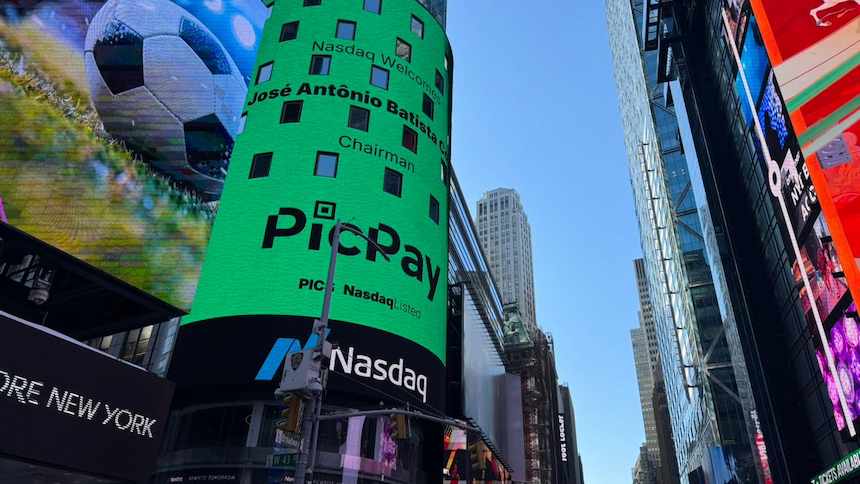
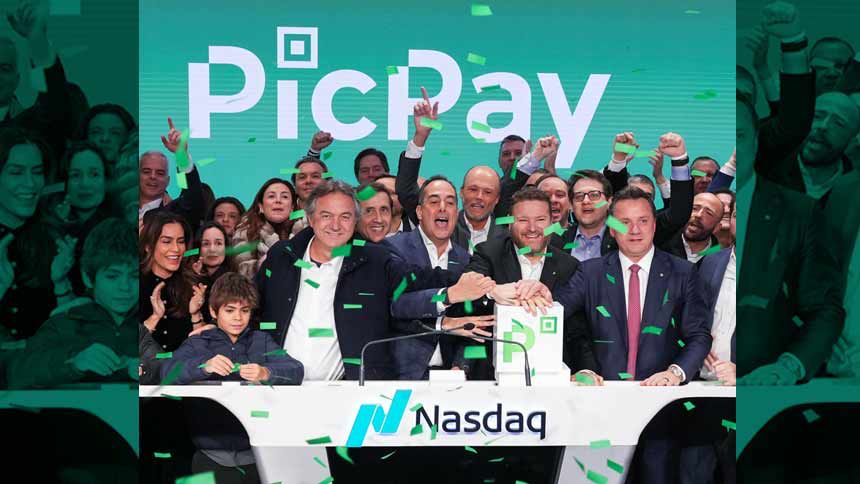
New York - The Nasdaq studio on 42nd Street in New York was too small for the number of people who were there to witness the first initial public offering (IPO) of a Brazilian company after a 5-year hiatus. On the podium, Joesley, Wesley , and José Antônio Batista of J&F; Anderson Chamon, founder of PicPay ; and Eduardo Chedid , the company's CEO, celebrated and rang the bell, initiating trading of the stock under the ticker PICS and a valuation of US$2.6 billion.
With demand almost 13 times higher than the book , PicPay exercised its hot issue and raised a total of US$490 million, representing 20% of the company's Class A shares, which started with a screen value of US$19 each. The IPO was anchored by Bicycle, owned by Marcelo Claure, which committed to investing US$75 million, and along with it came funds such as BlackRock, GIC, Fidelity, Columbia, and other giants for PicPay's cap table .
J&F, owned by the Batista brothers who control the company, in turn, acquired 100% of the Class B shares, which grant the right to ten votes per share, and 71% of the Class A shares.
With this, the Batista family's holding company maintains control of the company with 98% of the votes. "Listing on Nasdaq isn't the finish line, it's a new chapter in PicPay's history," said Eduardo Chedid during the ceremony.
PicPay's IPO opens a new window for Brazilian companies, which, in recent years, have not found the opportunity to go public on the stock exchange. PicPay itself went through this. The company tried in 2021 and had to recalculate its path to finally ring the bell on Nasdaq today. At the time, the fintech was burning through a lot of cash – R$ 1.9 billion in that year alone.
Chedid, the company's leader, realized that a change was necessary. Investors no longer wanted companies that only focused on growing their customer base without addressing the bottom line. That's when PicPay revised its operations and shifted its focus from accelerated growth to sustainable growth. The first profit was expected in the last quarter of 2022. At the time, Chedid warned that this would be the company's direction going forward.
“During 2021, we reviewed this. We needed growth in the customer base and an increase in revenue,” Chedid told NeoFeed at the time. He continued, “In November 2021, the challenge was also to look at EBITDA and net profit. It's no use just increasing revenue and burning cash. PicPay had to become sustainable.”
Judging by the numbers, it succeeded. In the first three quarters of 2025, the most recent data available, PicPay recorded a net profit of R$ 314 million, an increase of 82% year-on-year, and revenue of R$ 7.2 billion, a growth of 92%.
The cost of service reached R$17.80 per customer, while the Average Revenue Per Active Client (ARPAC) reached R$65 per quarter, which is 3.7 times the cost of service. For more mature customers, the ARPAC reaches R$145. The company's goal is to achieve an ARPAC of 5 times the cost of service for its entire customer base.
The return on equity (ROE) in the last 12 months up to the end of September reached 17.4%, above the 14.2% recorded in 2024. The goal, however, is to reach 30% ROE by the end of 2027. To achieve this, in addition to increasing service efficiency, the digital bank will need to increase customers' share of wallet . In other words, to get customers to use its various services more and more. PicPay has ample resources to do so.
The company has 65.6 million open accounts and 42 million active customers as of September 2025, representing increases of 11.7% and 12.2% respectively compared to the same period last year. Deposits totaled R$ 26.7 billion, a 61% increase in 12 months. And the TPV (Total Payment Volume) reached R$ 392 billion in the first nine months of 2025, a 32% increase.
What was once a digital wallet is now a robust ecosystem with a banking license and a wide variety of financial services. In recent years, the company has entered segments where it previously operated through third parties with its marketplace, but realized it needed to operate directly in them. Credit cards, payroll loans, personal loans, and insurance have been added to the menu for individual customers.
In parallel, the company began to pay more attention to business clients, focusing on small and medium-sized businesses with payment terminals and working capital credit. PicPay Shop, the company's marketplace with 300 stores, also falls into this vertical. After all, many business clients can connect to the platform. From January to September 2025, the business segment generated revenue of R$ 272.5 million – which reveals that there is still enormous room for growth.
Business plan
The IPO money will be used to give the company a boost. NeoFeed spoke to investors who attended PicPay executives' roadshows. Over the past three weeks, they met with more than 200 funds presenting the business plan for the IPO money, which is 100% primary. What they heard is that the company will focus on key areas such as credit, insurance, and M&As in the sectors where it currently operates only with partners.
In the credit market, for example, the goal is to increase the share of wallet of customers, which is currently 6%, to 12% within three to five years. Today, 40% of the credit offered by PicPay is collateralized, meaning it has a guarantee. The remainder is credit card and personal loan. One of PicPay's bets will be on private payroll loans. In the last three months, for example, the company originated approximately R$ 500 million per month.
“We have a long way to go in cross-selling,” Chedid said at the press conference following the start of trading in the shares. “Credit will be our priority.”
Beyond this vertical, the insurance segment is strategic for growth. Currently, PicPay has around eight million active policies. And, until now, it only operated through the distribution of connected partners, such as the Kovr insurance company, which was controlled by Banco Master.
The fintech company announced the purchase of the insurance company for R$ 600 million and is now awaiting approval from CADE (Brazil's antitrust agency) and SUSEP (Brazil's insurance regulator). Part of the acquisition money will come from the IPO. The remainder will be paid with PicPay shares.
That's where another advantage of going public comes in. Now, for future M&As, the company has a market capitalization, which makes it easier to use equity in transactions. And this is in the digital bank's pipeline – especially in areas where PicPay doesn't operate directly.
In 2021, when PicPay first attempted to go public, at a time when valuations were inflated by an abundance of cash, the company aimed to reach a market capitalization of US$20 billion. "Now it's more grounded," says a manager familiar with the company. "And that's better; it starts with enormous potential for appreciation," he says.
Another manager NeoFeed spoke to says that the IPO already represents an achievement for the Brazilian market in the current industry climate, especially given the scandals involving Banco Master. "It shows that there was no image contamination of other players in the sector."
PicPay chose Nasdaq primarily because the bank is digital and because its growth thesis is more easily understood by American investors. A market player told NeoFeed that there are many growth funds in the US that would hardly invest in the company if it were listed on the B3 (Brazilian stock exchange). It's no coincidence that Inter and Nubank have their shares traded there.
Because it's listed on the American electronic stock exchange, the company is now in the sights of funds dedicated to Latin America and Emerging Markets, large Brazilian funds that make direct investments in the American market, and funds focused on tech and growth . It's in the crosshairs. Now, the challenge begins of providing liquidity for the stock and preparing for market scrutiny every three months.
PicPay's CEO, Eduardo Chedid, and investor relations director, André Cazotto, say they are prepared for this. "What will make our role liquid is delivering results," says Chedid. Cazotto, in turn, adds, "It's delivering on the thesis we promised the market."