

Controlled by the Menin family, Inter was one of the pioneers among digital banks in Brazil. And, after consolidating its model in the country, it expanded its operations to the United States – which included migrating its main listing to Nasdaq in 2022 – and, more recently, to Argentina.
The technological footprint was essential in this journey. And it is at the heart of a new initiative that is now gaining official status and directly addresses the next steps in this journey: Inter Science, the bank's advanced research hub focused on quantum computing , artificial intelligence , and blockchain .
“I joke that Inter is a technology company that happens to have a bank. We rode the wave of cloud computing, digital, and mobile-first thinking way back when,” says Guilherme Ximenes, CIO of Inter, to NeoFeed . “And the role of Inter Science is to ensure that we don’t miss the next waves and this technological DNA.”
The new hub began to take shape in 2024 and originates from experiments in the digital assets area of Inter, led by Bruno Grossi. Specifically, it stems from a partnership with the Federal University of Minas Gerais (UFMG) in the field of quantum computing.
“That’s when we started attracting PhDs and researchers to Inter and building this structure,” says Grossi, head of digital assets at Inter. “Many technologies are born in academia, and we need to be close to universities to anticipate the financial infrastructure of the future.”
Inter Science's thesis goes far beyond a simple test tube disconnected from Inter's day-to-day operations. The plan is to be at the forefront of both short- and long-term technologies, bridging the gap between what is being tested in academia and the bank's applications at the operational level.
“It’s not just about being locked up in the lab, working with data that isn’t real. The idea is to understand what we can quickly embed into the products that customers are using,” says Ximenes. “When a technology reaches the point of real-life application, we won’t be starting from scratch.”
The hub was created with its own structure of just over 20 people, distributed between Inter's operations and those of partners such as UFMG. The material available to this "laboratory," however, is much broader. Starting with the data generated from the transactions of the bank's 43 million customers.
Although the project is still in its initial stages, there are already some examples of what is being done. One of them involves the area of artificial intelligence (AI), where Inter Science is developing the CodeEvolve project.
The initiative starts with large AI language models – so-called LLMs – to create a set of agents capable of identifying and improving the most suitable code to solve a given problem – from memory usage to application execution time.
“You have, for example, high-volume services like Pix. The tool will optimize the performance of this application,” says Ximenes. “This extends to other services, such as credit analysis, where it will improve mathematical resources and accelerate the model's response.”
Another example cited is in anti-fraud tools related to Pix, with the analysis of multiple factors to define the score of that transaction. "With this model, I can optimize one service for cost, another for performance, another for accuracy, and so on," says Ximenes.
The creation of a model that allows Inter to delve deeper into the knowledge of each client and personalize what is offered to these account holders is yet another example in this vein of AI. "Only Inter has this data. Not even OpenAI or any other AI company can use it," says the CIO.
In the field of blockchain, one of the projects includes converting and settling cryptocurrencies automatically and more efficiently. Another area on the radar is the use of these resources in the back office , with the plan to bring more efficiency and simplification to Inter's core banking operations.
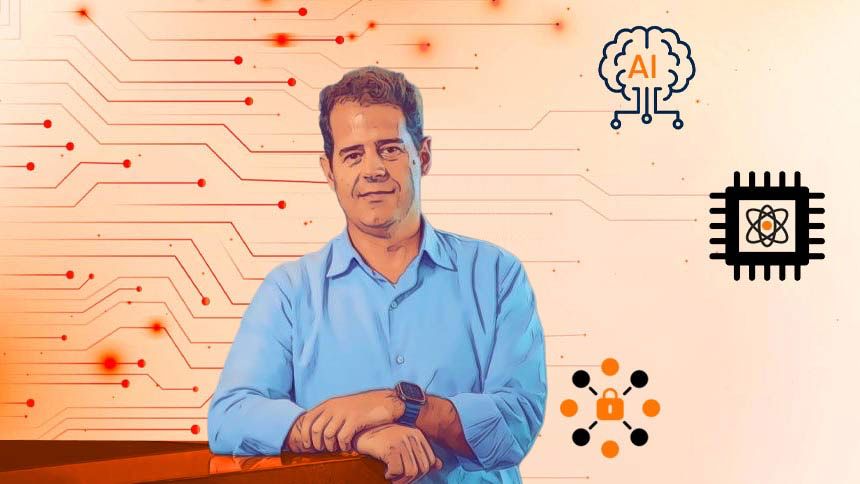
While AI and blockchain technologies are already in production, in quantum computing, work is still largely confined to the theoretical realm. This is especially true in fields such as quantum machine learning and the exploration of resources that could bring advancements to different areas of operation.
“We are studying, for example, new paradigms to have more advanced encryption mechanisms,” says Grossi. “And also to perform more complex simulations, in areas such as risk analysis.”
"Outside" and "inside"
As is typical of structures of this nature, in addition to UFMG, the hub has partnerships with institutions such as Oxford Quantum Computing in the United Kingdom, and companies like AWS, from Amazon. And it is already negotiating new partnerships, especially abroad. One of them is with the University of Miami.
Ximenes emphasizes that both these partnerships and the thesis behind Inter Science are strongly connected to Inter's strategy of expanding beyond the Brazilian market.
“The Brazilian financial industry is ahead of the American one. But, on the other hand, in the US, you have the big tech companies, which are creating cutting-edge technology all the time,” says the CIO. “So, the plan is to start localizing our technology there, take it to the US and connect it with these large companies.”
At the same time, he understands that there is work to be done internally. That is, to strengthen the dialogue between Inter Science and the other areas of Inter and to communicate what is being done by the hub.
“We have bi-weekly and monthly committees with the areas to show what's coming up, what we're already doing, and to understand what problems they have that we can solve with what we're studying,” says Ximenes. “We're giving them momentum. Looking ahead, outward and inward.”