

The technological rivalry between China and the United States, previously focused on semiconductors and algorithms, has gained a new visible and highly symbolic front: the stage of the Spring Festival, the most-watched program in China, comparable to the Super Bowl in audience and cultural impact.
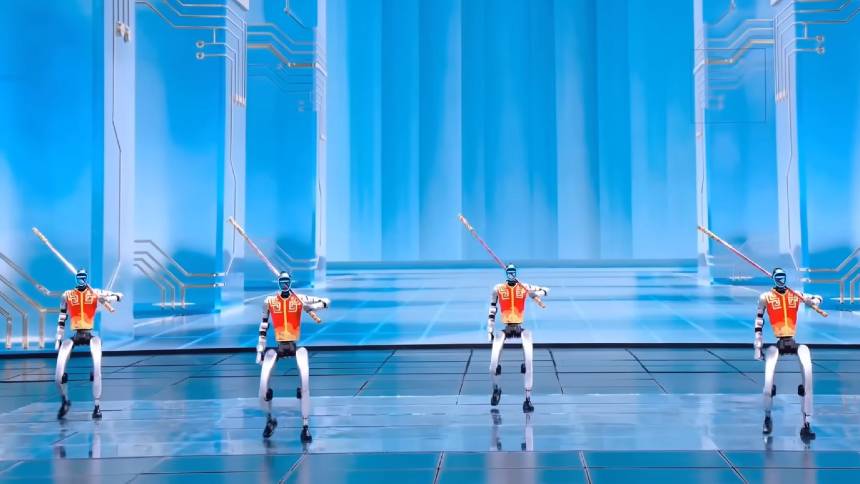
At the Spring Festival, watched by hundreds of millions of people, the country showcased humanoid robots dancing, dueling, and balancing with a precision that seemed almost like a geopolitical provocation.
The star of this show was Unitree Robotics, which had already gone viral the previous year with its Yangge dance performance and returned now with even more sophisticated demonstrations.
Their humanoids executed martial arts with precision, coordinating complex movements — from sword fights to sequences inspired by traditional "drunken boxing" — and even regaining their balance after falls, something considered a technical milestone in the industry.
Other companies like MagicLab, Galbot, and Noetix also shared the stage, reinforcing the feeling that humanoid robotics has ceased to be a laboratory experiment and has become a showcase of technological soft power. The timing is also not accidental: Unitree and AgiBot are preparing their initial public offerings for this year, amidst a wave of domestic investments in robotics.
But the Chinese display of power didn't stop on stage. Offstage, another demonstration—quieter, more sophisticated, and potentially just as disruptive as Unitree's robots—came from ByteDance, which unveiled Seedance 2.0, its AI-powered video generation tool.
In the United States, two companies are racing to match the Chinese humanoids. One of them is Tesla, owned by Elon Musk. The other is Boston Dynamics, one of the pioneers in the sector.
Tesla is trying to transform Optimus into a scalable product, with Elon Musk promising thousands of units this decade. And Boston Dynamics, a technical icon in the sector with Atlas, although still far from a mass production model.
In an interview with NeoFeed last November, Boston Dynamics founder Marc Raibert said that technology has primarily driven the cognitive aspects of robots, but significant advances in mechanics and safety were still lacking.
“It would be overly optimistic to expect them to be highly functional in two or three years. But in 10 years, I think there will be a major revolution. These robots will be very capable,” said Raibert.
The presentation of the Unitree humanoids is impressive precisely because of the mechanical aspect, showing movements that are difficult for humans but seem natural for the machines.
Ultra-realistic AI
If Unitree's show displayed China's strength in robotics, ByteDance reinforced the speed with which the country is converting data, consumer models, and computational scale into AI products that are beginning to rival, and in some cases surpass, their Western equivalents.
The company showcased Seedance 2.0, which produces highly realistic videos with fluidity and texture that are difficult to distinguish from real footage. The new tool works with up to 12 multimodal references—from images and audio to short videos—allowing the user to define angles, rhythms, and aesthetics as if they were directing a film set.
One of the features is "multi-lens storytelling," which transforms a single prompt into several interconnected scenes, maintaining consistency of characters, lighting, and atmosphere.
Hollywood fears the impact of the tool not only on the professional market, but also on the already delicate global debate about deep fakes. And the fear is well-founded: the videos generated by the new model confuse even visual effects experts.
Disney, for example, accused ByteDance of having a "pirated library" of characters protected by Disney copyrights on its new platform. Paramount said the AI model produced "vivid representations of Paramount's famous and iconic franchises and characters."
ByteDance, in a statement, said that it "respects intellectual property rights and we are aware of the concerns regarding Seedance 2.0." It added: "We are taking steps to strengthen current safeguards while working to prevent unauthorized use of intellectual property and imagery by users."
The performance of Seedance 2.0, however, reinforces a pattern that has become frequent. Its predecessor, Seedance 1.0, already outperformed Google Veo in text-to-video and image-to-video benchmarks.
ByteDance, whose global presence is often reduced to TikTok, is transforming itself into an AI powerhouse thanks to two factors that few companies in the world can replicate: privileged access to one of the largest video databases on the planet and a domestic ecosystem that quickly adopts everything that is launched, providing massive metrics of real-world usage.
China is no longer just chasing American leadership: it is setting the pace in strategic areas — from humanoid robotics to generative models. The Unitree robot dance and the advancement of Seedance 2.0 are distinct scenes, but they belong to the same script.