

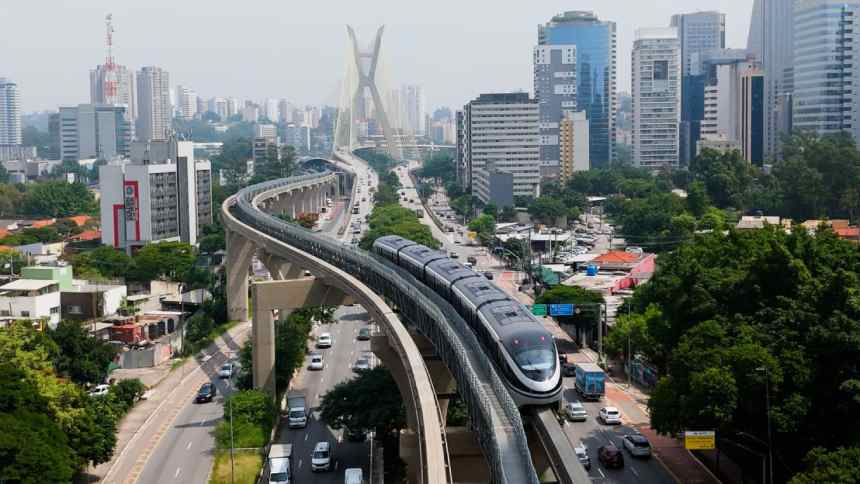
Agis Construtora solved an urban mobility problem that had plagued São Paulo for over a decade: the completion of Line 17-Gold, which connects to Congonhas Airport. The initial deadline for completion was the 2014 World Cup, held in Brazil.
The construction company, owned by businessman Eduardo Capobianco, from a family with a long tradition in the civil construction sector, took over the construction of Line 17-Gold in August 2023 to resume the work, which had been halted. The promise from the São Paulo state government at the time was precisely to serve the tourists who would come to watch the competition's games in the country. And it only came to fruition almost three World Cups later.
And now, after completing the nearly seven-kilometer, seven-station metro line from the Morumbi terminal to the airport, Agis has begun its next challenge: the first phase of the Intercity Train, between Jundiaí and Campinas.
The company will be responsible for the initial stretch of approximately 50 kilometers. Governor Tarcísio de Freitas (Republicanos) participated, on Wednesday, April 8th, in the event that marked the beginning of the works.
Agis was contracted by the TIC Trens consortium, formed by the Comporte group and the Chinese company CRRC, which won the bid in February 2024, in an auction held at B3. The total project, which aims to connect São Paulo to Campinas, will have an investment of R$ 14.2 billion and is expected to begin operations in 2031.
At this stage, Agis will carry out earthmoving works and the construction of physical engineering structures (bridges and viaducts). The deadline for completion of this phase under the responsibility of the construction company is 21 months. The cost was not disclosed.
“Since the Comporte group doesn’t carry out construction projects, it goes to the market and hires companies with the capacity to perform these activities,” says José Lima, president of Agis Construtora, in an interview with NeoFeed .
Following the completion of this service, the concessionaire will make new contracts to continue with the construction of the permanent way, next to the existing railway line along the route. Agis also intends to participate in the new bidding processes.
The Intercity Train project will help the company reach a revenue of R$ 2 billion in 2026, which should represent a 67% increase over the 2025 revenue of R$ 1.2 billion.

In the company's share, at least 40% of revenue comes from public contracts. The remaining 60% comes from contracts with private companies, including models like the Intercity Train, which, despite being a public works project, is contracted to a private company.
Even though contracts with the public sector have clauses that guarantee monetary correction, it is challenging, according to the president of Agis, to predict the impact of an interest rate scenario, in which a good part of last year it was necessary to deal with a Selic rate of 15% per year.
“This is not easy. Operating with a 15% rate is higher than the margin of the contract itself. Just as there is rigor in the technical engineering aspect, we were also meticulous in the financial matter. The impacts of a project of this size are significant because we need to pay upfront,” says Lima.
At the inauguration event for Line 17-Gold on March 31st, Tarcísio also announced studies for the expansion of the monorail, adding another 4.6 kilometers and four more stations, including one in the Paraisópolis community. There is no timeframe yet. Agis is also expected to participate in this new bidding process.
Brazil's 'second 7-1'
In practice, the World Cup in Brazil left two shameful moments: the 7-1 thrashing by Germany and the failure to meet the deadline for the delivery of Line 17-Gold, which was part of a large logistical plan designed as a global showcase and as a legacy of the competition.
“As a citizen, it was frustrating to see that unfinished construction on Avenida Roberto Marinho and near Congonhas. But as an executive, it was a great opportunity for us to meet this challenge and deliver this project to society,” says Lima.
When the company took over, at least 40% of the work was still to be completed. But, in practice, nothing was finished. It was an open-air skeleton, in one of the most important traffic corridors in the city of São Paulo, crossing Brooklin and the area surrounding Avenida Luís Carlos Berrini.
“Taking on a remaining mobility project is much more difficult. Everything had been started and nothing finished. No tracks, no stations, nothing. We worked on everything to be able to deliver it on time,” says Lima.
Another issue was ensuring the least possible impact on São Paulo's traffic as the work progressed to the final phase, especially regarding the concrete beams, some weighing over 100 tons, installed at a height of about 15 meters, where the stations are located.
“The interference with traffic had to be as minimal as possible. We even closed the Marginal Pinheiros highway on a Friday night to install a curved beam. And we had to reopen it by Sunday. The responsibility was enormous,” recalls the executive.
According to Lima, one of the main challenges in completing the monorail was meeting all the technical specifications for the correct "fitting" of the trains supplied by the Chinese manufacturer BYD, in the electric car manufacturer's first foray into this type of monorail in Brazil.
“It was an integrated engineering effort with the rolling stock owner. The tolerance was minimal, reaching a maximum of three millimeters. We held weekly meetings to adjust everything as needed. It worked well,” he explains.
This was not the first unfinished project – one that took more than a decade to complete – that Agis took on. The company also participated in the construction of the São Francisco River diversion project in the Northeast.
“The two share a similarity in terms of symbolism and the importance of these works for their regions. They also had the characteristic of being remnants. We completed the water pipeline to Ceará in 2022. That was a great challenge as well,” Lima recalls.
Although delivered and already in operation, under the initial management of the São Paulo Metro, Agis will still complete the last station of this phase of Line 17, Washington Luís. According to the president, the remaining physical part will be delivered within 90 days. The Água Espraiada depot will also be completed. By September, access to the stations will be free.
The expectation is that ViaMobilidade, from Motiva Trilhos (formerly CCR), which won the concession, will take over the operation of the monorail starting in the second half of this year. In this initial phase, the line operates from 10 am to 3 pm, Monday to Friday.
According to the Metro, the average waiting time varies between seven and 14 minutes, in the Shuttle format, where each train goes back and forth on the same line. When fully operational, the line is expected to transport 100,000 passengers per day.