



Cocos Capital is preparing to enter the competition among investment platforms in Brazil by betting on what worked in Argentina: attracting investors with smaller investment amounts.
The brokerage firm, which finalized the acquisition of Warren Investimentos , aims to revive the investment democratization initiative spearheaded by XP Investimentos and BTG Pactual in the past decade, bringing financial products to retail investors, especially those considered underserved by the large platforms.
Furthermore, Brazil represents an opportunity for the platform, founded five years ago, to take a leap in terms of size and relevance in Latin America.
"We believe there is room to do in Brazil what we did in Argentina," says Nicolás Mindlin, co-founder and chairman of Cocos, to NeoFeed .
"The Brazilian market is ten times larger than the Argentinian market in size and, due to its sophistication, perhaps 50 or 60 times larger in volume. The opportunity for us is enormous," he adds.
The intention is to focus efforts on clients with assets under US$100,000, a segment that, according to Mindlin, does not receive an adequate supply of financial products, even though the country has large investment platforms.
"The big competitors end up targeting other types of customers. We want to reach that segment which, often, has not yet received the tools it is looking for," he says.
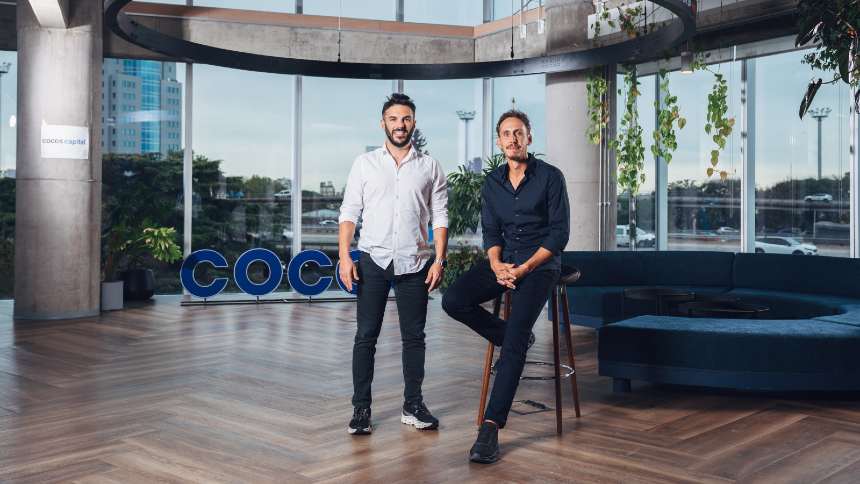
The strategy replicates the recipe that fueled Cocos' growth. The company was founded five years ago by Mindlin, who built most of his career in the family group that controls Pampa Energía, one of Argentina's largest energy companies, and by Ariel Sbdar, who came from the Argentine financial market and established himself as a finance influencer with over 190,000 followers on Instagram.
Starting with the founders' own resources and without external investors, Cocos amassed over 2 million customers last year, manages over US$2 billion in assets, and ended 2025 with annualized revenue of US$70 million and EBITDA of US$40 million.
Mindlin says the company manages to monetize lower-net-worth clients through a lean structure and technology. Cocos operates with fewer than 200 employees, through digital channels, without the need for dedicated agencies or advisors.
In addition to brokerage, the company generates revenue from investment funds, capital market operations, foreign exchange, and other financial products. In Brazil, the executive states that the company intends to adapt this model to the characteristics of the local market.
"Technology, financial education, and communication are things we do well. We want to use this experience to simplify products and bring them to millions of Brazilians," says Mindlin.
This doesn't mean abandoning higher-net-worth investors or companies. In Argentina , about 70% of Cocos' revenue comes from retail, but the other 30% is generated by institutional clients, companies, and high-net-worth investors.
The acquisition of Warren represents the first step in Cocos' international strategy, which began more than a year ago. The company had been exploring expansion opportunities in Latin America, primarily in Brazil and Mexico , the two largest markets in the region.
Mindlin explains that the company was more focused on the Mexican market, but decided to turn its attention to Brazil when the opportunity arose to acquire Warren. Four months passed between the start of discussions at the beginning of the year and the signing of the agreement.
Cocos has agreed to purchase Warren's assets, including the infrastructure of the former brokerage firm Renascença, now Warren Rena, as well as its asset management and capital markets operations. The sale process of Warren, which began as a search for a strategic partner , was previously reported by NeoFeed .
Following approval from regulatory authorities, Cocos expects to quickly begin operations in the country. The plan is to preserve the Brazilian platform's current businesses, especially its institutional fixed income desk, while implementing its retail-focused strategy.
"Starting from scratch is very difficult. Warren already has a team, infrastructure, and a very significant institutional operation. This gives us an important foundation for growth," says Mindlin.
With the incorporation of Warren and the completion of the purchase of Banco Voii in Argentina, through which it obtained a banking license, Cocos' priority will be to consolidate the two operations, which should help the company exceed US$100 million in annual revenue by the end of 2026.
"In the coming months, the idea is to integrate these assets into the Cocos ecosystem," says the company's co-founder and chairman. "Currently, we are not looking at further international expansion."