

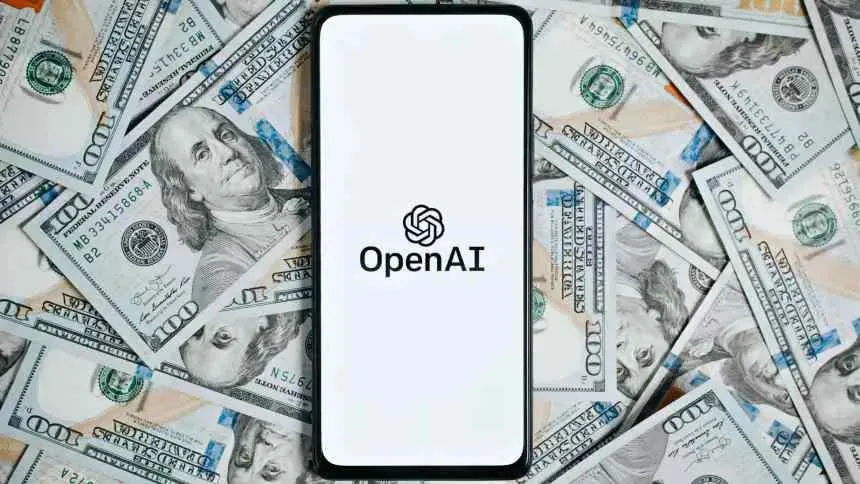

OpenAI has filed a confidential application to go public in the United States, taking the first formal step toward one of the most anticipated initial public offerings in recent years.
The creator of ChatGPT has filed documents with the Securities and Exchange Commission (SEC), the American equivalent of the CVM, in a move that could lead the company, headed by Sam Altman, to go public later this year. However, the company stated that it has not yet made a decision on the timing of the operation. The company is reportedly aiming for a valuation of approximately US$1 trillion.
In a statement, OpenAI said that "it may take some time" before an eventual listing, because there are still "things we want to do that are probably easier as a private company." The company also stated that there is "a complicated set of trade-offs" linked to the decision to go public.
The confidential request does not obligate OpenAI to go public immediately, but it puts the company in a position to accelerate the offering should the market window prove favorable.
It also officially places the company in a race with other private technology giants, such as Anthropic and SpaceX , which are also preparing to enter the public market with billion-dollar valuations.
The battle isn't just for investors. It's also for narrative. Anthropic, owner of Claude and OpenAI's main rival among artificial intelligence companies, filed a confidential request to go public last week. Elon Musk's SpaceX is also moving towards the public market, in an offering that could be among the largest in history.
For investment banks, whoever arrives first can set the benchmarks for the new industry and capture a capital base interested in gaining direct exposure to artificial intelligence beforehand.
But the IPO is still viewed with skepticism by the financial market. OpenAI has raised unprecedented amounts of capital and made billion-dollar commitments to expand its data center infrastructure. The bet is that more chips, energy, and processing power will give the company a competitive advantage over rivals with less firepower.
However, this advantage comes at a cost. According to projections shared with investors and cited by the Wall Street Journal, OpenAI is expected to burn cash at a level unparalleled among public companies. If it proceeds with the listing, it will have to demonstrate that its revenue will grow fast enough to cover its computing commitments by 2030.
The dilemma is not unique to OpenAI. Anthropic must also operate at a loss in the billions while trying to scale advanced AI models, which still cost more to train and run than the revenue they generate. Google , with the Gemini family, is also putting pressure on the competition in a market that demands constant and ever-increasing investments.
For investors, the inevitable comparison is with Amazon, which spent years in the red while reinvesting in scale, infrastructure, and new business ventures. The question is whether Wall Street will accept applying the same logic to artificial intelligence, and for how long.
If OpenAI's IPO goes ahead, it should also generate liquidity for some of its main investors, including Microsoft, Khosla Ventures, and Thrive Capital. But, more than just a financial event, a successful offering will open a Pandora's box about the company: revenue, margins, cost structure, stock-based compensation, infrastructure commitments, and business risks.
The race for prominence
OpenAI is still the company most associated with the end consumer. ChatGPT became the most recognized product of the new phase of technology and gave the company a scale that is difficult to replicate. But Anthropic gained strength in the corporate market and overtook OpenAI in valuation in the private market.
OpenAI itself was valued at US$852 billion in March. Anthropic, in turn, was valued at US$965 billion in its most recent funding round. The gap shows how the competition between the companies has ceased to be purely technological and has also become financial.
Behind the scenes, OpenAI executives expressed concern about the possibility of Anthropic going public first, according to the Wall Street Journal. The company remains a leader in the consumer chatbot market, but missed some internal revenue targets and saw its rival gain ground among enterprise clients.
The IPO also comes after OpenAI removed a significant legal hurdle. In May, Sam Altman and Greg Brockman won a lawsuit filed by Elon Musk , co-founder of OpenAI, who accused the pair of unjustly enriching themselves by transforming the originally non-profit company into a for-profit enterprise.
A California jury found that Musk filed the lawsuit after the legal deadline. Judge Yvonne Gonzalez Rogers of the Northern District Court of California accepted the verdict. Musk indicated he intends to appeal, but the defeat was seen as an important step in clearing the path for OpenAI toward the public market.
The company's corporate reorganization also directly involves Microsoft, one of its biggest supporters. In October, the two companies altered the terms of their partnership to allow the ChatGPT developer to transition to a for-profit structure. Under the agreement, Microsoft received 27% of OpenAI Group PBC, a stake valued at US$135 billion at the time.
OpenAI's non-profit arm received a $130 billion stake in the new structure.
The relationship, however, has become more complex since Microsoft's initial $1 billion investment in 2019. The tech giant increased its exposure to over $13 billion and gained preferential access to OpenAI's intellectual property and models. But the two companies have also faced tensions surrounding Microsoft's computing power, of which...
OpenAI relied on OpenAI to train models and serve a growing user base.
In April, the companies again amended the agreement, allowing OpenAI to license its technology and models to other cloud providers. The change reinforced an increasingly evident reality: in the artificial intelligence race, computing power has become a strategic input.