


Facing its biggest financial crisis since its founding in 1988 by Antônio Alberto Saraiva , the group that controls the Habib's restaurant chain has decided to go to court to request protection from debt collection for a period of 60 days. The company claims to have an accumulated debt of R$ 312.4 million.
The plan is to keep operations running during this period without affecting the restaurants. And to obtain legal backing so that suppliers, who are not being paid, continue delivering the supplies needed for food preparation. The process is a kind of pre-petition for judicial reorganization.
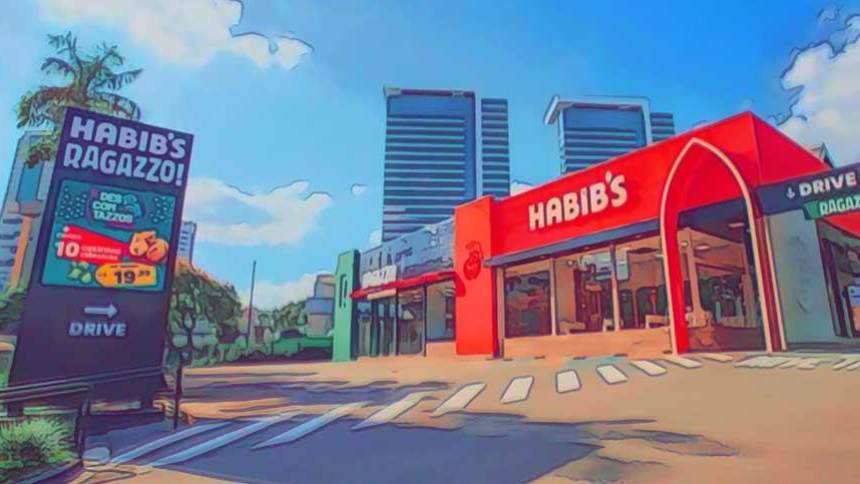
The Gennius Brasil Group, which controls the brands Habib's (Arabian food restaurant), Ragazzo (pasta chain), Mita (meal delivery) and Tendall Grill (steakhouse), claims that, without judicial protection, it would have difficulty continuing operations, precisely because of the volume of debt.
NeoFeed gained access to the lawsuit filed by the holding company in the 1st Bankruptcy and Judicial Reorganization Court of São Paulo. The measure, called a preliminary injunction, protects 174 companies that are part of the group, including the holding companies, central kitchens, and company-owned stores.
Also included in the group are Mercato Express, the group's arm of kiosks and hybrid stores, Alsaraiva Empreendimentos Imobiliários (the original corporate name of Habib's), and Allpasta Empreendimentos e Participações (which encompasses the dark kitchens of Ragazzo). The founder and president himself, Alberto Saraiva, and Belchior Saraiva Neto, administrators of the conglomerate, are also involved in the process.
In a ruling issued in early July, which had not yet been made public, Judge Jomar Juarez Amorim granted part of the requests to the food group. In the decision, the magistrate allowed a two-month stay period against collection actions. This means that, in practice, until the beginning of September, the company does not run the risk of being sued by creditors.
"This is an instrument designed to provide legal certainty to negotiations with creditors, in order to preserve the company and maximize the debtor's assets, avoiding the initiation of individual foreclosures or their continuation with the expropriation of assets and their disorderly liquidation," he states in the proceedings.
The decision, however, only covers debts that can be incorporated into a future judicial reorganization, which practically prepares the ground for this path should the group fail to balance its finances during this period. Of the total debts of the owner of Habib's, more than R$ 300 million are bank debts.
In the document in which he determined that creditors should not interrupt the supply of services and inputs to the chain's restaurants, the judge stated that, for this to happen, the company is obliged to make these new payments in cash, so as not to increase its liabilities.
"Regarding contracts essential to maintaining business activity, it is not lawful for a creditor to refuse to supply inputs, goods, or services upon payment in cash, based solely on the overdue debt that is the subject of the negotiation," says the magistrate.
However, in his decision, Amorim denied the Habib's group's request to release the company's receivables that had been given as collateral to banks, maintaining the bank liens and the legal security of the contracts. The company wanted to use these funds as cash flow.
In their petition to the court, the group presented three reasons to justify protection against executions. The first of these is directly related to the Covid-19 pandemic.
In the document, the company states that the economic and financial crisis occurred in the wake of social isolation and the consequent difficulty in continuing retail operations between 2020 and 2022.
The second point presented was the change in consumer habits in recent years, driven by the rise of delivery platforms, which, in the company's view, has affected the revenue of the chain's physical stores.
The company has its own delivery operation through a delivery app. But it is also on iFood and 99Food. Habib's does not operate on the Keeta platform.
The third argument relates to the challenging macroeconomic scenario, with the constant increase in the cost of capital, mainly due to the rise in interest rates - the Selic rate was reduced to 14.25% per year in June, but has already reached a peak of 15% in 2025.
A survey conducted by the Brazilian Association of Bars and Restaurants (Abrasel) on the out-of-home food market (which includes restaurants and snack bars), commissioned by NeoFeed , shows that in 2019, a year before the pandemic, the market was worth R$ 235 billion. The following year, it fell to R$ 175 billion.
After that, a recovery process began. In 2021, it was R$ 215 billion, and it jumped to R$ 396 billion in 2022. Last year, the market for this sector moved R$ 495 billion, and the outlook for 2026 is R$ 540 billion.
Scars in the sector
According to the National Restaurant Association (ANR), an organization to which the Habib's group belongs, the sector was indeed affected by the pandemic, causing many businesses to feel the impact of falling sales.
“Many companies are still carrying the burden of this crisis, mainly due to debt. But today there is growth. The challenges now are different, such as margins, labor, and the impacts of inflation,” says Fernando Blower, CEO of ANR.
But there is a perception among industry experts that the chain has not sought innovation and has failed to modernize, as other large groups in the sector have done.
“Other players have changed over time, and Habib's today is still very similar to what it was from the beginning. Customers penalize this. McDonald's, Bob's, and Grupo Trigo have taken steps to retain customers. And they haven't done their homework,” says an executive working in the food retail sector, to NeoFeed .
"In any case, it's unfortunate that a Brazilian brand like Habib's is experiencing such a difficult situation. The sector already has a high level of instability. The owners face a major challenge today and need to find a way to save the company," the source added.
The court-ordered protection against existing debts was not the company's only move to ensure the restaurants' continued operation.
One day before filing with the 1st Bankruptcy and Judicial Reorganization Court, the company had initiated a process in late June at the Judicial Center for Conflict Resolution and Citizenship (Cejusc) of the Regional Forum II, in Santo Amaro, also in São Paulo, to begin a debt renegotiation mediation process.
The process was even used as an argument to request asset protection and demonstrate the intention to begin a conciliation phase with at least some of the creditors. With the court decision, Habib's gains time to reach possible agreements without the risk of being foreclosed on beforehand.
If that doesn't work, then the path is open for a formal request for judicial reorganization. "The companies meet the requirements to request judicial reorganization and have initiated mediation proceedings before the Cejusc," states the judge.
Another one on the list.
By deciding to shield its operations from creditors through the courts, Habib's joins a growing list of companies in Brazil that have resorted to judicial or extrajudicial reorganization proceedings to try to rebalance their finances.
The most recent cases were those of Grupo Toky , which controls Tok&Stok and Mobly, reporting debts of R$ 1.1 billion, and Oncoclínicas , which has faced difficulties since the beginning of the Banco Master scandal and reported debts of R$ 5.1 billion.
The St. Marché supermarket chain, the Pão de Açúcar Group (GPA), the toy manufacturer Estrela , and Fictor , among other companies, also filed lawsuits.
The Saraiva family group currently owns around 300 Habib's restaurants and 200 Ragazzo restaurants, in addition to hybrid units. In the case of Tendall Grill, there are six restaurants (four in São Paulo, one in São Bernardo do Campo, and one in Santo André), and a premium unit, opened in December, in Barueri.
As it is a privately held company, the group does not disclose its revenues. However, in a report in August 2023, Alberto Saraiva informed NeoFeed that he expected to bill close to R$ 3 billion that year.
The company does not disclose the breakdown, but according to market sources, 60% of the units are company-owned and the other 40% are franchises. The company does not disclose its revenue.
In recent months, the group has reported the closure of units in the city of São Paulo, in São José do Rio Preto, in Limeira, in the Minas Gerais municipality of Passos, among other locations.
Contacted by NeoFeed , the Habib's chain did not respond to the questions before the publication of this report.