


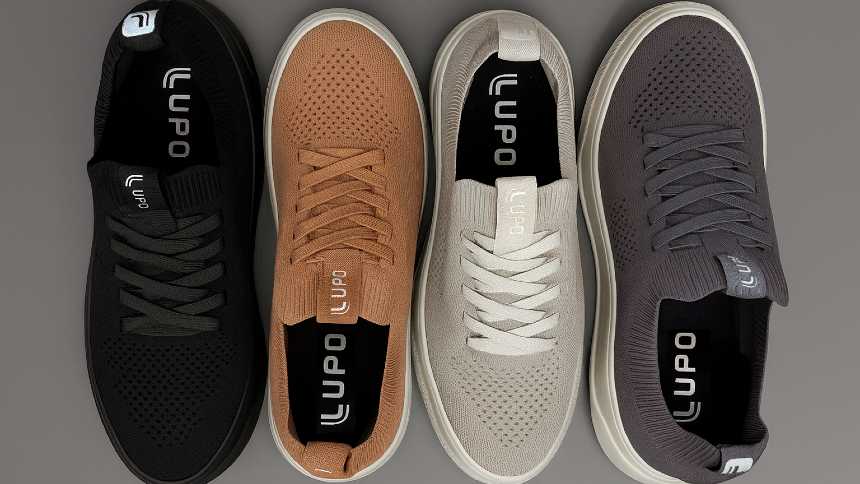
Amid efforts to expand beyond socks, underwear, and lingerie, Lupo is taking its first steps into the footwear market.
A textile group from Araraquara, in the interior of São Paulo, is launching its first sneaker model, believing that this market, which will reach R$ 51 billion in 2026, can be an important engine of growth for the coming years.
“When you compare the underwear market to the sneaker market, it becomes insignificant, as does the sock market,” says Carlos Mazzeo, managing director of Lupo, to NeoFeed . “However, the sneaker market, within the clothing sector, is much larger.”
The first release is a casual sneaker called Origem. The company began studying the subject about four years ago, when the first knit sneakers emerged—shoes with uppers made of lightweight, flexible, and breathable fabric, created by interwoven threads that form a net-like structure.
“We understand that this sneaker connects with Lupo’s three attributes: comfort, textile technology, and presence in people’s daily lives,” says Rogério Guimarães, Lupo’s franchise director. “Casual style has great appeal. We were born in the sock market, and the construction system is similar to its manufacturing.”
The company even tried to internalize the production of the shoe due to this similarity, but faced with unsatisfactory results, it decided to outsource, dividing the development of materials and manufacturing among four undisclosed suppliers.
The first prototype, designed for both men and women, was created in 2024 and tested by employees and retailers. Based on initial feedback , Lupo believes the time has come to enter the market, but in a phased approach.
Initially, Origem will be available in 100 select stores of the brand across all states of Brazil, out of a total base of 756 units.
The idea is to gradually advance in this segment, taking the product to other sales channels, especially multi-brand stores – Lupo has more than 34,000 points of sale in the country, responsible for 59% of revenue up to September.
“We are conducting a test, a careful entry, for the sake of the brand's reputation. We don't want to put a bad product on the market,” says Mazzeo. “It's a journey; we are taking the first steps and evaluating consumer acceptance.”
This caution makes executives hesitant to project how much revenue this product line will initially generate for the Lupo unit, which in the first nine months of the year showed revenue of R$ 711.1 million, stable compared to the same period in 2024.
The goal is to gain space in customers' wardrobes, as part of diversification efforts that have resulted in a portfolio of 13,000 SKUs, with 6,500 under the Lupo brand alone. "Our idea is that when a customer buys a pair of socks, they also buy a pair of shoes," says Guimarães.
If all goes well, the expectation is to expand the footwear portfolio, potentially including sports models, since the initial intention was to produce sneakers for Lupo Sport , the company's sports brand.
“What will guide our next steps is customer perception. It’s a long-term plan, a marathon, not a 100-meter sprint,” says Guimarães. “For us, these category extensions are natural progressions.”