


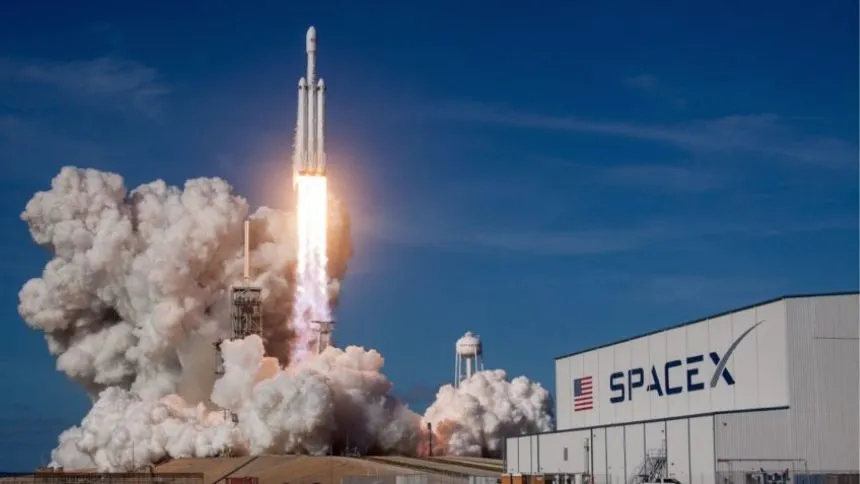
One of the most anticipated IPOs of 2026, SpaceX , the rocket manufacturer owned by billionaire Elon Musk, is expected to have Bank of America, Goldman Sachs, JP Morgan Chase, and Morgan Stanley leading the company's initial public offering (IPO) process.
SpaceX executives have been meeting with bankers in recent weeks as the company prepares for what is expected to be one of the largest stock market entry moves in history. The company is projected to surpass an $800 billion valuation.
Sources cited by the Financial Times believe that SpaceX's IPO could surpass the $29 billion raised by Saudi Aramco in 2019, which would make the company the largest initial public offering in history.
Since the end of 2025, there had been expectations that Morgan Stanley would be part of the group of financial advisors, given Musk's decades-long business relationship with the American bank.
Morgan Stanley was among the banks that took Tesla public in 2010, along with Goldman Sachs, JP Morgan, and Deutsche Bank. Subsequently, the institution advised Musk and led the financing for the acquisition of what was then Twitter, now X, in 2022.
Recently, businessman Anthony Armstrong, one of the bank executives involved in these negotiations, was appointed to the position of chief financial officer of his artificial intelligence company, xAI.
In an internal memo sent to employees in late 2025, SpaceX's Chief Financial Officer, Bret Johnsen, announced that the company was preparing for an initial public offering (IPO) in 2026.
"Whether this will actually happen, when it will happen, and to what valuation are still highly uncertain questions, but the idea is that, if we execute brilliantly and the markets cooperate, a public offering could raise a significant amount of capital," Johnsen wrote at the time.
In the text, the CFO wrote that SpaceX would use the capital raised from the IPO to increase the frequency of flights of its next-generation Starship rocket, currently under development.
He also stated that part of the funds raised would be used to deploy AI data centers in space, a complementary effort to his Starlink business, which would bring the company even closer to the artificial intelligence boom.
Although Musk had publicly stated for a long time that he preferred to keep SpaceX as a privately held company, the company's steady appreciation and the success of its Starlink satellite internet service motivated the change in strategy.
Having solidified its dominance in the rocket launch market, SpaceX has become the world's largest satellite operator through Starlink, a network of nearly 10,000 satellites that transmit broadband internet to consumers, governments, and corporate clients.
Although there had already been speculation about the possibility of Starlink going public independently, sources consulted by Reuters say that the IPO could include both companies, although the plans are still subject to change.
The company plans to build a base on the lunar surface. SpaceX is one of the main contractors for NASA's Artemis program, with a $4 billion contract to take astronauts to the lunar surface using Starship, a transportation system designed by the company.
Sending humans and robots to Mars has been Musk's long-standing vision for SpaceX. In this sense, Starlink's revenue will contribute to the development of Starship, which was also designed to serve as a means of travel to Mars.
In Davos, during the World Economic Forum, Musk stated on Thursday, January 22nd, that in five years, AI will be more intelligent than humans. He also said he expects to start selling his humanoid robot, Optimus, to the general public in 2027. It was his first time participating in the event.
The impending SpaceX IPO comes at a time when Musk is facing criticism from minority shareholders of his other companies, primarily involving the sale of Tesla stock and the alleged use of insider information.
The businessman has also had conflicts with the SEC, which even investigated the Twitter acquisition process. He is also embroiled in controversy with investors in OpenAI, a company he was a partner in until 2018. In 2024, he filed a lawsuit against the company, claiming he had been deceived.
In June, Musk projected that SpaceX's revenue in 2025 should be around US$15.5 billion, from multi-billion dollar contracts in the defense and telecommunications sectors. By 2026, the expectation is that revenue will exceed US$24 billion.