

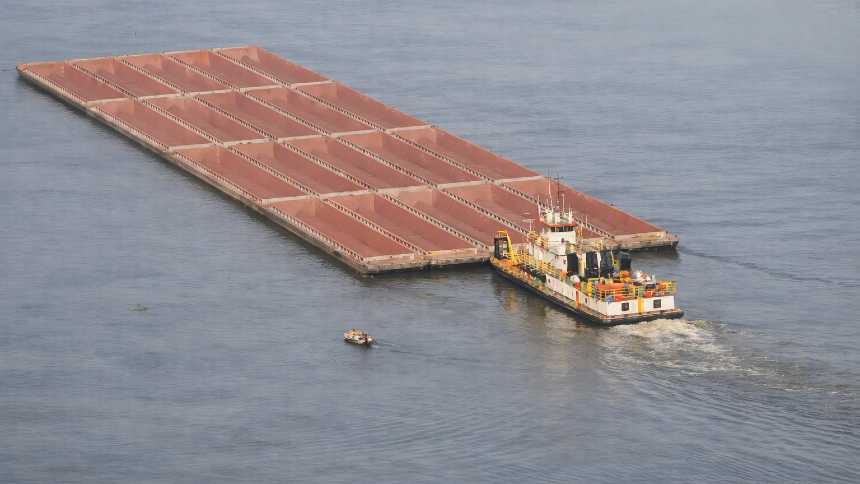
Brasilia — In the final stages of negotiations with the governments of Paraguay and Bolivia, the Brazilian government intends to send a bill to Congress by the end of the year to ratify the Paraguay Waterway concession. The concession is eagerly awaited by the infrastructure sector and is expected to expand the flow of iron and manganese ores, as well as grains, across the border between the three countries.
The project, which has been under discussion since the end of 2024, foresees a 15-year concession for 600 kilometers between Corumbá (MS) and the mouth of the Apa River - located in the city of Porto Murtinho (MS) - and projects investments of R$ 43.2 million. It is one of the alternatives to relieve congestion at logistics terminals such as the Port of Santos, expanding cargo movement to the North, especially minerals.
The agreement is still undergoing complex negotiations, as it requires consensus among the Brazilian, Paraguayan, and Bolivian governments. The concession section of the waterway—the southern stretch—still involves 222 kilometers in the Brazilian portion, 330 kilometers in Paraguay, and another 48 kilometers on the Bolivian side. In total, the waterway covers 1,272 kilometers in Brazil alone (the route also includes the northern stretch, which will not be granted to the private sector).
Over the past six years, the cargo transported via the Southern Section of the Paraguay Waterway has quadrupled, reaching 9.4 million tons in 2025. Iron ore represents 83% of all cargo transported, with an estimated potential to exceed 30 million tons annually.
Currently, the project is under review by the Federal Court of Accounts (TCU). However, it depends on a final positive assessment from Paraguay. In addition to the agreement of the governments, a tripartite agreement ratified through approval by the legislatures of the three South American neighbors is also required.
“In this case, it has to be approved by Congress. It’s an election year, so there’s less traction. And I think we can send it to Congress this year, even before [the elections]. We are also working towards that, with Paraguay and Bolivia,” said the Minister of Ports and Airports, Tomé Franca, in an interview with NeoFeed .
The minister also mentions that Asunción recently made a proposal to Brazil in an attempt to reach an agreement regarding the tripartite concession. Brasília is expected to respond soon with a counter-proposal concerning the rules to be established for the waterway.
“Because, who will do the regulation? Will it be Antaq [the Brazilian regulatory agency] in the first concession? And then in the next ones, who will do it? So that's the agreement that needs to be made. Who will do the oversight? These are issues that need to be aligned, but there is already a very convergent interest,” he added.
The proposal for shared management between the three countries also aims to define common rules for navigation services in the region, such as buoyage and nautical signaling, hydrological monitoring, and maintenance of navigability conditions. It also foresees the use of technologies for vessel traffic and environmental monitoring, according to the Ministry of Ports and Airports.
Market
Currently, LHG Mining, a company belonging to the J&F group, which owns two high-grade iron ore mines in Corumbá (MS), operates in the Brazilian section of the waterway transporting cargo. However, the company will not be able to participate in the first round of the auction, at least for now, according to a preliminary version of the bidding document being prepared by Antaq.
Last year, LHG moved approximately 9 million tons of ore, but envisions increasing its cargo capacity to 25 million tons by 2035 and doubling it to 50 million tons within 20 years. The company also has a port and a river transport operation.
Adalberto Tokarski, former director general of Antaq and currently head of the Agency for Sustainable Development of Waterways (Adecon), says that commercial navigation already exists on the waterway, but without operating year-round or 24 hours a day (at night, for example).
“There are sections that haven’t been dredged. There are three points where a section needs to be separated, and that generates costs because sometimes it hasn’t been dredged, there isn’t a suitable bridge. But the concession will solve these problems, and you would have year-round navigation with greater safety,” Tokarski told NeoFeed .
“The biggest navigation problems on the waterway were in Paraguay, but they've already solved them. This will be the first concession for waterway infrastructure services in Brazil. It won't privatize the river. Only those who move cargo will pay.”
The private sector expects, however, that the tender may only be launched in 2027 due to the electoral calendar and the short window of time to finalize the negotiation, approve the agreement in the parliaments of the three countries, and still have it approved by the TCU (Brazilian Federal Court of Accounts) and Antaq (in the Brazilian case).
“I think the deadline is extremely tight,” says Tokarski. “From our side, we will support the government so that this stage moves forward. If they manage to finalize this agreement quickly, there will be time to pass it through the Congresses of the countries involved. In Paraguay, they approve it easily, and in Brazil, nobody is against it.”
The executive further explains that the concession is highly anticipated by the private sector, which has been showing interest in the future auction of the waterway, which has been in commercial operation for at least 90 years – even Vale has operated the waterway. “Businesspeople are all excited because the river has already improved its navigation considerably, but now, if they have the assurance of greater transport safety, it will be even better.”