


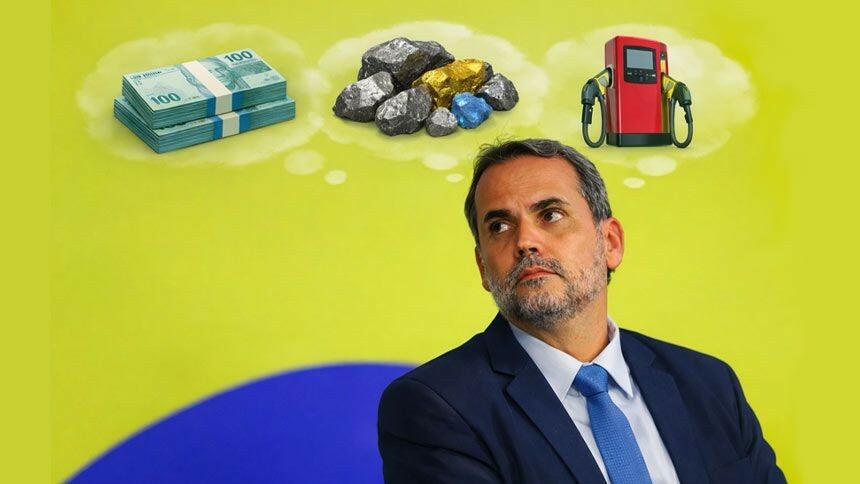
Brasilia — In just over a month at the helm of the Ministry, the new Minister of Planning, Bruno Moretti, has been gaining prominence within the economic team, becoming a kind of rising figure in the government, already enjoying the personal confidence of President Luiz Inácio Lula da Silva (PT), according to government and congressional sources interviewed by NeoFeed in recent weeks.
Having come from the Civil House — where he was the right-hand man of Minister Rui Costa — a well-known technician with good connections in the National Congress and considered a "government executive," he has been leading the final negotiations on the bill regulating the exploration of critical minerals in Brazil since April, on behalf of the government. He also actively participated in designing the package of measures to contain fuel prices amidst the war in Iran.
Not to mention the proposed Budget Guidelines Law (LDO) and the Draft Budget Law (PLOA), both for 2027, that is, the budget that the next president will have to execute.
READ ALSO: "There will be no change in fiscal rules in 2027," says Planning Minister.
On several occasions, Moretti even led press conferences at the Palácio do Planalto (Presidential Palace) to explain fiscal measures, also within the scope of the Ministry of Finance, contained in decrees and other regulations.
As head of Planning, his main mission is to forward and manage the Budget, in partnership with the Treasury. But this function has been somewhat diminished, given the lackluster presence of former minister Simone Tebet, according to sources in the Esplanade of Ministries. It was common to hear, even from his aides in Brasília, that Tebet was a member of the party's (MDB) quota—she was a senator for Mato Grosso do Sul and had a more political profile, unlike Moretti.
A career employee of the Planning Ministry since 2004, specializing in budgeting and public policy, the current minister is also familiar with other government issues. And due to his previous role as Special Secretary for Government Analysis in the Civil House, he brought with him, upon returning to the Planning Ministry, agendas and actions he had already been working on, some even unrelated to the Ministry itself, according to a source within the ministry.
“He is a rising figure within the government,” Congressman Arnaldo Jardim (Cidadania-SP), who is not part of the government's base but, as rapporteur of the rare earth bill, has had significant contact with Moretti in recent weeks, tells NeoFeed.
Jardim says that Moretti was the minister chosen by the Planalto Palace as the government's interlocutor in the discussion surrounding the proposal, which was approved by the Chamber last week.
Before the project went to a vote, the minister even intervened with the rapporteur regarding the "prior approval," a responsibility of a new governing council that had been causing friction between companies and lawyers in the mining sector.
Moretti, who was chairman of Petrobras' Board of Directors until March, argued that it would be unfeasible for every project involving the exploration, production, or export of critical minerals to require authorization from this new collegiate body foreseen in the proposed law.
The rapporteur ended up withdrawing his approval and now stipulates that the projects should only be ratified by the new committee. "He agreed to the change, but we discussed it beforehand and he warned that if this wasn't properly implemented, it could interfere with the market."
While still serving as Chief of Staff, the congressman also recalls discussing several projects with Moretti, which he also reported on in the Chamber of Deputies: "Fuel of the Future," the green hydrogen framework, and the regulation of incentivized debentures.
Speaking to NeoFeed , Moretti said that he worked on issues such as the Rare Earth Bill and measures to reduce fuel taxes, always at the request of the Presidency of the Republic. " There was an instruction for me to support [these two government issues], without prejudice to sectoral debates."
He notes, however, that his actions outside of Planning were specific and even then always limited to fiscal issues inherent to Planning's responsibilities. "I believe it's always within my duties. I don't think there's a general [government] formula. It will depend on each case."
Civil House
NeoFeed has learned that during his time as Chief of Staff, Moretti also played an important role in, for example, the amendment to the Constitution regarding the financial and administrative autonomy of the Central Bank. He even argued, in meetings with parliamentarians and Central Bank technicians, that the proposal should not affect the government's primary expenses.
In the Civil House, which coordinates all other ministries, Moretti effectively acted as an executive secretary, a "piano player," who dealt with and participated in practically all the major government issues, many of them related to fiscal policy.
"Rui Costa was the minister, but many times it was Moretti who made the machine run," recounts a source who worked with him during his time as secretary.
Former minister Costa, who left the government to run for a Senate seat in Bahia, was known as a tough figure and accustomed to heated discussions within the government, especially with the Finance Ministry. In the Esplanade of Ministries, it was common to hear disagreements between Rui and Haddad, for example.
However, Moretti was even considered for the Ministry of Finance while discussions were still underway about who would succeed Haddad. The fact that he is an economist and already dealt with the government's fiscal issues in the Civil House sparked this possibility, but now as minister he has a smooth relationship with Durigan, unlike his former boss Rui Costa, who was involved in several clashes with the former Minister of Finance.
A source in the electricity sector who knows Moretti believes that his discreet demeanor enables him to move between different areas of the government and also in Congress – the minister has also worked in the Senate. And that his position in the Civil House qualified him to participate in major Executive agendas, even as a secretary. "So this prominence is natural," says the source.
Public coffers
Despite his prestige within the government and active voice on various issues, Moretti is not immune to the uncertainties harbored by economic agents and the market regarding fiscal challenges, especially next year.
For 2026, still under Tebet's administration, the government committed to a primary surplus in an election year (0.25% of GDP). And it repeated the commitment for next year, regardless of who will be the President of the Republic, projecting another surplus of 0.5%.
According to Felipe Salto, chief economist at Warren Investimentos, who has known Moretti "for a long time," the minister has knowledge and experience in fiscal matters and already played an important role in addressing budgetary and tax issues, even while at the Presidential Palace. And now he gains even more strength in this area as a minister.
On the other hand, Salto argues that, despite moving towards meeting the 2026 fiscal target (through the reduction of court-ordered payments, combined with the use of the lower end of the target and with the help of oil revenues), this "does not necessarily indicate a positive outlook".
“We don’t foresee any difficulty in fulfilling the legal commitment. However, we will still end with a primary deficit of around 0.4% of GDP, far from the surplus needed to stabilize the debt-to-GDP ratio,” he told NeoFeed . “Therefore, the central issue is not meeting the legal target, but how to forge a plan to improve the result and return to generating surpluses from next year onwards.”
Looking ahead to next year, the economist is even more skeptical. "It's unlikely the 0.5% of GDP surplus target will be met. Considering the information we have so far, our projections point to the need to change next year's target," says Salto.
According to him, it's important to remember that, after the elections, regardless of who wins, the final months of this year should be used to plan measures that will allow for a tougher initial year in the next term, from a fiscal standpoint. "I understand that this will happen after the second round, but we need to wait and see what kind of measures and how thorough they will be."