


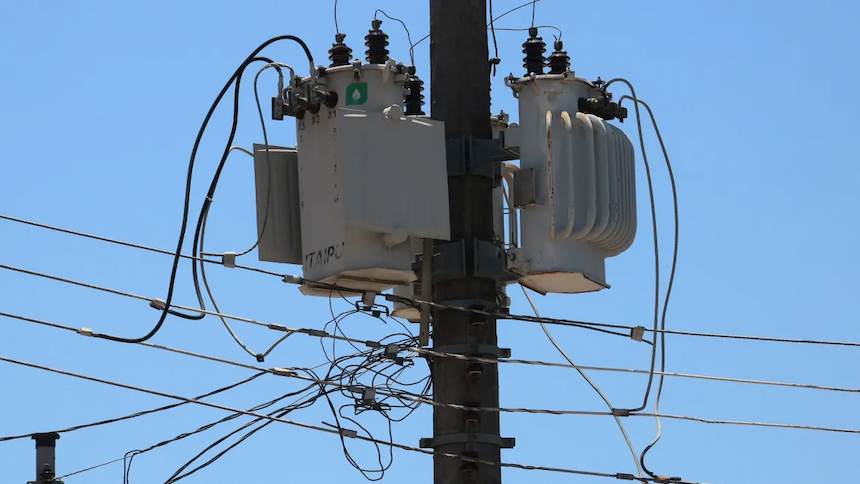
Brasilia — It's no secret that running a company in Brazil is like untying knots in tangled wires. The country is considered the king of oddities, and if it can get any more complicated, someone always has to ask: why not? Well, Congress is entering the fray with a unique idea: to create a new economic segment called "posteiro" (pole installer). That's right, a law being debated in Brasilia to create private companies that will decide the future of power and telecommunications poles.
The goal is to solve the chronic problem of tangled network cables on power poles across Brazil. But, it seems, it will add another layer of bureaucracy to an already complex business. The possible creation of the "mandatory pole operator," a third-party company that would manage the sharing of cables on poles, has already raised concerns among energy distributors and telecommunications operators.
Currently, the contracts for managing utility poles are handled by the energy companies, which in turn lease them to the telecommunications companies. The "pole operator" would serve as the deciding factor in this relationship. But what is generating high tension among the private sector is the obligation of this new activity.
Uncertainty surrounding the identities of these new companies, which have never operated in the sector before, has been causing friction in Brasília. The distributors want to maintain their current prerogative, as owners of the utility poles, to decide whether the management of this asset will be carried out directly or by third parties, in this case, the "pole operator".
Furthermore, the issue is surrounded by operational and competitive uncertainty. Currently, there is a large proliferation of cables from approximately 20,000 internet providers that irregularly occupy 53 million utility poles in Brazil, small businesses without operating licenses, loose wires posing a risk of accidents, fire incidents, damaged poles, thousands of different municipal laws regulating the use of poles, in addition to visual pollution.
After passing through the Senate with the support of both distributors and telecommunications operators, following seven years of debate, the bill began causing behind-the-scenes noise when it reached the Chamber of Deputies, even before being voted on in plenary. The proposal, in fact, had already had its urgency approved by the federal deputies at the end of May, following an agreement with the president of the Chamber, Hugo Motta (Republicanos-PB).
The text previously approved by the senators, drafted by rapporteur Espiridião Amim (PP-SC), creates rules to regulate this sharing of cables and defines rights and sanctions in this regard. And, at most, it creates the possibility of action by the so-called "pole operator," but in an optional way—a position shared by the telecom companies.
The only exception in the telecommunications market would be an agreement among operators, according to industry sources, who also agree to continue delegating the management of utility poles to distributors, but also argue that the new law should define, as a last resort, criteria and rules of operation for a potential pole operator, should the concessionaires fail to fulfill their obligations.
Now, the expectation is for the report from Congressman Juscelino Filho (União-MA). The former Minister of Communications has already indicated that he may present his opinion at any time, including this week. The rapporteur is expected to meet with Motta in the coming days to set a voting date. However, companies fear that his report will make the "poster" mandatory.
When contacted, the congressman did not comment. However, sources close to the rapporteur have already admitted that a preliminary version of his report should include the figure of an "optional representative," NeoFeed has learned. The final text, however, may still undergo changes.
The revolt against pole operators also has a financial impact. According to the Brazilian Association of Electricity Distributors (Abradee), the current revenue of concessionaires from pole management totals around R$ 4 billion, of which R$ 2.4 billion is used to reduce electricity bills for consumers (tariff moderation) — an amount that would be threatened and could mean a tariff increase for consumers, with the eventual entry of the "pole operator" into the market.
According to Patrícia Audi, CEO of Abradee, the figure of the "posteiro" (poster) is causing surprise in the sector due to the lack of an equivalent parameter in the international scenario.
“What kind of person is this ‘postman’? If the distributor is forced to hire a third party, who doesn’t have the field knowledge or a sufficient team to do this, it will be yet another cost that will have to be shared with consumers,” Audi told NeoFeed .
The executive from the energy concessionaire sector also states that distributors currently lack the legal power to cut an illegal cable belonging to a small, unlicensed internet service provider, for example.
“What the distributors want is to have the tools to resolve these issues. We are hoping for the approval of the bill as it came out of the Senate to finally regularize the situation of illegality and irregularity on the utility poles,” he adds.
Conexis, an organization representing telecom companies, recently released a statement also defending the approval of the bill in the form passed by the Senate. However, it raises concerns, such as the "prohibition on any potential pole operator from providing telecommunications services."
Among the other points that the entity advocates should be maintained in the Chamber's text are: guaranteeing asset owners the freedom to decide whether pole management will be carried out directly or by third parties; equal treatment for telecommunications providers, according to the effective use of the infrastructure; a transition period for regularizing pole occupation with a maximum price; allocation of resources for regularization during the transition; and an incentive for the regularization of irregular providers.
"The text approved by the Federal Senate represents progress towards a structural solution for a historical and critical bottleneck affecting Brazilian urban centers, namely, the disorderly and informal use of utility pole infrastructure," adds Conexis.
Government and agencies
A 2024 decree, signed by President Luiz Inácio Lula da Silva and Minister Alexandre Silveira (Mines and Energy), already foresaw the operation of the so-called "pole operator," as regulated by Aneel (electricity) and Anatel (telecommunications). The two regulatory agencies have been discussing the sharing of utility poles since 2018.
The decree delegates to electricity concessionaires the right to cede to a "distinct company (pole operator) the space in distribution infrastructure, the occupancy zones and the pole attachment points of overhead distribution networks intended for sharing with the telecommunications sector."
It then fell to the two agencies to approve a joint resolution to regulate how this "telephone operator" would operate. To this day, however, the resolution has not yet been published. After several discussions, Aneel even approved its part, but the matter still depends on approval from Anatel as well.
The director of Aneel, Agnes Costa, explained to NeoFeed that the agency's collective decision was to make the activity of "pole operators" non-mandatory and maintained the prerogative of contracting by distributors. However, a recent opinion from the Attorney General's Office (AGU), in line with the Ministry of Mines and Energy, has positioned itself in favor of the mandatory commercial exploitation of poles by pole operators.
"We support the bill as it came from the Senate [optional pole operator], but a bill isn't necessary to have this interpretation that the transfer to a pole operator would be mandatory," Agnes stated. "The bill creates a competence for us to regulate, and that's positive. I just understand that the contracts between the pole operator and the distributor have to be very exhaustive. And an advantage of having a bill is that perhaps there [in Congress] it's decided who regulates this new figure."
The Ministry of Communications, to which Anatel is linked, was contacted and only stated that it has been in dialogue with the telecommunications sector in order to seek a consensus on the bill currently being processed in Congress. The Ministry of Mines and Energy (MME) did not comment.