

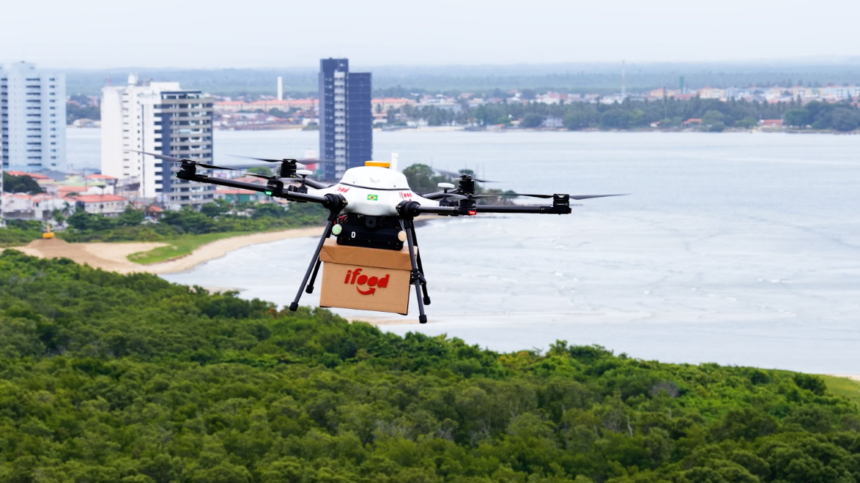
iFood is making a minority investment in the Brazilian drone manufacturer Speedbird Aero, reinforcing its commitment to this type of unmanned aerial service for the delivery of small items.
iFood's investment in Speedbird Aero complements a funding round led by the Portuguese investment firm Lince Capital last year, which raised US$3.5 million. Now, iFood is contributing US$1 million, bringing the total funding to just over US$5 million.
iFood and Speedbird are long-time partners, with the first test flights taking place in 2020. The partnership was resumed at the end of last year in Aracaju, with an operation capable of handling up to 280 orders per day.
Speedbird currently holds licenses to operate in 14 countries. In addition to Brazil, Portugal, Belgium, Italy, Ireland, Scotland, and Singapore are on the list.
"In the United States, we even had a temporary license to operate in Michigan, delivering goods by ship. 'We want to make this license permanent,' says Manoel Coelho, CEO of Speedbird, to NeoFeed ."
In Italy, for example, Coelho states that Speedbird is operating on routes that were initially intended for the German companies Volocopter and Lilium, which, although they attracted significantly more passengers, were unable to get their projects off the ground. In Brazil, Speedbird has licenses to operate in urban areas with a density of up to 5,000 people per km².
With iFood, the company maintains active routes in Aracaju, in addition to having a history of operations in Rio de Janeiro, Salvador, and Florianópolis. The next step, according to Coelho, is to obtain a license to operate in the metropolitan region of São Paulo.
“We are seeking all the necessary authorizations to highlight this operation and add value to our partners and iFood's partners,” says Coelho.
According to Coelho, the plan is not to use drones for final delivery, but to support deliveries in hard-to-reach areas – a model similar to that already implemented by iFood in Aracaju.
In the capital of Sergipe, for example, drones reduce the travel time from 30 minutes to three minutes between a shopping mall at one end and a delivery point at the other. From there, delivery drivers pick up the order and complete the delivery.
"It was 18 kilometers of dirt road that the delivery driver had to travel to get there and another 18 to get back. So, it didn't make sense for him to do it," says Coelho.
In São Paulo, once all the necessary permits are obtained, iFood's first drone delivery route is expected to connect a shopping mall to residential condominiums.
“We’ve done tests before, but they were isolated incidents. To implement this on a large scale, we need both technological maturity, which we have already achieved, and air traffic control capabilities,” says Coelho.
According to Coelho, Speedbird Aero should reach breakeven with this new funding round. The drone manufacturer is also preparing for a Series B round, but says that with the new capital, it has the funds to develop its current plans. "We are comfortable not accepting just anything," Coelho states.
Among Speedbird Aero's investors are DGF, Explorer Investments, Cedrus Capital, AcNext Capital, and MSW Capital. The latter is a multi-corporate venture fund whose shareholders include Embraer, a strategic investor for the Brazilian drone manufacturer.
iFood, in turn, has made several investments in companies that can connect to its delivery ecosystem. The two most recent demonstrate its appetite for startups.
Last year, iFood acquired a 20% stake in CRMBonus , with an option to acquire control for R$10 billion. The company, led by Diego Barreto, also bought AdSolve, an artificial intelligence company, to accelerate its growth in advertising.