

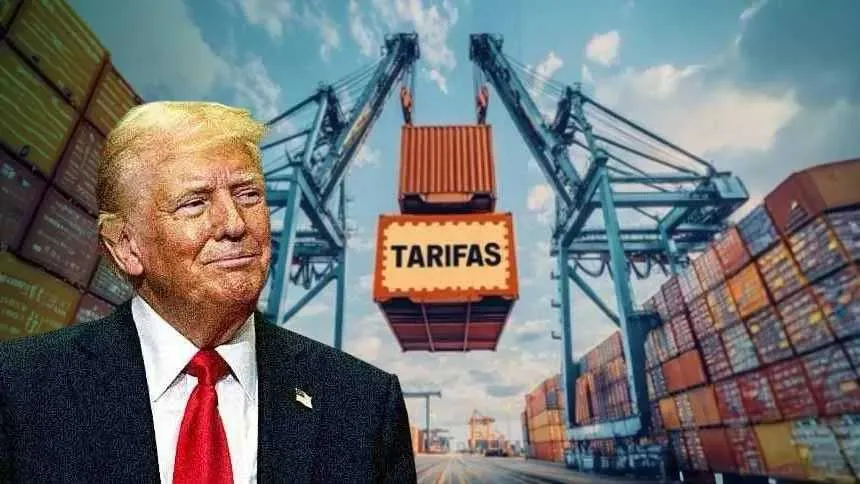

The United States government announced on Thursday, July 23, an additional 12.5% tariff on Brazilian products, part of a package affecting 60 other countries and marking the Trump administration's restructuring of the global tariff regime.
The new rates, of 10% and 12.5%, will come into effect at 00:01 this Friday, July 24th, exactly when the temporary 10% rate imposed 150 days ago expires. Brazil was included in the group that will receive the highest rate, under the justification of "inadequate oversight" of forced labor practices.
Days before imposing the new supplemental tariff of 12.5%, Donald Trump had already surprised Brazil by announcing tariffs of 25% on a specific list of Brazilian products, citing risks to US economic security.
This previous round primarily targeted industrial machinery, electrical equipment, chemicals, paper and pulp, metal parts, and high-value-added items, extending the impact beyond steel and aluminum, which were already subject to tariffs under Section 232—a provision of U.S. trade law that allows the president to impose tariffs when certain imports are deemed a threat to national security.
For agribusiness, the tax fell on processed meats and by-products, although soy, corn, and coffee were excluded as they are considered essential to the American food chain.
The Brazilian government rejected the new 12.5% tariff announced by the United States on 60 trading partners – including Brazil – for alleged failures to effectively prohibit and combat the trade in goods produced with forced labor. The Executive branch stated that it will invoke the Reciprocity Law .
"Given the completely arbitrary and unjustified nature of the tariffs announced against Brazil, we will immediately initiate the procedures to activate the instruments provided for in the Reciprocity Law, unanimously approved by the National Congress, and we will take the matter to the WTO's dispute settlement mechanism," says the statement released by the Secretariat of Social Communication (Secom) of the Presidency of the Republic.
The announcement of new tariffs against Brazil was criticized by former US Treasury Secretary Janet Yellen. "The tariff policy adopted by President Donald Trump against Brazil reflects his own long-held personal views, and not a sound economic diagnosis," Yellen said during an ExpertXP event in São Paulo.
According to Yellen, "there aren't many economists, if any," who support the tariffs imposed by Trump. She said that the broad tariffs applied to Brazil and other trading partners are harming long-term trade relationships and imposing significant costs on American families, even though they generate significant revenue for the U.S. government.
The immediate replacement of the temporary tariff with a more lasting regime, based on Section 301 of the Trade Act of 1974, was announced by the office of U.S. Trade Representative Jamieson Greer. The new tariffs target 60 countries that, according to Greer's office, represent about 99% of U.S. trade.
Section 301 is considered legally more enduring than the basis for the tariffs that the Supreme Court struck down. Once implemented, the tariffs can remain indefinitely and be unilaterally changed by the president.
Although some critics argue that Greer's investigation into forced labor is not as thorough as previous Section 301 investigations, the Commerce Act does not require "mathematical precision" for tariffs to be considered legal, Tim Brightbill, a partner at the law firm Wiley Rein, told The Wall Street Journal .
Debt strategy
The joint announcement of the tariffs was no coincidence. The rapidly growing US public debt, now close to US$39.6 trillion, has become the cornerstone of an economic strategy that American and European analysts describe as unprecedented.
Instead of treating indebtedness as a fiscal risk, the Donald Trump administration began using it as justification for maintaining high tariffs on 60 countries, including Brazil.
The system works because the financial market, responsible for buying the bonds that finance this debt daily, has become dependent on the cash flow generated by the fees. The higher the revenue, the greater the security to absorb the growing volume of bonds issued by the Treasury.
Thus, even after the end of Trump's term, the pressure to maintain high tariffs is likely to persist for at least 10 years, not for political reasons, but out of fiscal necessity.
The international impact is significant. Countries that depend on the American market, such as Brazil, face a scenario of long-lasting and unpredictable tariffs. For exporters, this means higher costs and reduced competitiveness. For the United States, it means transforming trade policy into a fiscal pillar, something unprecedented in recent history.
The debate now focuses on the limits of this strategy. American economists warn that linking debt financing to tariffs could distort global supply chains and prolong trade tensions.
European analysts argue that the financial market, as it becomes accustomed to this arrangement, tends to push for the maintenance of tariffs even in scenarios of political change. The combination of growing debt, market dependence, and tariff revenue creates a mechanism that will be difficult to dismantle in the short term.
“The biggest obstacle to reversing Trump’s tariffs after 2028 will not be legal, but financial,” warned Josh Lipsky, vice president and director of international economics at the Atlantic Council, in an article in The New York Times .
According to him, with the national debt growing, the market responsible for selling that debt quickly became dependent on the money that enters the government daily thanks to tariffs.
“Few politicians are willing to disrupt the bond market, since it dictates the cost of borrowing for some of the most important purchases Americans make, including their cars and their homes,” he added. “Instead of being constrained by these forces, the next president can find a way to use them to the country’s advantage.”
In other words, with or without Trump, the American tariff spree is set to continue for at least another ten years, during which time these tariffs could generate nearly $1 trillion for the US Treasury.