

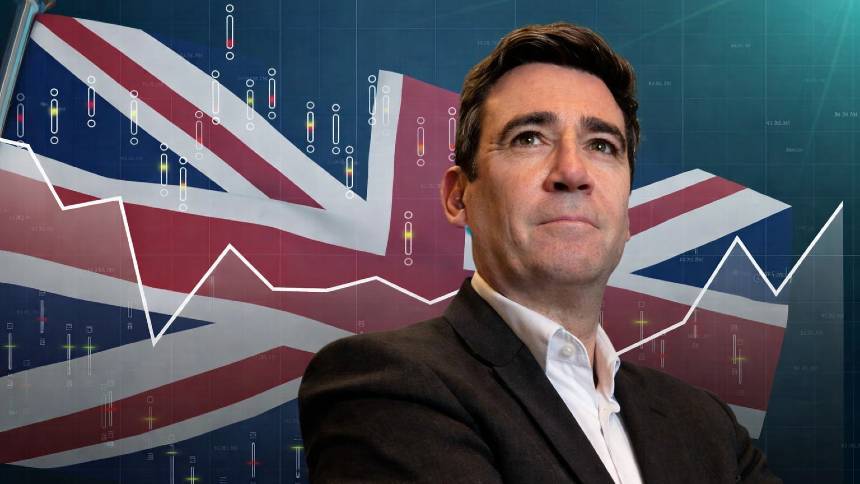
The British reacted on Monday, June 29, with a mixture of optimism and distrust to the first speech by Andy Burnham, former mayor of the Greater Manchester area, as the new Prime Minister of the United Kingdom , replacing the resigning Labour leader Sir Keir Starmer .
In a speech delivered at the Manchester Museum of Popular History – his first major political address since returning to the House of Commons after serving three terms as mayor – Burnham outlined a series of measures that he said were part of a ten-year plan to reverse the UK's economic stagnation, a difficult task that ultimately led to the downfall of his predecessor.
The decision to speak in Manchester, and not in London, symbolizes what he intends to do: shift part of the country's political center of gravity. The most emblematic announcement was the creation of an official Prime Minister's office in Manchester, which he named "Number 10 North" – a reference to the address of the British government headquarters, Downing Street, in London.
Although previous governments have distributed departments and staff to other cities, Burnham wants something more profound: a decision-making hub with real autonomy. The new prime minister states that he intends to give new powers to local leaders across the country, including authorities in Scotland, Wales, and Northern Ireland. He describes the plan as "the biggest rebalancing of power in British political history."
The new office in Manchester, he said, will be responsible for coordinating the largest social housing construction program since the post-war period. This is an ambitious promise in a country where the housing deficit has become one of the main drivers of the cost-of-living crisis.
He also promised to increase the government's capacity to invest in the productive sector, reform the social welfare system for the elderly, and uphold the Labour Party's principle of not raising taxes.
His proposals have been praised, but there is skepticism as to whether he will have the political strength to implement them – Burnham was barely a member of parliament a month ago, and yet he is about to assume the highest office in the country without having had the trouble of winning a leadership contest, let alone a general election.
At 54 years old, he arrives at the position of Prime Minister of the United Kingdom as a figure known for his trajectory outside the traditional axis of British power.
Although he had been a Member of Parliament and a minister in previous Labour governments, it was during the decade he led Greater Manchester — a metropolitan area of nearly three million inhabitants in northwest England — that Burnham consolidated his image as a pragmatic manager, a defender of decentralization and a critic of the concentration of decisions in London.
Economy in decline.
Burnham takes over the government facing a delicate economic scenario. The United Kingdom's Gross Domestic Product (GDP) grew by 1.1% in 2024 and 1.4% in 2025. Annual inflation, as measured by the Consumer Price Index (CPI), averaged 2.5% in 2024 and closed the year 2025 at around 3.4%.
Furthermore, productivity is not growing, real household income is stagnant, and the cost of living has become a constant concern. The country spends around £110 billion (US$140 billion) a year on interest payments alone on public debt, which is approaching £3 trillion (US$3.8 trillion).
One of the most significant changes involves the reform of council tax , the municipal property tax, based on 1991 property values. The update could significantly increase the amount paid by residents of London and the Southeast of the country, where property prices have skyrocketed in recent decades.
Conversely, it would reduce the tax burden in poorer regions, especially in the so-called "Red Wall" districts, former Labor strongholds that have shifted to the Conservatives in recent years.
Another central point on Burnham's agenda is the reform of the social care system for the elderly. In the United Kingdom, this service is not part of the NHS — the public health system — and many people have to sell their homes to pay for long-term care. Previous governments have tried to solve the problem, without success.
Burnham already proposed, in 2010, a tax on the value of properties after the owner's death, a measure that was labeled by the conservative press as a "death tax". He does not rule out revisiting a version of this idea. Resolving the social welfare impasse, he argues, would reduce pressure on the NHS and provide greater financial security for families.
The new prime minister also promised to respect the Labour Party's fiscal rules, which prohibit increases in taxes such as VAT, income tax and social security contributions. He also pledged to ensure that current expenses are covered by revenue within three years, reserving borrowing only for long-term investments.
Even with these restrictions, the new British prime minister believes there is room to expand investments in infrastructure — especially in transport, housing and local public services.
Burnham comes to power in a Parliament that, according to himself, seems more tense and unhappy than when he was last a member of parliament. Pressure from social media, public dissatisfaction, and security threats have changed the political environment. Even so, the new prime minister tries to convey a sense of lightness: he gave his speech wearing a dark blue t-shirt, an informal style unusual for British leaders.
For many Labour MPs, who have spent years fearing unfavorable polls and internal disputes, Burnham represents a chance to rebuild trust and stability. If he manages to "make politics fun again," allies say, he will have already won some of the support needed to advance his agenda.
What is concerning is that many of his proposals had already been made by Starmer, who only lasted 23 months in office, including fiscal responsibility and the reconstruction of public services after years of austerity.
His government prioritized economic stability, more predictable institutional relations, and an attempt to regain the trust of the traditional Labour electorate, especially in northern England. Despite some progress, Starmer faced growing internal and external frustration over the slow economic recovery and the persistent cost-of-living crisis.
Burnham takes office with a rare combination of expectations: he is seen as both an outsider and an insider—someone who knows the center of power but has spent years away from it; someone who speaks of national unity but wants to shift power away from the capital.
Whether he will succeed in fulfilling his promise to "turn the United Kingdom upside down" is too early to say. But his agenda—affordable housing, decentralization, tax reform, and social welfare—brings to the forefront issues that have challenged British governments for decades. And, with three years until the next general election, Burnham will have time to try to prove that the Manchester model can, in fact, be scaled up across the country.