




The country's solar and wind energy sectors – which have been accumulating losses due to cuts in renewable energy generation by the ONS (the regulatory body for the electrical system) to avoid overloading the system – cannot find peace of mind even when they are the target of a measure that, in principle, would benefit them.
This feeling of frustration gripped the sector after the Ministry of Mines and Energy (MME) published Normative Ordinance No. 140 earlier this week, defining the rules for compensating for wind and solar power generation cuts that occurred between September 2023 and November 2025.
According to estimates from the consulting firm Volt Robotics , the potential compensation value could reach R$ 2.7 billion if all generators choose to adhere to the stipulated conditions – which includes waiving legal actions seeking full restitution for losses due to curtailment , as renewable generation cuts are known.
Compensation for the cuts was a long-standing demand of the centralized power plants, which accumulated losses of R$ 6.5 billion last year alone due to curtailment .
What would at least be a relief, however, turned into a new cause for concern after a thorough analysis of the ordinance. This is because, although the final text brought advances in relation to the draft submitted to Public Consultation No. 210/2025, it left unanswered the central question: how to transparently identify the reason for each cut.
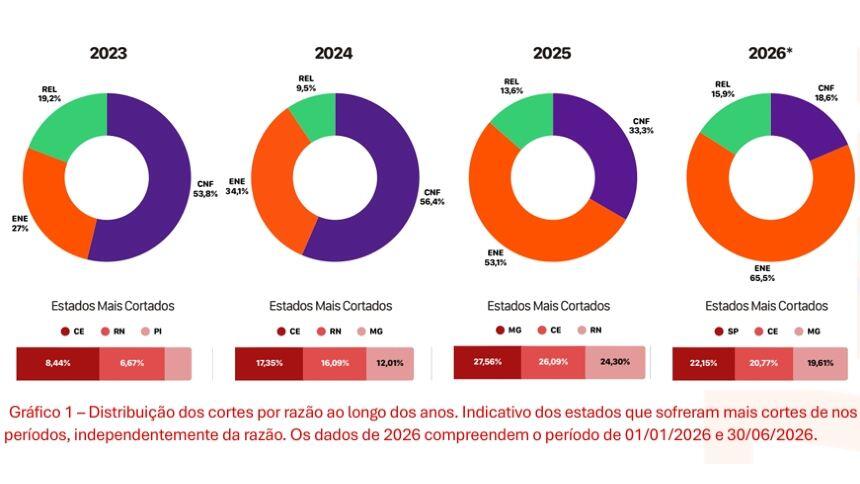
This definition is essential to determine whether or not there is a right to compensation. The plight of centralized renewables gains relevance with the realization that non-refundable cuts are growing and already represent 65.5% of the total in the first half of 2026. It is precisely this uncertainty on the subject that has been paralyzing investments in the sector, especially in solar power plants, which are most affected by curtailment .
Renewable energy generation cuts are classified into three types, according to regulations from the National Electric Energy Agency (ANEEL). The first is the Energy Ratio Cut (ENE), caused by an excess of supply relative to consumption, when there is more energy available than demand.
The second is Electrical Ratio Interruption (REL), caused by the unavailability of transmission lines, whether due to maintenance or faults. The third is Reliability Ratio Interruption (CNF), applied when the network, although available, may behave unstably if all generation is channeled, increasing the risk of failures.
This classification defines who bears the losses and impacts revenues, contracts, and investments.
“There have been significant advances, especially in operationalization and recalculation, but the central point still needs to be resolved: the classification of cuts cannot be a black box,” says Donato Filho, CEO of Volt Robotics, which released a study on the ordinance, denouncing the lack of clarity precisely on the central point of interest to the sector.
"It's not enough to report that a power outage occurred: it's necessary to publish the data, the assumptions, and the criteria that allow for the reproduction and auditing of that conclusion," he adds.
Distorted results
In the initial draft, the Ministry of Mines and Energy (MME) proposed the SOSIN formula to identify moments of oversupply, when wind and solar generation would need to be reduced due to excess energy in the system.
The calculation combined hydroelectric, thermoelectric, small power plants, wind and solar potential, and microgeneration estimates, discounting the total load of the National Interconnected System (SIN), with data updated every half hour.
The problem is that this data already reflected operational decisions and safety constraints, which could distort the diagnosis and classify situations caused by technical or reliability limitations as oversupply. As Donato Filho explains, the formula mixed elements that represented not only economic dispatch orders, but also inflexibilities and specific operational needs.
The wind and solar energy sector entities (ABEEólica and Absolar), with support from Volt Robotics, tested the formula using ONS data between September 2023 and November 2025.
The result showed that the oversupply calculation was 143% higher than the total cuts classified by the ONS (National System Operator) as energy-related, demonstrating that the equation incompletely reconstructed the real balance of operations.
Furthermore, 74% of the power outages occurred at the same time that thermal power plants were being dispatched on a merit-based basis, and more than half happened with a Marginal Operating Cost (MOC) above zero. Since the MOC represents the cost to produce the next megawatt-hour needed by the system, positive values indicate that the system was not experiencing a full energy surplus, which reinforces the suspicion of misclassifications.
Spatial analysis also revealed inconsistencies. At times, the Northeast region recorded cuts of up to 80%, while the South had no restrictions. Wind farms in Rio Grande do Sul experienced cuts equivalent to 58% of the national average, while those in Ceará reached 159%.
Such large differences suggest the influence of transmission, regional reliability, or connection characteristics, and not just systemic oversupply.
The final version of Ordinance No. 140 removed the SOSIN formula and the definitions of generation and demand aggregates, avoiding the consolidation of a technically weak criterion. It also eliminated exceptions based on old access opinions and nominal transmission solutions, which could generate legal uncertainty by imposing increasingly stringent restrictions on generators over time.
Despite this, the central problem remains. According to the consultancy, the ordinance removed the formula, but did not present a quantitative and public method to characterize oversupply. The ONS (National System Operator) will have to classify each event as external unavailability, electrical reliability, or oversupply, but the text does not specify which tests, variables, or criteria will be used.
“There is no clarity on how the CMO (Marginal Cost of Operation), the Settlement Price of Differences (PLD) – the price used to calculate how much each agent in the electricity sector should pay or receive in the short-term market – thermal inflexibilities, or regional restrictions will be handled,” warns the Volt study. “Nor is there a method to transform a potential systemic oversupply into a non-compensable portion for each power plant, which could generate significant distortions.”
Industry associations suggested an individual limit to prevent a power plant prevented from generating due to electricity restrictions from being treated as a participant in the general oversupply, but this proposal was not incorporated.
The result is a system in which non-compensable energy cuts continue to grow. In 2023, they represented 27% of the total; by 2026, they will reach 65.5%. Without clear criteria, the agents cannot predict operational impacts or correctly assess the causes of the cuts.
In a statement, Absolar (Brazilian Solar Energy Association) asserted that the decree establishing a commitment to pay for liabilities arising from generation cuts may not be sufficient to completely end the legal challenges to the issue by stakeholders. In other words, the plight of centralized renewable energy plants is far from over.