


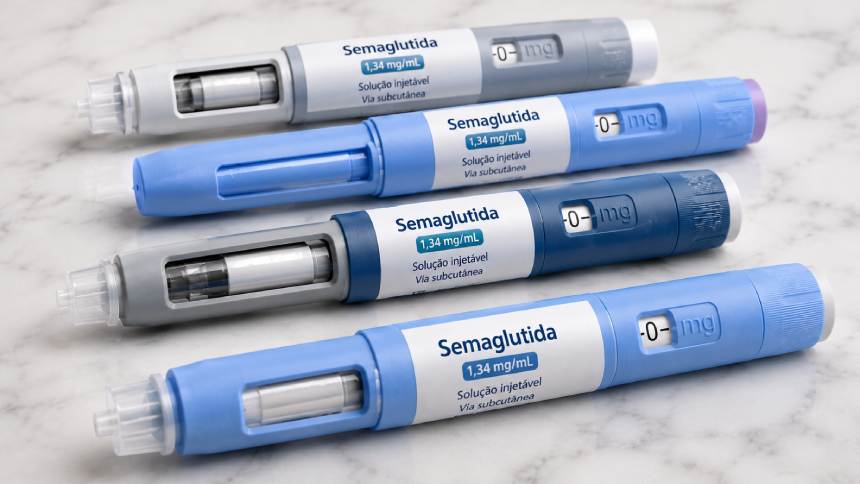
Brazil's National Health Surveillance Agency (Anvisa) approved, this Wednesday, July 29th, the registration of five more slimming pens based on semaglutide. The authorization was published in the Official Gazette of the Union (DOU).
The following brands were approved: Owozy, from Ávita Care; Zempneo, from Brainfarma (a Hypera Pharma company); Semavy, from Cosmed (also part of Hypera); Seemasun, from the Indian company Sun Pharma; and Orsema, from Ranbaxy.
The block release comes two months after the approval of Ozivy, from the pharmaceutical company EMS, the first semaglutide produced in Brazil after the expiration of the patent for Ozempic and Wegovy, from the Danish company Novo Nordisk, in March of this year.
The difference with the new registrations is that none of them will actually be produced in Brazil. And not all of them by the companies that obtained the registrations from the agency.
NeoFeed has learned that, of the five slimming pens, one of them, the Zempneo, will not be manufactured at this initial stage, in a strategic decision by Hypera to first understand market demand.
The company will launch Semavy, which will reach pharmacies under the Mantecorp brand, considered one of Hypera's strongest brands in prescription drugs. However, production will take place in India, by Sun Pharma.
“This medication will expand the national supply of semaglutide, helping to make this type of treatment increasingly accessible and available to the Brazilian population,” says Breno Oliveira, CEO of Hypera Pharma, in a statement to NeoFeed . The expectation is to launch the pen within two months.
In addition to Hypera's product, the Indian company will also manufacture its own version of semaglutide and that of Ranbaxy, which is owned by Sun Pharma. However, since Ranbaxy also operates in Brazil, it will be responsible for the distribution and marketing of its pens.
NeoFeed had previously revealed that Ávita Care's slimming pen was close to being approved and would be marketed by the pharmaceutical company Sandoz.
According to sources interviewed for this report, Ávita's registration took a little longer than expected, and it didn't come through sooner because Anvisa (Brazilian Health Regulatory Agency) rejected the production line that was to be assembled in a factory in Canada. As a result, the company obtained registration for good manufacturing practices for its production facility in China, from where the pen approved in Brazil will originate.
On Wednesday, Sandoz, led in Brazil by Isabella Wanderley, former CEO of Novo Nordisk, confirmed the information. The product is expected to reach pharmacies sometime in the second half of this year, although a specific date has not yet been set.
According to Anvisa, of the 24 requests for these medications that were in Anvisa's queue, 11 have already had their analyses completed, resulting in six approvals. Therefore, 13 are still pending.
The evaluation process includes conducting clinical studies, reviewing documents, and inspecting the production line.
The arrival of new competitors will intensify a market that continues to expand rapidly and already represents one of the main avenues for growth in the pharmaceutical retail sector.
A survey by Close-Up International Brazil shows that, in the 12-month period from May 2025 to May 2026, the market for slimming pens reached R$ 13.3 billion, including all products.
The leader is Mounjaro (tirzepatide), produced by the American company Eli Lilly, which grossed R$ 8.5 billion during the period. Wegovy comes in second, with R$ 3.7 billion, followed by Ozempic, with R$ 1.1 billion.
Itaú BBA, on the other hand, sees an annual market of R$ 14.6 billion in Brazil in the annualized scenario up to April, with growth of 110% on the same basis. The outlook is that, by 2026, this market will reach R$ 19 billion.
Another consequence of the arrival of more players in the slimming pen market was the reduction in prices from all pharmaceutical companies that have products on the market, including Mounjaro, which lowered prices in pharmacies by 35%.
As NeoFeed exclusively revealed in early July, the EMS group has already registered for the production of the "clone drug" of the Ozivy pen , which has become considered a reference drug by Anvisa (Brazilian Health Regulatory Agency). The registration was requested in the name of Brace Pharma.
The new pen from the Sanchez family's pharmaceutical company will be called Semaclick and is also expected to hit the market by the end of the year.
The company is expected to produce 700,000 units of the new pen in 12 months. In the case of Ozivy, the forecast is 1.2 million in one year. In the first 15 days, EMS's semaglutide generated R$ 100 million in revenue with 230,000 units sold.