

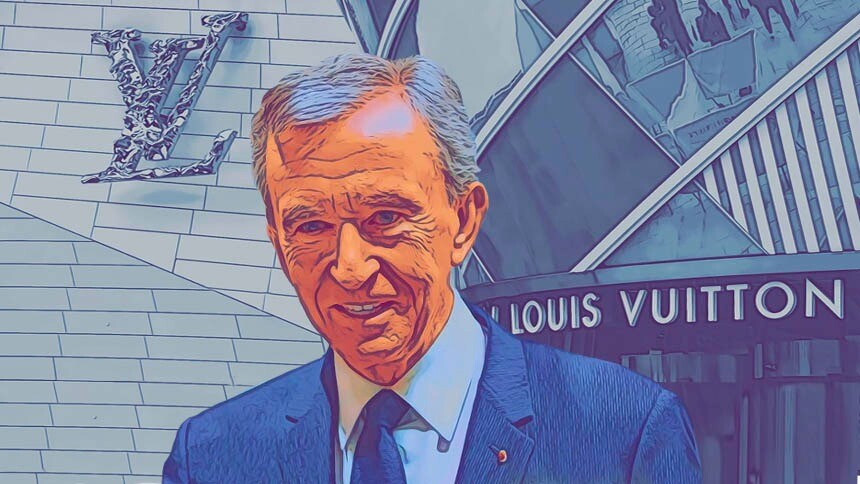
Family feud in the luxury market. Billionaire Bernard Arnault, founder and chairman of the French giant LVMH, owner of brands such as Louis Vuitton, Dior and Tiffany & Co., who has always maintained a discreet style throughout his career, has publicly responded to accusations about a family dispute over his succession, published by the French newspaper Le Monde .
The most interesting detail of this story: Le Monde's majority shareholder is Xavier Niel, who is none other than his son-in-law. He is married to Delphine Arnault and has two children with Arnault's eldest daughter. Also a billionaire, Niel is also a shareholder in the telecommunications giant Vodafone.
In an ironic tone, Arnault wrote, on his account on the X platform, his version of a series of reports published by the French newspaper. He begins by saying he is the head of the "last royal family of France" ( read the full letter at the end of the report ). And he ends by denying any family rift due to his control of the conglomerate.
The reports detail a possible rivalry between Arnault's five children from two marriages, as well as friction between his second wife, Hélène Mercier, and Xavier Niel.
The curious thing is that the businessman's sharp and ironic response was his first foray onto the social network. In the public message, he responded to questions about his political connections and his ownership of media outlets.
“Apparently, among the Arnaults, we don’t discuss, we plan; we don’t deliberate, we compete,” she wrote on the platform. “He doesn’t deny anything. That’s the most important thing for us,” says Raphaëlle Bacqué, one of the Le Monde journalists who wrote the reports, in an interview with the American newspaper The Wall Street Journal .
Arnault has always been seen as a controversial figure in France. His admirers consider him responsible for transforming brands like Louis Vuitton and Dior into global powerhouses and for helping to consolidate France as the dominant force in the luxury industry.
But, in the view of critics, the businessman is a symbol of inequality. His face appeared on posters during protests against President Emmanuel Macron's pension reform.
In April of this year, during LVMH's general assembly, Arnault, who is 77 years old, responded to a shareholder who had brought up the topic of his re-election to the group's leadership with 99% of the vote. He suggested that the shareholder revisit the issue "in seven or eight years."
The billionaire has not yet publicly named his successor, but all of his heirs work for the group, and four of them are currently on the board of directors. Two of them, Antoine and Delphine, are on the LVMH executive committee.
Arnault currently holds the ninth position among the world's richest people on Forbes' list, and leads in France, with an estimated net worth of US$142.7 billion. His son-in-law is in 183rd position, with a net worth of US$15.8 billion.
In the letter, Arnault stated that the luxury sector is one of the rare sectors that thinks in terms of generations, not quarters, not to mention the challenging macroeconomic context for his company.
The second-quarter results, released by the company on Monday, July 27, reported revenue of €19.5 billion, a 3% increase. For the first half of the year, revenue reached €38.6 billion.
For many years, LVMH was the most valuable company in Europe. But it lost this position in September 2023 to the Danish company Novo Nordisk, owner of the Ozempic and Wegovy slimming pens.
By 2026, the luxury company's shares on the Paris Stock Exchange have fallen by 27.3%. Over 12 months, the devaluation is 4.6%. LVMH's market capitalization is €226.8 billion. Today, the most valuable company in Europe is ASML, which operates in the semiconductor market and is worth €600 billion.
See Bernard Arnault's letter, published in X, in response to Le Monde :
Thanks
Apparently, I am the head of the "last royal family of France".
I learned about it while reading Le Monde, between two cups of tea. My children, notified via WhatsApp, asked if this meant they would now have to bow to me. I replied that a simple “hello, Monsieur” would suffice, as usual. They burst out laughing. That was, I believe, the best moment of the week.
Le Monde then decided to use heavy artillery: six months of investigation, two full-time journalists, six double-page spreads, a series that ended on Friday. This deserves a word, and that word will be... thank you.
I hadn't received such treatment since the acquisition of Boussac in 1984. Back then, they called me "The Terminator." I prefer "the last royal family": more elegant and better for Dior's sales.
I am aware that, in responding, I am giving this series the spotlight it perhaps desired: a final episode, written by me. So be it.
Let this serve at least one purpose: to save the energy of all those elsewhere who go hunting for some family scandal to sell newspapers. They'll have to wait a long time.
Let's continue.
First, I learned that my colleagues were impeccably dressed and that none of them were overweight. I apologize to readers for this lack of body diversity and will address the issue on Monday with the company restaurant. I also learned that visitors' Hermès ties are confiscated. This is false: we leave them with them. We simply offer a second, more discreet tie for the elevator. It's a matter of etiquette. I add, confidentially, that I myself own several.
Then, it seems, I whispered in the ears of all the presidents. I confess my guilt: Mitterrand, Chirac, Sarkozy, Hollande, Macron. I should have stayed on Avenue Montaigne talking only to my dog. To top it off, besides five American presidents, I also whispered to three British prime ministers, two German chancellors, and an Emperor of Japan. Not a single line about these whispers. Are we to assume that only French whispers are scandalous? For a group that generates 75% of its revenue outside Europe, the editorial hierarchy escapes me.
Next comes the "business priority strategy." That a group that exports most of its products manufactured in France includes trade in its strategy would therefore be a major revelation. I await the next examples: L'Oréal sells beauty products, Danone is interested in food, Renault manufactures cars, etc. We'll get to Christmas.
But be warned: LVMH selling its products is acceptable, but not everywhere! Among all the major exporters to China, only one, it seems, deserves to be held accountable regarding the nature of the regime—the one that brings French luxury there. Airbus, for example, with its 2,200 aircraft delivered to Chinese airlines—as well as many other French exporting groups in China—apparently did not arouse the same scrutiny. Continued...
Further on, it says that I put pressure on the media. I read that passage with particular attention. It appears in a daily newspaper whose sole individual shareholder, in private life, is my “son-in-law.” One day, someone will have to explain to me, calmly and without irony, the exact geometry of French editorial independence. I find it fascinating. I would gladly pay for that training.
Then, my favorite: “lover of the arts and tax breaks.” I contributed 200 million euros to the reconstruction of Notre-Dame. I am funding a 50 million euro mathematics research institute at the Polytechnique. I gave Paris and France the Louis Vuitton Foundation and its 1.5 million annual visitors. In fact, I funded the Louis Vuitton Foundation within the framework approved in 2003 by the French Parliament, at the proposal of the Minister of Culture. In other words: the law of the Republic invites companies or individuals to make donations for the general interest; I donated, and that seems suspicious. If the mechanism is so reprehensible, it remains to convince the legislator to repeal it. In the meantime, I take responsibility. Nobody forced me.
Finally, the decisive argument: family. One cannot write about a man for six months without ending up inviting oneself, in thought, to sit at his table. There I found my five children, my wife, my nephews. I would have liked to have seen a nuance: that which allows five strong personalities to work in the same house without everything turning into an Italian opera. With the Arnaults, it seems, there is no arguing, only plotting; no celebrating, only rivalry. It's something worthy of a novel. In the real world, my children run Maisons, form teams, make decisions and—a sacrilege—call each other on Sundays. What, in a typical family, is called Sunday, here is seen as intrigue. It's a matter of vocabulary. We prefer Sundays.
One more serious word, if you'll allow me.
Luxury is one of the rare sectors that thinks in terms of generations, not quarters. A cognac rests for between 10 and 50 years before being marketed. A vineyard is passed down over eighty years. The know-how of a saddler or a glassmaker takes twenty years to consolidate and three to lose. This cannot be managed like a digital platform: it needs to be preserved, prepared, and transmitted. It's a long-term perspective... a craft and a responsibility—all the more serious because it doesn't belong to me. It belongs to the know-how of the group's 220,000 employees, the 40,000 who work in France, the families who depend on it, and the Maisons of which we are merely the guardians.
Regarding all of this—hundreds of production workshops across the country, thousands of apprentices trained annually in artisanal trades—the series didn't deem it necessary to write a single sentence. It preferred to invent wardrobes and dissect a family dinner. It's an editorial choice. I respect it. In a free country, one might prefer gossip to workshops. It's more intriguing; I readily admit.
One last sincere observation for Ms. Bacqué and Ms. Schneider. Their previous series ended by addressing the Wertheimers, owners of Chanel: "discreet," "patrons," "following the fourth generation, away from the spotlight." This one, about the Arnaults: "court," "terror," "rivalries." The difference between these two families? The Wertheimers didn't receive them. We did.
For six months, several executives dedicated time, at their request, to meet with them, present their work, and explain what it takes to manage a global group. My family did the same: my five children, my wife—with dedication and attention—and myself. All present, all available, all united.
I suspect, very clearly, that you have punished transparency. Let this serve as a lesson for your future policies.
One question, to conclude, with a smile. In 1984, when I took over Boussac, would your newspaper have wagered even a symbolic franc on the fact that, forty years later, France would be home to the world leader in luxury, proudly displaying the flag of French excellence in nearly 100 countries and having contributed more than 40 billion euros to public coffers?
Don't be in a hurry to reply. I invite you for an aperitif at the Foundation. The wines will be French. You might even meet some characters from your series there. You'll see they're more presentable people than you imagine. As for me, rest assured: I'll continue doing the Le Monde crossword puzzles, which are excellent.
Bernard Arnault