


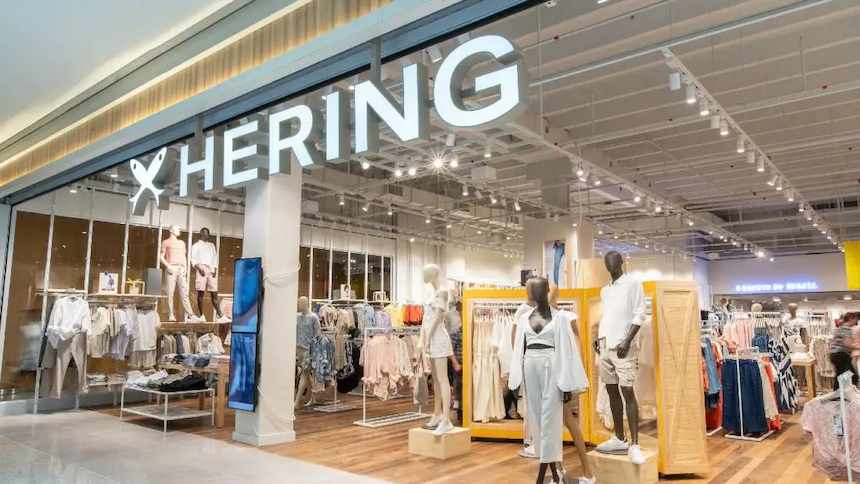
The result of the merger between Arezzo&Co and Grupo Soma , announced exactly two years ago and approved in June 2024, Azzas 2154 is well advanced in another stage of the intricate integration process of the two fashion retail operations.
The group is unifying the management and back-office operations of the Shoes & Bags vertical, which is part of the Arezzo&Co legacy and brings together brands such as Arezzo, Schutz, Anacapri, Alexandre Birman and Vans, with the Basic division, responsible for Hering , a legacy of the Soma Group.
In a material fact disclosed on the evening of Wednesday, February 4th, Azzas 2154 informed that the new unit will be headed by David Python, who was previously in charge of the Basic division. Rafael Sachete, who was previously the group's CFO and led the Shoes & Bags operation, is leaving the company.
“Simplifying management was something everyone was demanding, and it was only a matter of time,” says Alexandre Birman , CEO of Azzas 2154, to NeoFeed . “We went from four business units in August 2025 to two divisions now. And, in the future, we will become a single company. That is the goal.”
Last August, the initial step in this direction involved unifying the women's and men's fashion & lifestyle divisions . The former originated from Grupo Soma, while the latter comprised brands from Arezzo&Co.
Subsequently, Azzas announced two other developments directly related to today's announcement. In September 2025, Thiago Hering left his position as CEO of the Basic division and his day-to-day operations within the group. A month later, David Python was announced as his replacement.
A familiar face at Arezzo&Co – he had left the retailer in 2016 to co-found the sneaker brand Cariuma – Python returned to his former company with a mandate to restructure Hering's operations. And this experience is one of the executive's strengths in leading the new unit.
“The merging of these two divisions wasn’t a circumstantial idea or something that came about suddenly,” says Python. “This project had been under discussion and analysis for some time, weighing the potential synergies and benefits of them being led jointly. So, nothing will be done haphazardly.”
In line with this discourse, Birman observes: "Everything was very well planned," he says. "Unlike other changes we made, which, I confess, had a more immediate character and for which we couldn't provide a roadmap because, in reality, one didn't exist."
Until the second half of March, the first step in putting this plan into action will involve Sachete. Once this period is over, he will leave the group to take up a position in finance and investor relations at another listed company – whose name has not been revealed and which does not compete with Azzas.
“I am very happy to participate in this management transition to David, whom I greatly admire,” says Sachete. “My belief is that this move will be very beneficial and bring significant value to the group.”
As part of this transition agenda, one of the first initiatives will be the integration of the human resources, finance, and technology areas of the two verticals. The next phase, between April and June, will invest in a hybrid management model, encompassing the remaining areas of the divisions.
In this equation, Birman will temporarily assume leadership of the Brand, Style, Marketing, and Channels areas of Shoes & Bags. Python, on the other hand, will focus on the turnaround of the Hering brand, in addition to managing the multi-brand area of Shoes & Bags.
"Despite the distinction in categories, these two operations share a very strong historical similarity because they are both more industrial and have a distribution more focused on B2B," says Birman.
During this period, the plan is to design the governance and long-term strategy of the new division. The expectation is to conclude this phase by the end of 2026, when these two initiatives will begin to be implemented in earnest.
One of the priority areas in developing this new strategy is the reformulation of the franchise model, a channel that, through the combination of these forces, will bring together 1,312 units, 743 of which are Shoes & Bags and 569 are Hering. Birman cites one example in this direction.
“Today, there’s a certain type of franchisee, quite common, for example, at Hering,” says Birman. “These are operations with more scale, structure, and investment capacity. And, in fact, networks like O Boticário have a multichannel operation. That’s something we don’t have and that we want to implement.”
While outlining these plans, Azzas is tallying up some figures from this combined operation. With projected revenues of around R$ 8 billion in 2026, the division launches with over 1,400 stores, a presence in 15,000 multi-brand points of sale, and an e-commerce platform generating approximately R$ 1.5 billion in revenue.
In the most recent figures, still separated, the two units weighed on the group's balance sheet for the third quarter of 2025. During the period, gross revenue from Shoes & Bags fell 5.6%, to R$ 1.11 billion. Revenue from Basic fell 4.2%, to R$ 638.8 million.
In a recent report previewing the fourth-quarter results and the consolidated results for 2025, which will be released by Azzas 2154 on March 11 of this year, XP projected that this scenario will continue.
“We expect Azzas to deliver weak fourth-quarter results, as anticipated, with slowing revenue due to ongoing challenges in the Basic and Shoes & Bags business units, as well as tough comparisons in the Men Lifestyle segment,” highlighted XP, which has a buy recommendation and a target price of R$ 40 for the stock.
Shares of Azzas 2154 closed Wednesday's trading session down 3.63%, quoted at R$ 25.45. In twelve months, the shares have accumulated a devaluation of more than 24%, giving the group a market value of R$ 5.1 billion.