

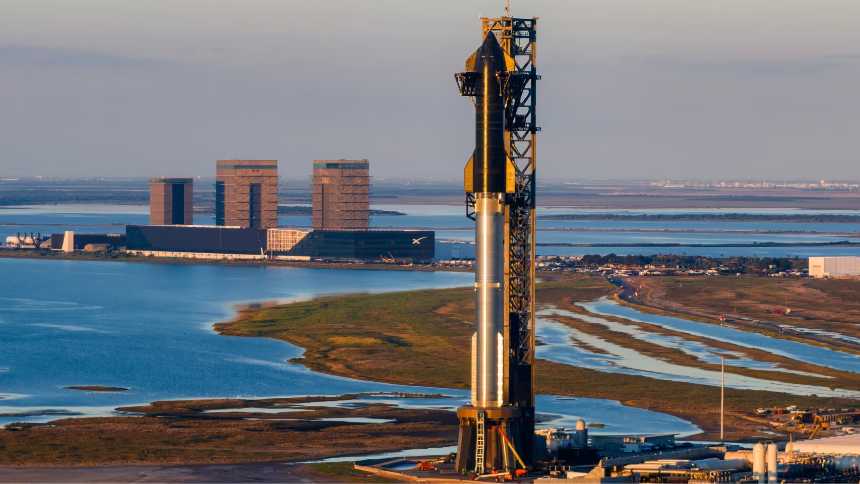
Starbase, a corporate city created by SpaceX on the Texas coast, has become in just a few years one of the most visible symbols of the accelerated transformation of the southern United States with the grandiose projects of Elon Musk – the richest man in the world, who intends to send the aerospace company's rockets to colonize Mars.
Since 2021, when Musk posted a call on then-Twitter encouraging his supporters to move to Starbase, the location has accelerated its transformation from a corporate city into a different kind of enterprise, one that promised a revolution in artificial intelligence and interplanetary travel.
Officially founded last year, and already home to around 500 residents, almost all of whom are SpaceX employees, Starbase has quickly established itself as a technological hub and a destination for young people interested in aerospace engineering, with its population projected to exceed 1,000 by December.
The expansion coincides with the strengthening of the industrial and militarized agenda of the Trump era, which transformed the town – located 1.5 kilometers from the border with Mexico – into a stage for major energy and infrastructure projects.
At first glance, Starbase resembles other small towns in Texas. It has a school, a medical center, a recreation center, and even a sushi restaurant. The difference is that, in this town, almost all the common spaces are privately owned.
SpaceX owns nearly all the real estate within the city limits and is building hundreds of townhouses and apartments – all for rent, available only to employees of the aerospace company. Employees of third-party companies are not welcome and must seek housing outside the city limits.
Owner of a fortune of US$1.1 trillion, Musk began to envision his "Muskland" in 2011, when he was looking for a seaside location for a new SpaceX launch facility, created in 2002. Boca Chica, a beach on the Gulf of Mexico 40 km from Brownsville - a city of 200,000 inhabitants with a Hispanic majority - met the requirements.
In the following years, Musk bought the properties of longtime residents and hundreds of acres of undeveloped land on the outskirts of Boca Chica, which underwent a multimillion-dollar revitalization. Its dilapidated streets were landscaped, the decaying farmhouses were remodeled in an elegant SpaceX black and white, and electric vehicle charging stations were installed for the Tesla Cybertrucks that now roam the streets of Starbase.
At the same time, Musk contributed millions of dollars to political action committees (PACs) that support conservative candidates for the Texas Legislature and Judiciary. He sent a dozen lobbyists to the state Capitol and cultivated a close relationship with Texas Governor Greg Abbott.
A new Texas law makes interfering with Starbase operations punishable by imprisonment. Another allows the company to close the beach and highway leading to the city at the mayor's discretion. A third protects SpaceX, and by extension Starbase, from lawsuits filed by neighboring residents due to nuisances caused by its rockets.
The laws are so protective of Starbase that critics fear they could be used to criminalize any protests in the vicinity.
Private government
Musk – who serves as chairman, CEO, chief engineer, and chief technology officer of SpaceX – holds no elected office at Starbase. Nor does he need to. His "Muskland" is run by a municipal commission headed by a mayor elected for a one-year term, ending in May 2025.
In their monthly meetings, the mayor and two elected commissioners, who act as city councilors – all SpaceX employees – discuss common municipal matters, such as voting to approve laws and initiating the hiring process for a police chief.
The city is experiencing a frenetic pace of construction. Trucks and Cybertrucks circulate along the widened four-lane highway between Brownsville and Starbase, while workers erect the Gigabay, the future rocket assembly line. The 120-meter launch towers reinforce the feeling that the Texas frontier has become a laboratory for interplanetary ambitions.
Other companies are eyeing the region's growth. Near Starbase, a tangle of about 20 cranes can be seen on the horizon, constructing NextDecade's Rio Grande LNG project.
The plant will produce 30 million tons of liquefied natural gas (LNG) per year, contributing to fulfilling yet another mission of the Trump era: exporting the "molecules of freedom" of energy. Weapons manufacturers and other technology companies are eyeing the region.
Saronic Technologies, a defense contractor based in Austin, expects to build a $3.2 billion shipyard. Developers have proposed several data center projects.
The American press cites similarities between Starbase and the autocratic corporate cities of the 19th and early 20th centuries. Like Musk, the industrial magnates of that era built their own private fiefdoms, not only to consolidate control over workers, but also to realize their vision of an ideal society.
Perhaps the grandest company town of all was Fordlândia, the sprawling city that Henry Ford built in the Brazilian Amazon rainforest for rubber tree cultivation. Fordlândia was Ford's personal utopia, an expression of his social views, his personal preferences, and even his vegetarianism.
Inaugurated in 1928, Fordlândia ended up as one of the biggest business failures in the history of the United States in Latin America. The project was officially abandoned in 1934, after years of conflict, disease, labor unrest, and disastrous economic results, with losses estimated at US$500 million in today's values. Ford sold the area to the Brazilian government in 1945 for a minimal fraction of what it had invested.
Today, the darkest realities of Starbase are whispered. Accident rates at the site far exceed the space industry average, according to a 2024 Reuters report. Twelve-hour workdays are common there.
A real estate agent quoted by The New York Times said that one of the main motivations for SpaceX employees to move to Starbase was to spend their little free time with their families, instead of commuting to work. But one of his clients had to be hospitalized for consuming excessive amounts of energy drinks, which prevented him from staying alert after 38 consecutive days of work.
Musk not only intends to consolidate Starbase but also create other spaceport cities, thanks to the enormous capital injection from SpaceX's recent IPO. On May 12, he announced on social media that "SpaceX is considering several locations, both domestic and international, to build the most advanced spaceports in the world!"
His announcement came shortly after reports that a large area of land on the Louisiana coast may have been acquired by an unnamed aerospace company, widely speculated to be SpaceX. Immediately, Louisiana lawmakers had just approved a similar package of incentives and tax breaks for the aerospace sector in an attempt to win Musk over.
Between enthusiasm and unease, Starbase has become a new Fordlândia — now powered by rockets, trillions of dollars, and interplanetary ambitions — and a laboratory for how economic power, political influence, and technological colonization can redefine the future of the southern Texas frontier in the 21st century.