

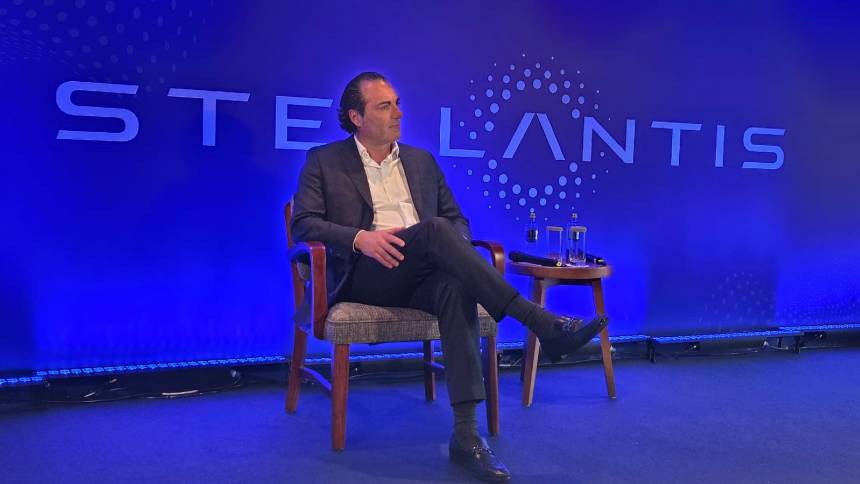

Italian executive Antonio Filosa took over the global leadership of Stellantis just over a year ago with the mission of reversing the losses and cash burn of one of the world's largest automakers. After ending 2025 in the red, the company began to show signs of recovery. In the first quarter of 2026, net revenue grew 6% to €38 billion.
Despite his Italian origins, Filosa built a significant part of his career in Brazil. He spent 15 years in the country, during which time he participated in, among other projects, the establishment of the Jeep factory in Pernambuco. Now living in Detroit, he returned to Betim, in Minas Gerais, to celebrate Fiat's 50th anniversary and discuss Stellantis' next steps.
In an exclusive interview with NeoFeed , Filosa stated that the automaker intends to respond to the advance of Chinese manufacturers with local production and partnerships with groups from the Asian country, such as Leapmotor and Dongfeng .
He also issued a warning to the Brazilian government: the expansion of imported cars and models assembled with Chinese kits is transferring demand to China that could benefit domestic steel mills and suppliers.
Check out the main excerpts from the interview:
When you took over at Stellantis, the company was facing one of the most delicate moments in its history. What was the main challenge of that first year?
I took over as CEO of a company that was burning through cash and losing money. Unfortunately, 2025 ended with negative numbers, both in cash flow and operating income. The first challenge was to reverse this situation.
The reasons were multiple, but I believe we managed to identify them. In our business plan until 2030, we have the necessary actions to reverse this trend. This started to appear in the numbers from the first quarter of this year: we returned to profitability, we returned to growth, and we improved significantly, up to 37% in cash generation. So, we are on the right track. The road ahead will still be long. We will hit some speed bumps, but we will continue.
Combined, Chinese automakers are now approaching Fiat's market share in Brazil. Are the partnerships with Leapmotor and Dongfeng a strategy to counter this competition?
First, Fiat is the market leader in Brazil and South America. It's true that, together, Chinese automakers are growing significantly, but that's a comparison between a single brand and several companies.
We know the Brazilian consumer and we have the ability to be close to them. This is the expertise we want to offer our partners. We already have a well-established partnership with Leapmotor outside of South America and we are now beginning to develop it in the region as well.
Our strategy is not to import. We want to produce here, develop local suppliers, talk to the customer daily, and offer what they want. We are finalizing a modular production line for Leapmotor in Pernambuco, and we can do the same work with Dongfeng.
More than just putting brands in direct competition, our recipe is localization. We will bring technologies and products, work together, and develop suppliers in Brazil. What is produced here will be made by local workers and with components and systems from local suppliers.
"More than just putting brands in direct competition, our recipe is location."
Does this strategy only apply to electric vehicles?
No. There is a market for multiple types of engines. Electric and electrified vehicles are growing and will have a very important place, but there is still a predominant market for biofuels and traditional fuels.
Our strategy is multi-energy. Consumers want freedom of choice and a car suited to how they intend to use it. We will continue to offer vehicles powered by ethanol, gasoline, hybrids, and electric vehicles.
With countries becoming increasingly protectionist, such as the United States implementing its new tariff policy, what, in your view, should be the role of the Brazilian government in strengthening the national automotive industry?
The key point is to establish priorities. The automotive industry generates hundreds of thousands of direct jobs and four, five, or six times more indirect jobs, considering the entire supply chain. The question is: what is the country's priority?
The United States has decided to prioritize automotive manufacturing and its suppliers. To this end, it is defining its own regulatory system and trade policy. Europe is also discussing which rules to apply to the sector to encourage and favor local production.
Brazil is a huge market with great present and future potential, and it also needs to establish its priorities. This is an important moment to discuss this with Brazilian politics.
"Brazil is a huge market, with great present and future potential, and it also needs to establish its priorities."
Could this mean higher tariffs for companies that only import components or assemble vehicles in Brazil, without developing a local supply chain?
That's a political decision. I work with numbers. In June 2026, the Brazilian automotive industry sold approximately 260,000 cars, compared to approximately 225,000 in June 2025. The market grew, which, in theory, should mean more business for automakers and local suppliers and, consequently, more jobs.
But when we look at the numbers, we see that the market share of Chinese brands has increased from less than 10% to around 20%. And each car contains between approximately 900 kilograms and one ton of steel. So, what is the impact of this advance on the Brazilian steel industry?
Considering imported cars and kits brought from China, the volume of steel that entered Brazil through these vehicles increased from approximately 20,000 tons in June 2025 to 50,000 tons in June 2026. It more than doubled.
This means that, even with the growth of the Brazilian automotive industry, companies like Gerdau and Usiminas may not be capturing this increased demand. The producers based in China have gained the most ground.
These numbers should be put into a spreadsheet and considered in the decision-making process. If the priority is to continue developing Brazilian steel companies, as well as local suppliers of plastics, electrical and electronic components, there is a path. If the priority is something else, the path will be different. It is up to the politicians to decide.
Stellantis announced R$32 billion in investments in South America, of which R$30 billion will be allocated to Brazil. Where will this money be invested?
In products, technologies, supplier development, dealerships, and partnerships. Fundamentally, in product and technology. We localize production; we don't simply import.
We have very strong brands and a team capable of understanding what the consumer wants and offering the technology and product they will want to buy in the coming months.
What is Stellantis' goal for South America by 2030?
We want to grow 10% in volume and maintain leadership in the continent, both with the brands we already have and with new partnerships. We also want to preserve leadership in Brazil and expand our presence in markets such as Chile, Peru, Ecuador, and Colombia, where our market share is still below the level we have in Brazil and Argentina.