


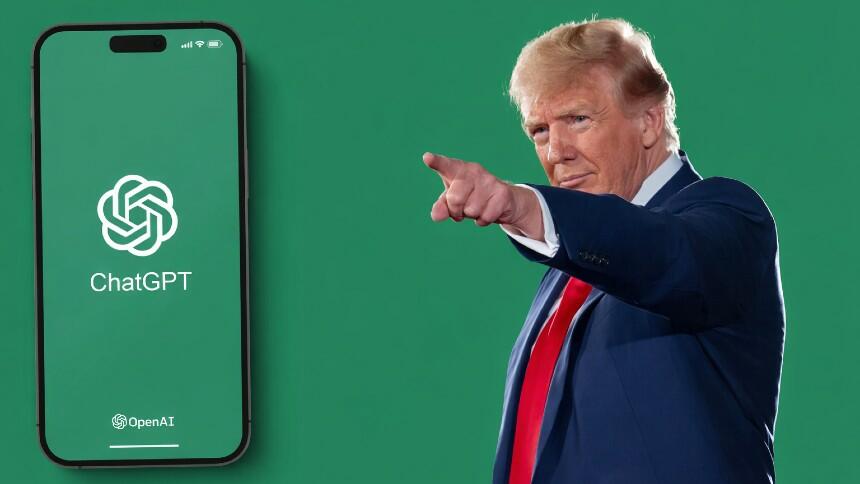
Is "ChatGPTrump" coming? OpenAI , the company behind the popular artificial intelligence tool, is conducting preliminary negotiations to sell a 5% stake to the United States government as part of a broader plan to go public.
Still in its early stages, the initiative — announced on Thursday, July 2nd, by the British newspaper Financial Times — represents a significant turning point in the trajectory of the company led by Sam Altman , which seeks to balance commercial expansion, robust governance, and regulatory alignment.
The proposal emerges amid an increasingly intense environment of pressure in the United States, where AI companies face questions about security, transparency, social impact, and economic risks.
By considering the entry of the government led by Donald Trump as a minority shareholder, OpenAI signals a willingness to adopt a hybrid governance model, capable of reconciling public and private interests in a sector considered strategic for national competitiveness.
In recent years, OpenAI has substantially expanded its investment base. The company has already raised over US$1 billion in recent rounds, involving venture capital funds, large technology corporations, and strategic partners.
The estimated annual budget is around US$8 billion, according to CNBC data. In 2025, the company generated US$13.1 billion in revenue, but burned through US$8 billion in the same period—an indicator of the size of its operation and the intensity of costs for research, chips, data centers, and the development of advanced models.
Internal projections indicate that this spending could exceed US$17 billion as early as next year, following the global surge in demand for generative AI. Revenue diversification—which includes technology licensing, corporate partnerships, and cloud services—has been essential to sustaining the accelerated pace of innovation.
Therefore, the potential partnership could be of interest to both sides. The initial public offering, if realized, could attract new institutional investors, increase liquidity, and strengthen the company's position in a sector growing at rates exceeding 20% annually.
Market estimates indicate that OpenAI's IPO could raise between US$50 billion and US$100 billion, should the company maintain its desired valuation of US$1 trillion.
Strategic effects
According to sources cited by the Financial Times and Barron's , the presence of the Trump administration among OpenAI's investors would have immediate and strategic effects on the company.
The first of these would be the political and financial endorsement of the technology developed by Sam Altman. Government involvement would serve as public validation of OpenAI's billion-dollar valuation, currently estimated at US$852 billion and potentially exceeding US$1 trillion at the time of its IPO.
Trump has a history of actively supporting companies in which the government holds a stake, as was the case with Intel, which he frequently cited in speeches about industrial competitiveness. This type of support often influences market perception and could strengthen the confidence of institutional investors when OpenAI shares begin trading.
The second benefit would be the reduction of regulatory hurdles at a time when the US government is tightening control over the release of AI models. Anthropic , for example, had its Fable model suspended for more than two weeks after security concerns were raised by federal agencies.
OpenAI itself has also been affected: its most recent models, grouped under the name GPT 5.6, are initially available only to a restricted group of clients approved by the Trump administration. The government's presence as a minority shareholder could smooth this process, accelerate approvals, and reduce the risk of unexpected disruptions, ensuring predictability for future releases.
The third effect would be pressure on other leading AI companies to accept government investments, creating a new governance standard in the sector. This would include not only Anthropic, the developer of Claude, but also giants like Google, Meta, and Microsoft.
The measure would also have a geopolitical impact: by strengthening the link between the government and OpenAI, it would reduce the risk of large cloud companies opting to host cheaper Chinese AI, which could weaken the market for American models.
The dispute with China's DeepSeek, accused by OpenAI and Anthropic of copying advanced models, intensifies concerns about external dependence and the need to protect US technological leadership.
The potential involvement of the Trump administration in OpenAI adds to a series of recent moves by the White House to expand its presence in the private sector.
In addition to Intel , the government announced strategic stakes in companies such as Palantir , which provides data analytics systems to federal agencies, and Moderna, which has become central to biotechnology and health security policy.
In both cases, the administration justified the investments as essential to maintaining US leadership in areas considered critical to national security. There are also ongoing negotiations to expand the state's presence in semiconductor companies, cybersecurity, and cloud computing infrastructure, reinforcing a more interventionist industrial policy.
The American president has publicly argued that the US needs to secure control and influence over emerging technologies, especially in areas where competition with China and the European Union is intensifying. In this context, the negotiation with OpenAI reflects not only a corporate decision but also a geopolitical gesture that reinforces the centrality of artificial intelligence in state policies.
On the other hand, the relationship between Sam Altman and Donald Trump, although not formalized as a political partnership, has gained relevance. Altman seeks dialogue with different government actors to ensure that AI advances responsibly and with regulatory predictability, while Trump sees the technology as one of the pillars of American competitiveness.
The convergence between the two, therefore, occurs at a time when the AI sector is simultaneously becoming an economic engine, a strategic tool, and a field of international competition.