

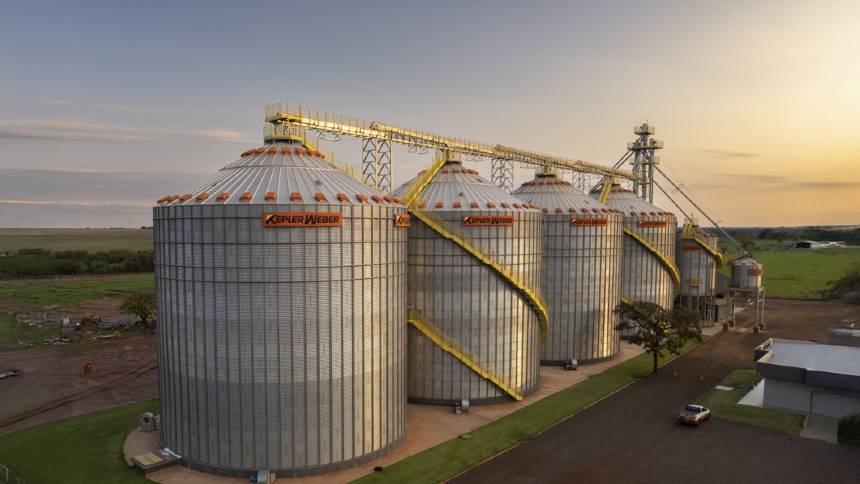

The deteriorating competitive environment, with the worst margins in the last 20 years for corn and soybean producers, led Citi analysts to downgrade their recommendation for shares of the Rio Grande do Sul-based manufacturer of silos and agricultural machinery, Kepler Weber.
The bank downgraded its rating from neutral to sell and reduced its 12-month target price for the shares to R$ 5.60, compared to a previous forecast of R$ 9. On May 29th, the shares closed at R$ 7.04.
According to analysts, Brazilian farmers are currently operating with margins close to the break-even point, which, at this time, eliminates the economic justification for investing in storage infrastructure.
"Kepler Weber's margins have historically shown a strong correlation with producer profitability, reinforcing our view that the deterioration of the agricultural economy should translate into pressure on the company's results," says the report signed by analysts André Mazini, Piero Trotta, and Kiepher Kennedy.
Citi's decision aligns with the perception of the entire financial market regarding the agricultural sector, especially the two crops, and the impact on companies in the sector. Around 12:30 PM this Monday, June 1st, Kepler Weber's shares on the B3 were down 7.7%, trading at R$ 6.50.
The expectation, in this scenario, is that this situation affected by interest rates will persist. "The cost of capital in Brazil remains among the highest in the world in real terms, and fiscal uncertainty makes any significant normalization in the short term unlikely, raising the minimum rate of return required for long-term rural investments," states the bank's document.
"Our new target price is R$ 5.60 per share (up from R$ 9 previously), and we estimate that KEPL3 is trading at 13.9 times projected earnings for 2026," the analysis concludes.
The worsening agricultural economy, according to analysts, with extremely squeezed margins, has also been directly reflected in lower commodity prices. Soybeans and corn are 20% below 2022 levels. There has also been an impact from the increase in input costs, mainly fertilizers.
"This combination has significantly reduced the profitability of the agricultural sector and, consequently, decreased producers' willingness to make capital investments (capex)," explain the Citi analysts.
Another point observed by the bank is directly related to the more restrictive availability of capital. Despite the existence of subsidized credit lines specifically for the sector, their use has been decreasing, according to Citi, mainly due to the impact of the Selic rate, currently at 14.5% per year.
The challenging macroeconomic scenario and the drop in producer profitability are also reflected in the company's financial results for the first quarter of this year.
Between January and March, Kepler Weber reported a 10.9% drop in net revenue compared to the same period in 2025, totaling R$ 318.1 million. EBITDA fell 36.4% to R$ 33.7 million. Net profit decreased by 33%, closing the quarter at R$ 171 million.
“The gross margin for soybeans, which is the flagship of Brazilian agribusiness, was 34% between 2010 and 2015. Then it fell to 21% between 2016 and 2020. Now, margins are around 1% to 2%, at the lowest historical levels,” said CEO Bernardo Nogueira during the first quarter results conference call.
"We are truly in a period of low cash generation, with high interest rates, high default rates, and more restrictive credit. It is the most challenging moment the company has seen in the last 30 years," the executive added at the time.
In the accumulated total for 2026, KEPL3 shares have registered a depreciation of 34.2% on the B3. In 12 months, the drop is 19%. Kepler Weber is valued at R$ 1.2 billion.