

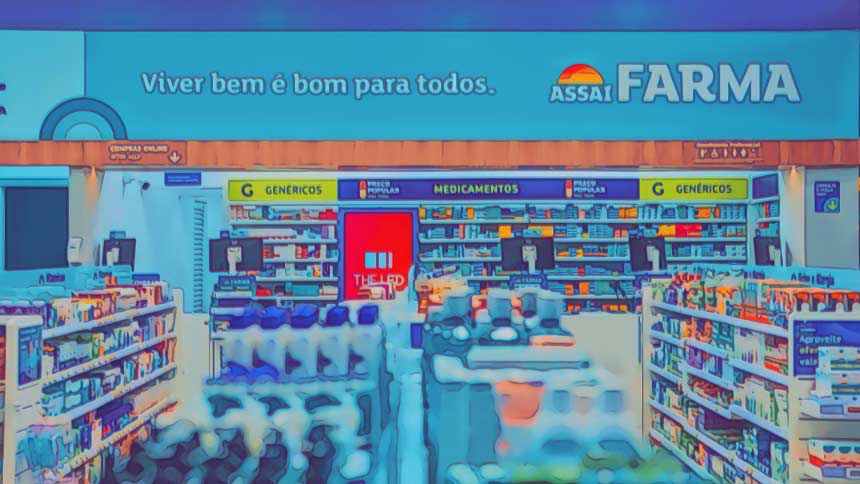

Less than four months after the approval of the law authorizing the installation of pharmacies inside supermarkets , the wholesale retailer Assaí inaugurates this Thursday, July 16th, the unit installed in the store near Marginal Tietê, in São Paulo, the first in the country.
The retailer plans to open 25 pharmacies in supermarkets by the end of this year, all in the state of São Paulo. According to the company, the potential for installing new units of the same model in its stores is 250 in Brazil, although no deadline has yet been set.
Assaí pharmacies will have around 10,000 SKUs (product units), a volume equivalent to an average street-level store of its main competitors. The first store is even opening with a stock of slimming pens .
While the company may not yet have the economies of scale to compete with pharmaceutical retail giants like RD Saúde (owner of Droga Raia and Drogasil), DPSP (Pacheco and São Paulo), Pague Menos , and Panvel , its competitive advantage, according to the company, will lie in reducing operational costs.
“A large part of the costs that they [chains] have, we won't have. Property tax and rent are fixed. Cleaning and security costs are also fixed. Approximately 40% of a pharmacy's expenses today are already covered within our operations,” says Belmiro Gomes , CEO of Assaí.
According to the executive, this explains the rationale for opening pharmacies instead of partnering with large chains to establish units in supermarkets. In any case, the plan is to be a competitive player in the sector.
“The pharmacy is part of our strategy to expand our relationship with the customer and to integrate a points program in the future, an extra benefit. We want to have this customer data. It would be difficult to do this by partnering with a large company in the sector,” he says.
With this, the group intends to compete for a share of the Brazilian pharmaceutical market, which reached R$ 243 billion last year. Half of this revenue comes from the large chains in the sector.
Another advantage that the CEO points out is related to the convenience of the purchase. The goal is to leverage the volume of 40 million customers per month who visit Assaí stores to capture sales of pharmaceutical products.
The basis for this argument lies in the fact that 80% of medications sold in Brazil are for patients with chronic conditions, according to a study by Bain & Company commissioned by Assaí. In the survey, 78% of people expressed an intention to buy medications at supermarket pharmacies.
“Our monthly flow is practically the total annual flow at Guarulhos Airport, divided across all social strata. Just as we can sell rice to a customer for the rest of their life, we can also sell medicine,” explains Gomes.
In addition to physical sales, the company is also launching an online platform for selling medications. Initially, it will operate on a "click and collect" format, with purchases made online and pickup at the store.
With 313 stores in Brazil, not all units will be able to accommodate a pharmacy inside. On average, each facility will have approximately 120 square meters (m²). And, according to the CEO, they will occupy spaces that were already unused.
“The old hypermarkets had a wide range of items, such as electronics, and we've been streamlining the product assortment because there was too much of the same product in some places. Therefore, it wasn't necessary to make major adjustments to the stores' operations,” explains Gomes.
In addition to a room for pharmaceutical services, the stores will also have a pharmacist on staff full-time, as required by law. This had been an initial concern of the Brazilian Association of Drugstores and Pharmacies (Abrafarma), which later worked on building the model approved by law.
Between July and August, Assaí will open six more pharmacies, located in Vila Maria, Tatuapé, Penha, Jaguaré, on Avenida Teotônio Vilela (in São Paulo), and in the Anchieta Pauliceia and Alvarengas units (in São Bernardo do Campo).
Through agreements established with pharmaceutical companies, the plan is to carry out this distribution directly, without the need to open a distribution center. This model differs from the food industry, which requires decentralized distribution.
“Unlike food, there are no regional brands for medicines. That's why this gain is better in the pharmaceutical sector, which doesn't need this dispersed purchasing,” says Gomes.
The company did not disclose the investment volume in each pharmacy, nor the expected revenue from this new business unit as a result of Assaí's consolidated revenue.
The law that guaranteed the installation of pharmacies in supermarkets was signed into law in March by President Luiz Inácio Lula da Silva, following lengthy discussions with industry associations.
In the first quarter of 2026, the wholesale retailer reported net revenue of R$ 18.6 billion, a 0.5% increase over the same period of the previous year. Adjusted EBITDA was R$ 1.02 billion, a 0.3% increase. The second-quarter results will be released on August 6th.
In the accumulated period of 2026, ASAI3 shares have appreciated by 20%. However, over 12 months, the scenario is a decline of 14%. Assaí's market value is R$ 11.8 billion.