

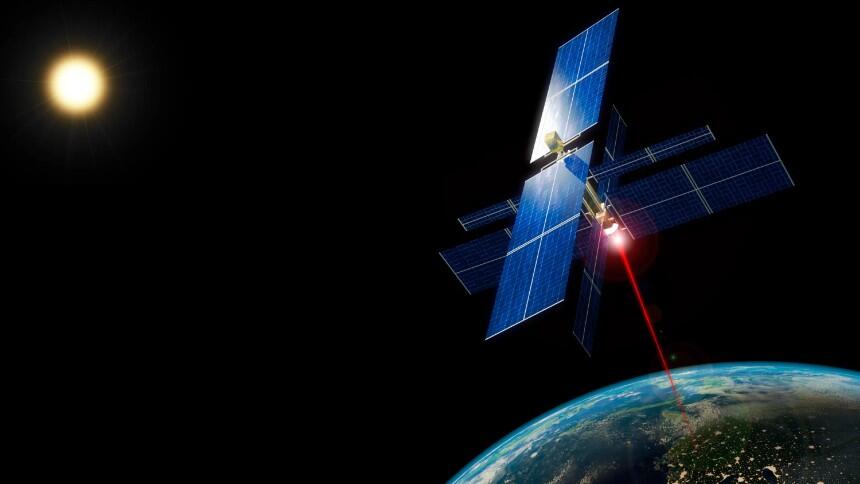

The recent decision by the U.S. Federal Communications Commission ( FCC ) to authorize the startup Reflect Orbital to test a satellite that would use a mirror to reflect sunlight back to Earth after nightfall has opened a controversial debate involving scientists from the U.S. and Europe.
The California-based startup plans to launch its test satellite, named Eärendil-1, later this year. The business model would be a kind of "iFood for the Sun"—the goal is to offer on-demand solar energy at night on Earth to power solar farms, illuminate rescue teams, and even city streets.
Once in space at an altitude of 640 kilometers, the satellite would deploy a square mirror nearly 18 meters in diameter that would reflect sunlight to illuminate a circular area about five kilometers in diameter on the Earth's surface.
If the test is successful, Reflect Orbital hopes to launch 1,000 larger satellites by the end of 2028 and another 5,000 by 2030. The largest planned mirrors will be nearly 55 meters wide, reflecting as much light as 100 full moons.
During one of the startup's presentation rounds to investors, Ben Nowack, co-founder and CEO of Reflect Orbital, stated that the company would charge approximately US$5,000 per hour for the light from a single mirror if the client signed an annual contract for at least 1,000 hours.
Lighting for specific and emergency events, which may require multiple satellites and greater coordination effort, would be more expensive. For solar power plants, he envisions the revenue from electricity generated by the additional hours of daylight being shared.
Nowack believes that Reflect Orbital's satellites can accelerate construction projects, allowing teams to work more safely at night. He also argues that farmers could grow more food per hectare.
The possibility of the startup generating solar energy after sunset – and solving the intermittency problem in the renewable energy sector, which has actually been addressed recently with the large-scale introduction of battery storage systems (BESS) – attracted Sequoia Capital , one of the most influential and traditional venture capital firms in the world.
Sequoia invested US$6.5 million in Reflect Orbital during the seed round announced in September 2024. This investment marked Sequoia's first move in the space sector since supporting SpaceX , and also included participation from Starship Ventures and prominent entrepreneurs in the technology and innovation ecosystem, such as Baiju Bhatt, Keller Rinaudo Cliffton, and Keenan Wyrobek.
Subsequently, in May 2025, Reflect Orbital raised US$20 million in a Series A funding round, led by Lux Capital , with further participation from Sequoia Capital and Starship Ventures.
Circadian rhythm
The FCC approval came despite a wave of opposition from astronomers, wildlife experts, and scientists in other fields.
The central argument is that the light from the mirrors could distract airplane pilots, impair astronomical observations, and interfere with circadian rhythms—the cycles of light and darkness that help people, animals, and plants know when to wake up and sleep, bloom, or migrate.
In a letter sent to the FCC last month, the American Astronomical Society stated that the initiative "cannot be considered to be serving the public interest" and would, in fact, waste taxpayer money, harm the work of federally funded astronomical facilities, and pose incalculable risks to people and wildlife.
“It is evident that the activities proposed by Reflect Orbital will have an impact on Earth’s environment, including human health, agriculture, and wildlife, in addition to astronomy,” wrote Roohi Dalal, the society’s director of public policy.
The European Southern Observatory (ESO) was another scientific institution to oppose the project. A study conducted by ESO and published last month in the journal Astronomy & Astrophysics assessed the extent to which constellations of large, very bright satellites could one day affect astronomical observations by brightening the night sky.
The conclusion is that, even when not pointing directly at the observer with their mirrors, the light scattered by the Reflect Orbital satellites would cause them to appear in the sky like thousands of Venuses, visible to the naked eye.
"Whether in Auvergne, France, the Sahara, or the Atacama Desert in Chile, the sky would cease to be clear and would resemble what is observed on the outskirts of a city," stated astronomer Olivier Hainaut, author of the ESO study.
In the paper , Hainaut warns about the growing number of satellites in Earth's orbit – around 14,000, including 6,000 Starlink satellites from SpaceX.
Billionaire Elon Musk's company within SpaceX offers broadband internet via low-Earth orbit (LEO) satellites, focusing on high speed, low latency, and global coverage—including areas where traditional operators don't reach. Starlink is currently the world's largest satellite system, and Musk plans to put another million satellites into orbit focused on space data centers.
The ESO study, which was conducted in collaboration with the Royal Astronomical Society of the United Kingdom and the International Astronomical Union, also served as the basis for a report submitted to the FCC.
The American federal agency, however, was unmoved by the scientists' warnings. "The Reflect Orbital demonstration satellite is an example of a potentially revolutionary technology," the commission stated in its decision to grant the license.
The approval follows other controversial decisions by Brendan Carr, chairman of the FCC, the agency that issues the necessary licenses for launching satellites. He has been a strong advocate for the space industry, supporting SpaceX and Amazon's plans to launch thousands of satellites for satellite internet connectivity.
Carr has also recently taken steps to ease regulations for telecommunications and media companies, describing the FCC as "too big and authoritarian in its rules."
The FCC's decision mirrors Carr's position – the general stance of the U.S. federal government is that activities in space are not subject to environmental regulations and assessments, which apply only to Earth.
"Even if the commission had the authority to review and condition these operations (which it does not), it is unlikely that such damage would occur," the FCC stated in the announcement authorizing the Reflect Orbital satellite test.