


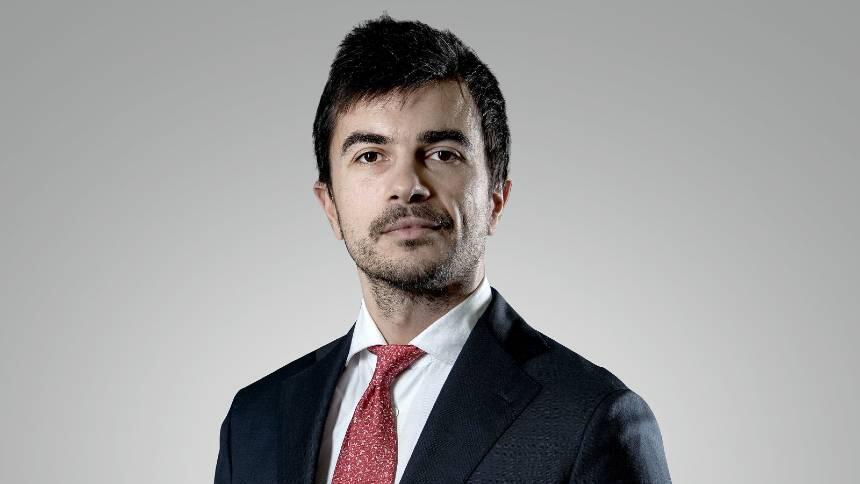
After raising $224 billion globally in 2025, according to S&P Global Market Intelligence, and becoming an industry estimated at over $2.3 trillion, private credit may be facing its first major test . This assessment comes from Alexander Pelteshki, fixed income manager at Aegon Asset Management, a global firm with $382 billion under management.
According to him, the advancement of artificial intelligence should put pressure on indebted software companies and expose risks that were being underestimated by investors .
“Until now, private credit has been sold as something with very low volatility, very high returns, and very low risk. That’s kind of a misconception, because it’s not a product that’s priced daily,” says Pelteshki, in an interview with NeoFeed .
"This means you'll have stable prices until you need to recognize a loss—and then the drop is quite significant," he adds.
Pelteshki is a fixed income manager who administers broad-mandate global strategies that can invest in both corporate credit and sovereign bonds and other fixed income instruments. In Brazil, one of these strategies is accessed through a feeder fund from Aegon in partnership with MAG Investimentos.
Based in London today, Pelteshki has been with Aegon for 12 years. Before joining the European asset manager, he was an equity analyst at ING Bank in Amsterdam and worked on the equity trading desk at UBS in New York.
According to Pelteshki, the pressure would not come from a systemic breakdown, but from losses concentrated in companies that have taken on too much debt in a sector that can be quickly reorganized by artificial intelligence.
“Of course, if a private credit portfolio has 30%, 40%, 50% or 60% in software , there’s a greater chance of having some defaults and needing to write down some of that. But many of these exposures are good. There are software companies that will benefit from AI,” he says.
For the manager, this will be the "first test of the structure" of private credit after the strong growth of the asset class in recent years. And the scenario becomes even more challenging given the shift in monetary policy projections, with investors now projecting a restart of the interest rate hike cycle in developed economies.
With no prospect of interest rates falling again, Pelteshki expects global rates to remain high for quite some time. This is not only due to the oil price shock, which he classifies as a temporary effect. According to him, the main reason is the increase in fiscal spending, which continues to put pressure on inflation.
"There will still be inflation above target in developed markets, but that will be the reason why you won't see developed markets entering a recession," says the manager at Aegon Asset Management.
Below are the main excerpts from the interview.
There's a lot of talk about a difficult scenario in the US credit market, with concerns about the software sector and the potential for AI to harm the entire industry. Is this something we should be worried about?
You don't need to worry. That's the short answer. The topic of AI will rapidly change software companies—and it's already changing the industry. This will impact how we value companies. Probably, in two years, there will be software companies that don't exist today and others that will have taken a lot of market share. So, this has profound implications for investing in technology and software . The impact can be everywhere. It can come through inflation, employment, and investment.
And what is the impact on private credit?
There will be companies that will incur losses, and that's okay. It won't be a systemic issue. This isn't something that would cause a recession in any one country or a global recession for the entire cycle. But there will be companies that have taken on too much software- related debt and may end up not recovering their money, especially in private credit, in select private credit, and they will incur losses.
Does this make it a bad time for private credit?
No. I think it's a good time for the private credit industry. It's the first test of the structure. Until now, private credit has been sold as something with very low volatility, very high returns, and very low risk. That's kind of a misconception, because it's not a product priced daily. This means you'll have stable prices until you need to recognize a loss—and then the drop is quite significant.
"Until now, private credit has been sold as something with very low volatility, very high returns, and very low risk. That's kind of a misconception."
Could it be said that this is a healthy movement?
This will be a moment of reckoning. I think investors should—and will, going forward—demand greater compensation for lending to private credit firms. I don't think you're being adequately compensated right now, given the illiquidity.
Do prices not reflect the risks?
You need extra compensation and you also need to price in credit risk, because this might be the first time you've had a credit event on a larger scale. But overall, this would be limited to that sector, to a handful of companies that would have some losses, and to a few investors. But it's not a cause for systemic defaults and recession.
Were private credit funds heavily exposed to software companies?
In private lending, some funds are purely technology funds. So that's their definition. They only lend to software and technology companies. Other funds, or other companies, have a mix within that. They have varying degrees of software , ranging from 0 to 5, 10, 20, and so on. Of course, if a private lending portfolio has 30%, 40%, 50%, or 60% in software , there's a higher chance of having some defaults and needing to write down some of that. But many of these exposures are good. There are software companies that will benefit from AI. They are also using AI and benefiting from it.
Does the emerging scenario for global monetary policy make this challenge even greater?
We have to face the fact that interest rates will likely remain high for quite some time. Perhaps they will rise. I imagine this also has implications for interest rates in Brazil. You probably don't expect rates to fall if they are rising everywhere else.
Are we heading towards a recession?
I don't think we're looking at a global recession. This is good for public credit, because we have a lot of fiscal spending, governments spending a lot of money, at the cost of keeping inflation under pressure. There will still be inflation above target in developed markets, but that will be the reason why you won't see developed markets going into recession.
You said that rates could go up. Where specifically do you see that happening?
The market expects rates to rise in Europe, the UK, and now also the US. Rates have been rising quite a bit in Australia, Japan, and New Zealand, so practically everywhere.
"Interest rates are rising because central banks have a mandate to control inflation. Inflation hasn't really returned to the target."
Because of the war and the impact of oil prices?
Interest rates are rising because central banks have a mandate to control inflation. Inflation hasn't really returned to the target. The UK targets 2% inflation, but it has never returned to 2%. The United States also targets 2%, and it has never returned to 2%. So, in fact, it's going upwards, in the opposite direction, and there are many reasons for this. I think the most important is structural. Governments are still spending much more money than they have for a long time. They are running fiscal deficits, which supports the economy, but is inflationary. That is by far the main reason. And then you have temporary shocks, such as energy prices, which obviously don't help.
Has the pandemic changed the way governments manage money?
An expansionary policy should be implemented when the growth rate is below trend, and the opposite when it is above trend, so that the economy does not overheat and cause inflation. Then, you can reduce the debt you incurred when you were implementing an expansionary policy. But the trick is: once you expand additional spending—or tax cuts, or whatever in fiscal space—and they remain in effect for one, two, three, five years, the economy and people get used to it. And when you try to reverse it, it becomes unpopular. Nobody likes taking home less money because taxes have increased.
Are the probabilities of an interest rate hike in the United States well priced in?
We don't have a crystal ball. The market is pricing in a higher chance of an interest rate hike than a cut. Until a month ago, it was pricing in a cut. We have to look at the economic activity in the United States and the trends in consumer prices going forward. If the economy is doing well, the labor market is tight and wages are rising, there is wage inflation, which feeds into headline inflation. Therefore, it may be necessary to restrict or not stimulate the economy as much, which has led markets to price in higher interest rates.
Could this year's congressional election in the United States change the dynamics of US spending and interest rates?
It's always possible, but what will happen in practice I don't know, because I don't know who will win the election. Most of the time, the things someone was elected for aren't implemented, because now they're in power. So, their job is to stay in power.