

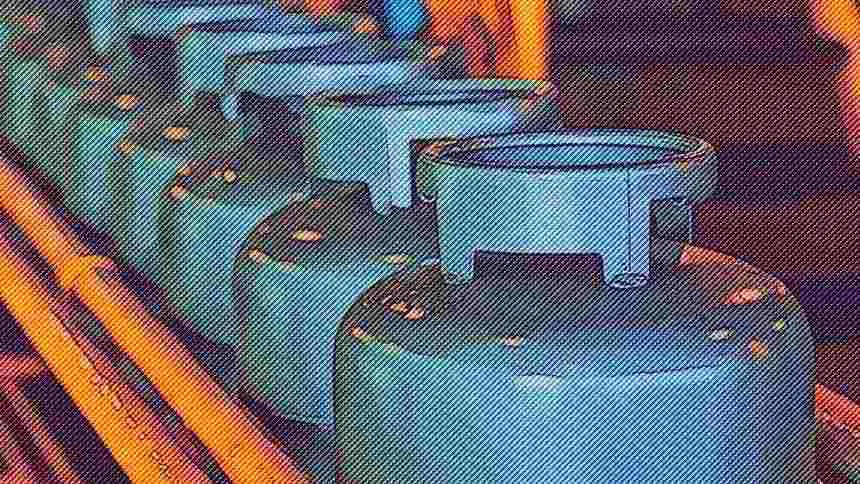
The real risk that businesses in the liquefied petroleum gas (LPG) sector, known as cooking gas, will interrupt their investment cycles to purchase new cylinders should become even more evident starting Friday, May 29th.
It is on this date that the directors of the National Agency of Petroleum, Natural Gas and Biofuels (ANP) will discuss the process that foresees the advancement of the possibility of fractional filling of the 13-kilogram (P13) gas cylinder, which is currently prohibited in the country, and the end of the exclusivity of this type of container.
The topic was on the agenda for the meeting held on May 15th . However, the item was removed from the discussion and postponed, without a decision at that time as to when it would be discussed again.
Speaking to NeoFeed , the Director-General of ANP, Artur Watt Neto, assured that the project will be on the agenda for the next board meeting. “It was postponed, but it will be back on the agenda on the 29th. There will be a discussion about this issue. The topic remains,” stated the director.
Watt Neto participated, on the afternoon of Friday, May 22nd, in a panel discussion on regulatory modernization during the Esfera Brasil Forum, at the Jequitimar Hotel, in Guarujá, on the coast of São Paulo.
In practice, he is anticipating the official release of the agenda, which will only come out on Tuesday, May 26, three days before the meeting between the directors of the regulatory agency. This confirms that the ANP wants to vote on the matter.
The issue, from the sector's perspective, is that the approval for these changes to take shape and be effectively adopted is already generating legal uncertainty for companies that are planning billion-dollar investments to meet the new demand stemming from the " People's Gas" social program.
In addition to the safety of the equipment itself and the end of the guarantee of responsibility for the technical quality of the bottling process, the proposed change opens a loophole, according to entities and companies in the sector, for the entry of organized crime. With less oversight, the sector, which is currently well-regulated in Brazil, would be vulnerable.
At the meeting, the topic will be discussed by five directors, and the trend is that the project will move forward, by a narrow margin of 3 to 2. Behind the scenes, the conviction is that Pietro Mendes and Symone Araújo will vote to maintain the current rule. And Daniel Maia Vieira and Fernando Moura will be on the side of change, approving the progress of the measure.
The deciding factor will be the head of the board, Watt Neto, who is expected to vote in favor of proceeding with the process, contrary to what the companies believe is the correct course of action. When asked how he would vote, he declined to reveal his position. "I will give my vote at the meeting."
The director-general also explained the timeline for the process, should the measure actually receive approval. The expectation is that, following the 'yes' vote, the next step will be public hearings and a public consultation.
And this should happen at the beginning of the second semester, a few months before the presidential election in October, and at a time when a large part of the business community will already need to have practically completed their investments for the new gas cylinders.
"From there, the consultation and public hearings will take place in 45 days [July 13, taking into account the approval on May 29]. And, with this, we will discuss what will be approved," stated the Director-General of the ANP.
He declined to directly address the companies' concerns, both regarding legal security and the potential jeopardizing the "People's Gas" program. "I'm not going to comment on that," he said.
The expectation is that each of the four main companies operating in the sector will allocate at least R$ 500 million to acquisitions, including cylinders purchased from national factories or imported. This means a minimum volume of R$ 2 billion to meet the demand resulting from the initiative launched last year by the federal government.
A survey conducted by ANP shows that, between January and April, the Brazilian LPG market reached 2.44 million tons. Of this total, 67.7% (1.65 million tons) corresponds to the P13 packaging.
The leader is Copa Energia – owner of the Copa Energia and Liquigás brands – with a 23.82% market share. In second place is Nacional Gás, with 21.49%, followed by Supergasbrás, with 21.4%, and Ultragaz, with 16%.
“If this initiative goes ahead, I will immediately stop investing in the purchase of more gas cylinders. And I will cancel the orders I have already placed. We cannot continue putting money into it while the ANP wants to end the legal security of our sector,” an executive from an LPG distributor in Brazil recently told NeoFeed .