

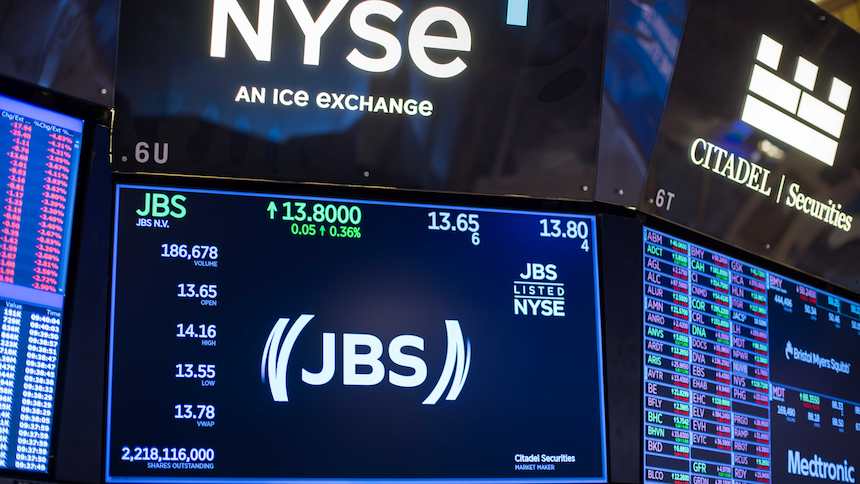
JBS has been included in the preliminary annual rebalancing of the Russell indices, released by FTSE Russell. The change will take effect after the close of trading on June 26 and marks the company's first concrete step in a new phase of its listing in New York: attempting to transform its presence on the American stock exchange into greater liquidity, a larger investor base, and a pricing closer to its global peers.
The company appeared on the preliminary list for the Russell 3000. Morgan Stanley states that JBS should also have been included in the Russell 1000, although specific confirmation of this index is usually detailed in the following weeks. The bank estimates a passive flow of approximately US$190 million – equivalent to roughly two days of trading.
Citi is working with a slightly larger account, between US$210 million and US$300 million. More importantly, however, is the medium-term potential. For the bank, the normalization of exposure to ETFs , factoring strategies, and active managers could attract between US$1 billion and US$4 billion in accumulated flows over 12 to 24 months.
BTG Pactual had already indicated in an April report that entering Russell would be the next natural step after the US listing. The ultimate goal, however, would be an eventual listing in the S&P 500, still dependent on requirements such as a history of listing in the United States, submission of forms, a free float greater than 50%, and a minimum market capitalization of US$22.7 billion.
To understand how the market is interpreting this move, NeoFeed spoke with managers and analysts who follow JBS. The prevailing view is that the immediate impact of the rebalancing is positive, but limited.
What really matters is whether inclusion in the American indices will help reduce the company's discount relative to companies like Tyson Foods and place it in even larger indices.
“It’s true that there has always been ill will from global investors towards JBS, as they see it as an emerging market company and not an American one, even though 50% of the company’s revenue already comes from the US,” says Luca Vello, a meatpacking analyst at Genial.
Today, Genial is neutral and its target price for JBS by the end of the year is US$18.5 – the stock is currently trading near US$13 on the NYSE. However, this target price may be revised upon its inclusion in the US indices. It remains to be seen what percentage the company will have in the Russell 3000 (and if it will even be included in the Russell 1000).
"There are approximately $2 trillion in passive funds that track the Russell index today, creating a future compulsory demand even without any basis for it," says Vello.
Regardless of the company's size in the indices, the fact is that simply entering the market already places it on another level.
“The point is that it allows the stock to gain more visibility among international investors, which could reduce the valuation discount of JBS compared to US companies and place it in even higher indices in the future,” says Alexandre Miguel, partner at RPS Capital.
At EQI Research, the US listing was already the main pillar of the JBS investment thesis. The firm included the stock in its recommended portfolio around the time of this move because it saw a repricing opportunity there. The inclusion in the indices is now seen as a necessary step for this thesis to gain traction.
“The listing in the United States was a determining factor for our thesis, very important, it was a pillar for the repricing of JBS,” says Nícolas Merola, analyst at EQI Research.
“It happened. The timeframe for the American market's view of the company to change took a while, but it's starting to happen now, based on this participation in the indices,” the expert added.
Head to head
JBS has always faced challenges in comparison on the Brazilian stock exchange. With a global scale, a significant presence in the United States, and operations spread across different protein and geographical areas, the company had few local peers capable of serving as a benchmark. On Wall Street, the most direct comparison becomes with American food and protein companies, especially Tyson.
This is the point the market wants to see unlocked. According to Merola, listing in the indices helps by bringing in passive cash flow and increasing liquidity, but also by signaling that the company is meeting the requirements demanded by the American market, such as disclosure and governance standards.
Tito Ávila, partner and director of Management and Risk at LIS Capital, sees the move as very positive for the company within the new market reality: that of companies that are in the major indices and that of those that are outside of them.
“Companies that are in the indexes end up being bought more, more closely followed by analysts, and more heavily covered by the market. Those that are left out end up being forgotten. This is no longer a technical detail,” says Ávila.
According to him, JBS trades at around 5 times EV/EBITDA, while Tyson's is around 8 times. If the company could close part of that discount, it could approach a market value in the range of "20-something billion dollars" and get closer to the criteria to compete for a spot in the S&P 500.
This move would have implications beyond the stock market. JBS is a frequent buyer of assets. With shares trading at low multiples, its cost of equity is higher. With a better-priced share, the company gains a stronger bargaining chip for acquisitions.
“If a company trades at low multiples, such as 5 times EBITDA, its cost of capital via equity is high. But if it manages to close the gap to something close to 8 times, it will have a stronger bargaining chip,” says Ávila.
This is happening at a critical time for the company, whose margins are further squeezed due to rising input prices. The main point of pressure continues to be cattle in the United States. Since the pandemic, the price of American cattle has been rising persistently, squeezing margins. Until recently, other JBS divisions (such as poultry in the United States, pork, poultry in Brazil, and beef in Brazil) helped offset this squeeze.
In the most recent results, this offsetting factor lost momentum. There was a simultaneous deterioration on several fronts, with worsening spreads and flattening margins in businesses that had been sustaining the company.
“JBS has always said that business diversification is important because it will mitigate these cycles. But, in this specific quarter, diversification was not enough to protect the company's results,” says the analyst from EQI Research.
Because of this, EQI reduced the weight of the stock in its recommended portfolio from 10% to 5% a few months ago, but remains constructive on JBS in the long term, largely due to the prospect of change with the listing.
And if the outlook is for the gap between American peers to narrow, the same will happen with Brazilian peers. "The company will gain greater competitiveness against Minerva and MBRF due to greater access to capital, which could make it even more competitive in Brazil," says the Genial analyst.
(Guilherme Guilherme contributed to this report)