


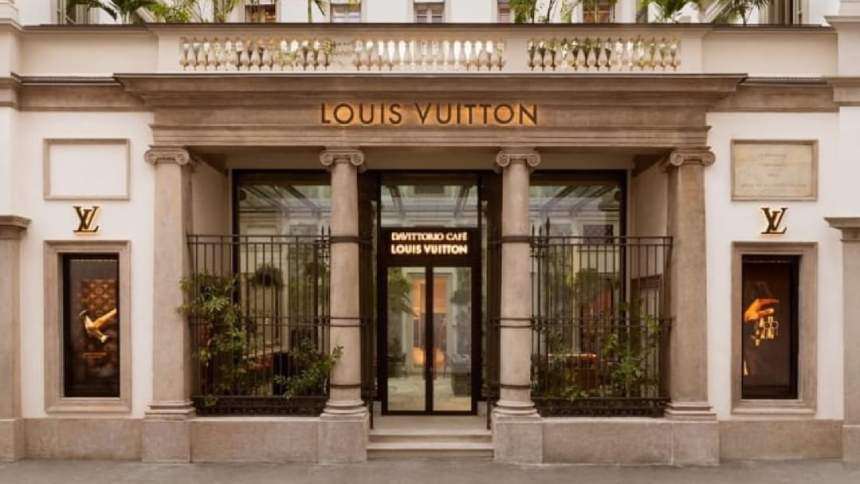
The decision by US President Donald Trump to impose a 10% import tariff on eight European countries, starting February 1st, and a 25% tariff in June, as a way to pressure the plan to incorporate Greenland, has directly affected major European luxury companies.
On Monday, January 19th, shares of major luxury retail companies were falling on European stock exchanges. LVMH, the world's largest luxury conglomerate and owner of the Louis Vuitton, Hennessy, and Moët & Chandon brands, was down 4.5% in its shares on the Paris stock exchange at around 5:30 pm (local time).
On the Vienna stock exchange, shares of Richemont, owner of Cartier, were down 3.12% at the same time. Kering also registered a 4.4% drop in Paris. On the Austrian stock exchange, the decline reached 4.06%.
Primarily driven by Trump's geopolitical and economic moves, Morgan Stanley downgraded its recommendation for LVMH shares from outperform to neutral. "The main reason for our increased caution is related to the impact of exchange rates and tariffs," analysts stated.
"LVMH will only be able to partially offset this impact through price increases, given the need to avoid excluding middle-income consumers," Morgan Stanley analyzed in the report.
In the wine and spirits market for the company, the trend, according to the bank's experts, is that the challenges will also intensify, mainly due to a possible change in consumer behavior resulting from increased competition, due to the effect of rising prices.
"We now project that profits from the wine and spirits division will fall to €988 million (18.1% margin) in 2026, the lowest level since 2010," states the Morgan Stanley document.
Trump's new tariff hike targets Denmark (which controls Greenland), Norway, Sweden, France, Germany, the United Kingdom, the Netherlands, and Finland. These countries have expressed opposition to the American president's desire to incorporate the Arctic territory.
“An escalation of the trade war between the US and Europe driven by Greenland could wipe out most of the growth in European profits in 2026,” says Laurent Douillet, senior equity strategist at Bloomberg Intelligence.
“Trump’s actions over the weekend exacerbated geopolitical risks and reignited trade uncertainty. After a start to the year with low volatility, stocks may experience some downward pressure,” Kyle Rodda, senior financial market analyst at Capital.com, told Reuters .
According to Goldman Sachs, the introduction of this new tariff on European products could reduce the gross domestic product (GDP) by between 0.1% and 0.2% in the countries affected by Trump's decision in 2026.
The US price hike is happening at a time of uncertainty in the European luxury market, which has been facing a slowdown since 2023.
On January 14, Saks Global, the group that controls major luxury department stores in the United States, filed for Chapter 11 bankruptcy protection.
In the petition filed with the court, the company stated that it has up to 25,000 creditors. Among those who are owed money by the company are major European luxury houses such as Chanel, Kering, and LVMH. The debt to these brands alone amounts to US$225 million.
In any case, the owner of Louis Vuitton rebounded in sales in the third quarter of 2025, with organic growth of 1%, against a forecast of a 0.6% decline. Total revenue in the period was €18.28 billion.
Over the past 12 months, LVMH shares have depreciated by 14.8%. The company is valued at €290.6 billion.