

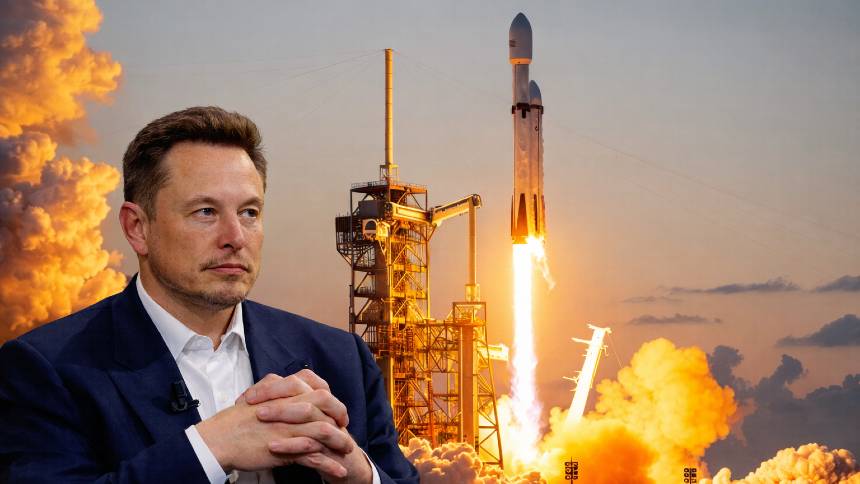
Two days before its highly anticipated initial public offering on Nasdaq, SpaceX is under the spotlight. And for good reason. The expectation is that, by ringing the bell on the American stock exchange, Elon Musk 's company will score the biggest IPO of all time.
In numbers, this milestone translates to the expectation of raising up to US$75 billion and achieving a valuation of approximately US$1.75 trillion in its initial public offering. This would even place the company ahead of Tesla, another of Musk's businesses, currently valued at US$1.43 trillion.
The figures are eye-catching. But, aside from the likely records, there are those who offer a more pragmatic analysis of the opportunities and risks in an offering of this magnitude. This is the case of Thiago Kapulskis , partner at São Pedro Capital , one of the leading technology analysts in Brazil, who saw through Nvidia's AI thesis before most specialists.
“The first issue is Musk himself. From the most objective point of view possible, he’s brilliant. He managed, for example, to make a rocket go in reverse,” Kapulskis tells NeoFeed . “So, the main factor is his brilliance. Which is both good and bad for SpaceX.”
In this regard, he refers to what's called key man risk . "If something happens to Musk, what happens to SpaceX? So, he's the biggest competitive advantage, but also the biggest risk for the company."
Kapulskis also establishes other counterpoints in this narrative. On the one hand, he emphasizes that the story told by the company, with episodes such as the plan to develop colonies on Mars and factories on the moon, is, in fact, intriguing.
However, he makes reservations about other possible chapters in this story. Among them are market projections estimating that SpaceX's revenue will jump from US$18.7 billion in 2025 to approximately US$500 billion in five years.
Thiago Kapulskis, partner at São Pedro Capital
"Today, among the big tech companies, the only one with revenue exceeding that projection is Amazon," he stated. "And it took Amazon 14 years to go from $18 billion in revenue to $500 billion."
In the conversation, Kapulskis also discusses other issues driving the offering, as well as topics that should be on investors' radar. Check it out:
What most appeals to you about this SpaceX offer?
Perhaps it's the sheer magnitude. We're dealing with the largest offering in history, the possibility of Elon Musk becoming the world's first trillionaire, and the first technology company to be valued at over $1 trillion at its IPO. When you look at the whole picture, it's almost fascinating.
But in your opinion, what explains this significant interest in the IPO?
The first issue is Musk himself. From the most objective point of view possible, he's brilliant. He managed, for example, to make a rocket fly in reverse. And he pioneered electric cars with Tesla, among other things. So, the main factor is his brilliance. Which is both good and bad for SpaceX.
Why?
Because this simultaneously creates the key man risk factor. If something happens to Musk, what happens to SpaceX? So, he is the company's biggest competitive advantage, but also its biggest risk.
In this assessment, taking Tesla as an example, do you think there is more patience with Musk regarding what he promises and what he actually delivers?
Musk's case is very particular. He has, in a way, created an idolatry, just like other figures such as Steve Jobs. There's also a lot of marketing involved in this story. So, he has many supporters who, ultimately, will give him the benefit of the doubt.
"The main factor is Musk's brilliance. Which is both good and bad for SpaceX."
What other factors are behind this frenzy surrounding the offer?
A second point is the narrative. The story is incredible to tell. They're talking about having a colony on Mars, a lunar economy, factories on the Moon, and everything else. So, there's room for imagination that excites everyone, including retail investors. But there's another issue when we move to the world of institutional investors.
Which?
Nasdaq decided to institute an accelerated entry into the Nasdaq 100 (to attract IPOs from companies like SpaceX). And this brings us to ETFs and many managers who, technically, track a similar index or must necessarily be over or under. So, they will all be inclined to try to track or beat that index. And this is an effect that can lead to an allocation almost independent of the company's fundamentals.
Who is most likely to be affected in this context?
Where we see the most pressure is in the big tech companies, because they are already the most liquid and easiest to trade. So, there's a technical effect of competition for capital here. These companies will have to make room not only for SpaceX, but eventually for companies like OpenAI and Anthropic .
Are there other factors driving this listing?
There's another point. The venture capital industry, particularly in the US, has become quite dependent not only on SpaceX, but also on companies that have raised tens or hundreds of billions of dollars in their latest rounds, such as OpenAI and Anthropic. So, because of this dependence, there's a bias here to, at the end of the day, focus on the positive aspects of these stories, creating a lot of content and narratives.
Could SpaceX's IPO be decisive for the IPOs of OpenAI and Anthropic?
The success of SpaceX's IPO should favor the success of these other IPOs. If it doesn't work out, it delays the plans of these other companies and creates nervousness in the venture capital market.
Considering all these factors, are the figures involved in this IPO justified?
For this valuation to be justified, quite aggressive estimates are needed. There are projections from an American bank that speak of revenue of around US$500 billion in five years. Given that SpaceX made US$18.7 billion in revenue in 2025, the company will have to multiply its revenue many times over, and more than that, at a very rapid pace.
"With so much interesting narrative and jargon, it's very easy to get carried away and lose sight of the variables that are most important for making the right investment decision."
Is there anything of this magnitude that could be compared to the technology market?
Among the big tech companies today, the only one with revenue exceeding that projection is Amazon. And it took Amazon 14 years to grow from $18 billion in revenue to $500 billion. Beyond that, there's also the issue of SpaceX's achievements being based on areas that don't yet exist.
Which ones, for example?
It's embedded in the general market expectation that this company will have data centers in the space, and not just one, but a significant capacity of data centers. Success is also expected from artificial intelligence initiatives, and we know there's a very fierce competitive landscape with Anthropic and OpenAI. So, obviously, the decision rests with the investor. But the asymmetry is undoubtedly unfavorable. Which doesn't mean they aren't capable of delivering.
Do you understand that this scenario extends to other tech IPOs besides SpaceX?
What we are seeing more and more are waves of overlapping technologies, enabling IPOs like SpaceX and, eventually, OpenAI and Anthropic. And these effects are creating possibilities for exponential returns. Which, at the same time, brings a very high degree of complexity.
As a manager, what advice would you give investors in this context?
I strongly believe in specialization and depth as differentiating tools when evaluating these investments. With the amount of interesting narratives and jargon, it's very easy to get carried away and lose sight of the variables that are most important for making the right investment decision. So, it's about doing the proper due diligence. You need to separate great business-building achievements from the investment itself. Good stories are not necessarily an excellent investment.