

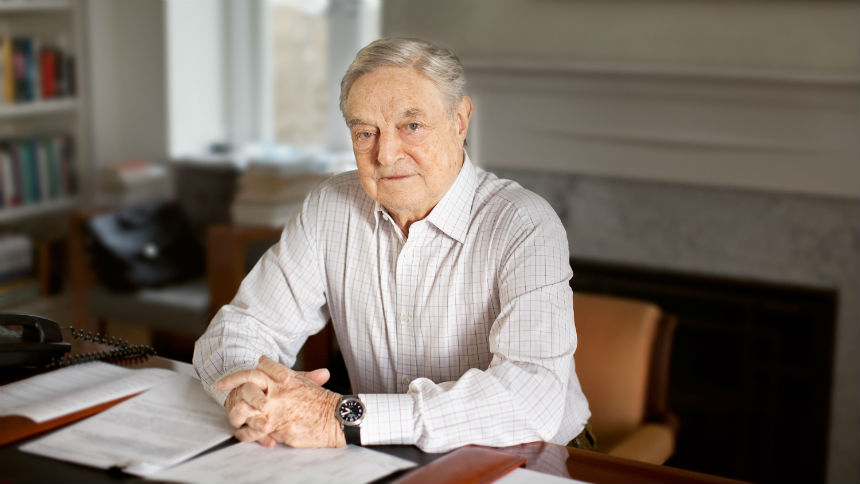
At 89 years old, billionaire George Soros is known for dedicating a large portion of his fortune, earned in the financial market, to political activism and liberal and human rights causes. Conversely, he is also a prime target for conservative politicians and activists worldwide.
On Thursday, January 23, Soros once again reinforced this reputation. During his participation in the World Economic Forum in Davos, he announced that he will invest US$1 billion to create a global network of universities, named the Open Society University Network (OSUN), focused on preparing for "current and future global challenges."
According to the billionaire activist, the project stems from the need to promote resistance to growing authoritarianism in countries such as the United States, China, and Russia, and to combat "current and emerging dictators," as well as issues like climate change.
“I believe our best hope lies in access to an education that reinforces individual autonomy, cultivates critical thinking, and emphasizes academic freedom,” Soros stated, describing the project as “the most important and enduring” of his life.
Under the premise of promoting the values of a democratic society, the plan is to integrate universities from around the world into the network and offer courses and degree programs in partnership. At the same time, OSUN intends to periodically bring together students and professors from different countries through in-person and online discussions.
These initiatives will also encompass refugees and politically threatened academics. “We are looking for partner institutions that feel responsible for the future of our civilization and people inspired by OSUN’s goals,” Soros stated. “We cannot build a global network on our own.”
The network, which will include the Central European University (CEU), founded by Soros, among its core institutions, is already establishing partnerships with several institutions. These include Arizona State University in the United States, the American University of Central Asia in Kyrgyzstan, and BRAC University in Bangladesh.
During a dinner for guests in Davos, Soros once again criticized Donald Trump. One of his fiercest opponents, he called the US president a coup plotter and added that, since Trump took office, "his narcissism has developed a pathological dimension."
At the event, the philanthropist also criticized President Jair Bolsonaro for failing to protect the Amazon and for not preventing the destruction of rainforests in Brazil.
From "Black Wednesday" to activism
The son of a Jewish lawyer, Soros was born in Budapest on August 12, 1930. After living through the Nazi occupation during World War II, he and his family left the Hungarian capital in 1947, heading to England.
In London, he combined his studies at the London School of Economics with work as a waiter and baggage handler at a train station. During this period, he came into contact with the philosopher Karl Popper. A defender of democracy and liberal values, Popper is said to have exerted a strong influence on Soros.
In 1956, after several stints at British investment banks, Soros moved to the United States. There, years later, he founded the Quantum Fund hedge fund. He truly began to attract attention on September 16, 1992, when he allegedly made a profit of US$1 billion by betting on the devaluation of the British pound. This episode became known as "Black Wednesday," and Soros gained notoriety for having broken the Bank of England.
From that moment on, Soros gradually distanced himself from the day-to-day operations of his businesses, while simultaneously increasing his involvement in activism and philanthropy. A year later, he founded the Open Society Foundations.
Through the organization, which operates in more than 120 countries, including Brazil, Soros, who has an estimated fortune of US$8.3 billion, has allocated billions of dollars to all sorts of projects and initiatives related to liberal, humanitarian, and progressive issues.
The scope included, for example, funding scholarships for black students during the Apartheid era in South Africa, and the disbursement of US$500 million in 2016 to assist refugee groups in Europe.
Soros is also known for his active involvement in the campaigns of Democratic politicians in the United States. He was among the top donors in the presidential races of figures such as Barack Obama and Hillary Clinton.
Because of these and other initiatives, Soros is a constant and growing target of politicians and conservatives, such as the Prime Minister of Hungary, Viktor Orban, and Trump himself. He is also the subject of conspiracy theories that associate him, for example, with Nazism and plans to start a civil war in the United States, by financing movements and protests in the country.
Soros, however, continues on his path. And he seems not to care about his detractors. This was made explicit, on one occasion, in one of his statements. "My success in the financial market has given me a greater degree of independence than most other people," he stated. "This allows me to take a controversial position. In fact, it compels me to do so."
Follow NeoFeed on social media. We're on Facebook ,LinkedIn , Twitter , and Instagram . Watch our videos on our YouTube channel and subscribe to our newsletter to receive daily news.