

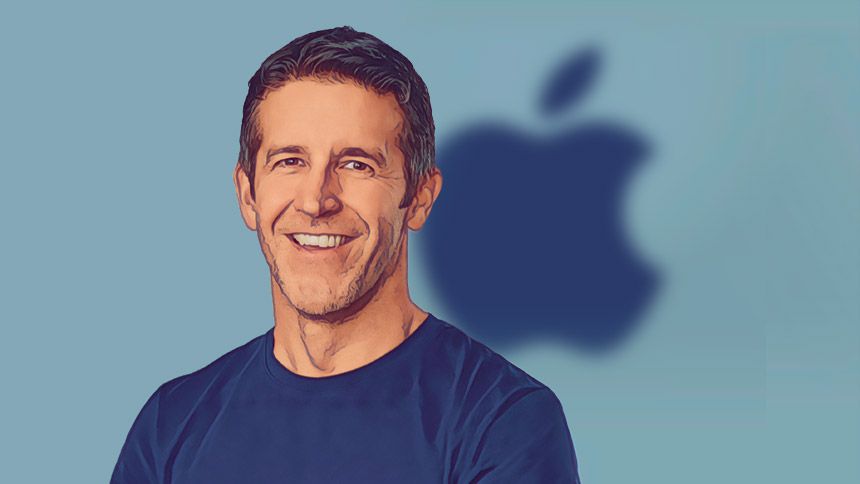

Apple has decided to make the most important leadership change since Steve Jobs' departure without resorting to an outside candidate. The company announced on Monday, April 20th, that John Ternus will be its new CEO starting September 1st, 2026, replacing Tim Cook, who will leave the position after 15 years and move to the role of executive chairman.
John Ternus may be a name unfamiliar to consumers, but he's quite important to the company. He was the senior vice president of Hardware Engineering and leads all of Apple's hardware engineering, overseeing the teams behind the iPhone , iPad, Mac, Apple Watch, AirPods, and Vision Pro. He's been with the company since 2001 and has been part of Cook's inner circle for years, which helps explain why his promotion sounds less like a disruption and more like the formalization of a plan that's been developing behind the scenes.
He is considered a low-key executive, capable of balancing product innovation with margin protection. For example, in 2018, when Apple was discussing including a small laser in iPhones to improve photos, environmental mapping, and augmented reality features, Ternus reportedly argued that the new feature should be restricted to the more expensive Pro models, aimed at consumers more willing to pay for cutting-edge technology.
Ternus is seen internally as a detail-oriented manager, knowledgeable about Apple's vast supply chain and skilled at navigating the company's bureaucracy without creating friction. At 50, he is the same age Cook was when he took over in 2011, and will become the first Apple CEO in three decades with an entire career built in hardware.
Recently, The New York Times published a report on Ternus and interviewed Apple executives who say he is more associated with maintaining and evolving products than with creating new categories. They also say he has limited exposure to the political and regulatory responsibilities that come with the CEO position. Thus, his profile is much more similar to Tim Cook's than to Steve Jobs'.
The career path of the new CEO
Californian Ternus graduated with a degree in mechanical engineering from the University of Pennsylvania, where he was a member of the university's swimming team. His final project was a device that allowed quadriplegics to control a robotic feeding arm with head movements. Before joining Apple , he worked for four years at a virtual reality startup.
At Apple, he started working on Mac screens, still in the transition away from the colorful iMacs of the late 1990s. Within a few years, he became a manager and earned the right to occupy a closed office, but he preferred to remain in the open space with the team, reinforcing the image of an approachable executive averse to signs of hierarchy.
His rise gained momentum when he became a key member of Dan Riccio's team, the former head of hardware at Apple. In 2013, he began overseeing the Mac and iPad teams. More recently, he spearheaded important strategic moves, such as the transition of Macs from Intel chips to processors designed by Apple itself, one of the company's most significant technical milestones in the Cook era.
The challenge of the next phase
If Ternus takes over surrounded by expectations, it's because he succeeds an executive who redefined Apple's scale. Since taking over from Steve Jobs , Tim Cook has transformed the company into an even more predictable and profitable global machine, taking annual revenue from $108 billion to $416 billion in 2025, and helping to push the company's market value to the $4 trillion mark.
Under his leadership, Apple also consolidated an installed base of over 2.5 billion active devices and expanded the weight of its services business, reinforcing the transition from a company focused solely on hardware to a global platform of products, software, and recurring revenue.
Ternus inherits a company that is still extremely profitable and dominant in hardware, but under pressure to show that its next phase will not depend solely on the iPhone and its already well-known execution discipline.
In October 2025, the strong initial sales performance of the iPhone 17, especially in China and the United States, drove the company's stock to an all-time high and brought its market value close to US$4 trillion, repositioning the company at the top of the game among global technology giants. On Monday, April 20, it closed the trading session valued at US$4.01 trillion.
At the same time, this succession is happening at a moment when Apple still needs to convince the market that it can transform artificial intelligence into a new driver of growth. Back in 2024, when it launched the iPhone 16 with Apple Intelligence and integration with ChatGPT , the company was described as lagging behind in the AI race and was betting that the new technology could reignite smartphone sales.
The question, since then, has been whether these resources would be enough to unlock a new cycle of device replacements and expand demand beyond the brand's most loyal customer base.
The challenge of the post-Cook era will be proving that Apple can continue to grow without losing its efficiency. And, at the same time, without falling behind in the main technological race of this decade and continuing to be innovative.