

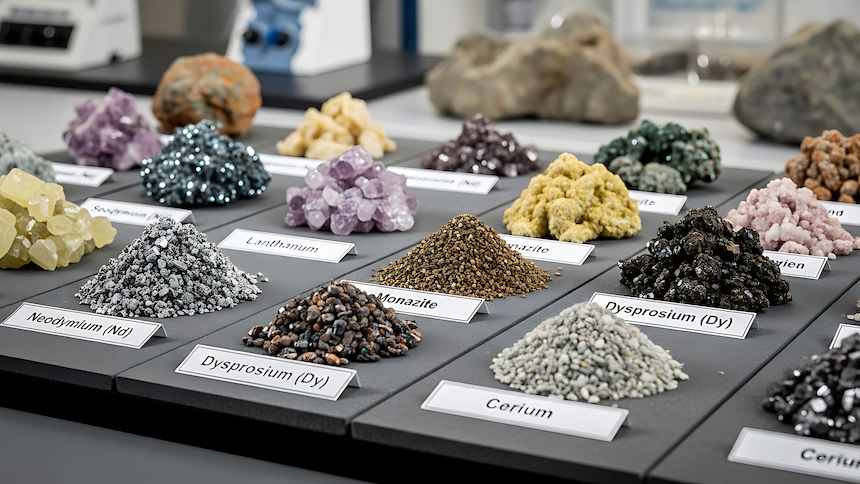
The potential of rare earth elements caught MadCap's attention. Looking to invest in this strategic new segment of the mining industry , the private equity firm has begun raising capital internationally for an investment fund.
With a goal of attracting US$200 million to fund 10 projects already mapped out in the country, MadCap began the roadshow in February for the LTWSK Mining Fund, which will be based in Delaware, USA, focusing on the global nature of the critical minerals market.
In less than 60 days, the fund already has advanced agreements with three major investors who are eyeing the exploration of the set of 17 chemical elements in the periodic table, essential for the manufacture of wind turbines, electric vehicles, and defense applications, among other key products of the digital age.
MadCap, created less than a year ago, has R$330 million under management and aims to reach R$1 billion by December in its private equity strategy, focusing on the agribusiness and consumer sectors. Its investment portfolio includes companies such as Oakberry, Liquid Death, Casadonna, Ease Labs, and Nave Bebidas Premium, among others.
The third vertical is precisely that of a mining fund , which is led by Mozart Litwinski, former CEO of Ferrous and former executive of Vale, and includes Elmer Salomão, former director-general of the National Department of Mineral Production and one of the leading experts in the field in the country; as well as Guilherme Jácome, Felipe Litwinski and Yuri Litwinski, all with experience in the development of projects in the mineral sector.
The business model created by MadCap is based on a formula that blends low risk, high technical expertise of the team, and asset diversification, without favoring any specific critical mineral.
In other words, instead of searching for unexplored opportunities in our subsoil, the LTWSK Mining Fund decided to invest where there is already relative security of return, taking into account certain selection criteria based on the knowledge of the terrain held by its executives.
“We prioritize setting up projects in locations with prior discovery rights, low socio-environmental risk—that is, far from indigenous and quilombola communities—and with good local acceptance, as well as viable infrastructure and cost competitiveness,” Jácome tells NeoFeed .
In total, ten projects were established, with diverse critical materials, without focusing on a specific mineral, but with different stages of maturity and development. These include projects for the exploration of rare earth elements , nickel, copper, graphite, lithium , and platinum group metals.
"It's difficult to list a mineral that will have the highest profitability in the future because the market today is very dynamic," Jácome continues.
"Three years ago it was lithium, today it's rare earths, and soon it could be something new; we need to prioritize projects with minimized risk," he adds.
The portfolio includes everything from greenfield projects to those that have already been approved and are under development, but which still need to advance with some technical-economic feasibility studies and licensing.
According to him, the total projected fundraising of US$200 million will be sufficient to cover the projects that take off. The capital will be allocated in tranches contingent on results.
For example: an initial investment of US$1 million, with further contributions as goals are met and committee approval is obtained, directing 70% to 80% of the capital to projects with the greatest technical and economic merit.
Governance also has established rules. The management company says it is not only seeking financial investments, but also experience in developing, implementing, and licensing projects responsibly.
“Our preference is for actionable control from the outset to guide management, including a minority stake with a board seat in an advanced Capex situation, ensuring quick decisions and strategic alignment,” says Jácome.
Regarding the destination of the production, the fund intends to make decisions on a case-by-case basis, between exporting concentrates or processing and refining them, with a focus on adding value locally.
“Diversification helps reduce volatility, so our focus is on supplying critical minerals to the US, EU, Japan and Korea, with ample demand aimed at the global competitiveness of projects, initially in rare earths and copper,” says the expert.
Terrabras in sight?
The proposal behind the launch of the LTWSK Mining Fund gives an idea of the country's growing weight in the competitive global market for critical minerals, whose potential can be measured not only by the fact that Brazil has the second largest reserve of rare earths in the world (19% of the total), the crown jewel of critical minerals, but also because it has mapped only 23% of its subsoil.
Since China accounts for more than 50% of the production of 18 critical minerals, in addition to controlling a large part of the refining and processing of rare earths, graphite, vanadium, and intermediate stages of lithium and cobalt, this market has become strategic in the trade war with the United States, generating pressure from US President Donald Trump on Brazilian reserves.
Brazil already has rare earth mining projects in Minas Gerais, Goiás, Bahia, and Amazonas. These projects are financed by both Brazilian and international companies (USA, Australia, and China). The Brazilian Mining Institute ( Ibram ) estimates an investment pipeline in critical mineral projects in the country of approximately R$ 100 billion by 2029, mostly from foreign sources.
The pressure from the American president to attract Brazil as a supplier of critical minerals – and, preferably, isolating China – ended up transforming the issue initially into a major geopolitical debate that is already being directed towards the election campaign.
At the end of March, during an ultraconservative event in the US, presidential candidate Flavio Bolsonaro gave a speech offering Brazil's rare earth resources to Donald Trump. "Brazil is the solution for the US to break its dependence on China for critical minerals," he said.
In response, two bills have emerged in the Chamber of Deputies proposing the creation of Terrabras, a new state-owned company for the rare earth and critical mineral supply chain in Brazil. One is signed by the PT leader in the House, Pedro Uczai (SC), along with 73 other deputies from the PT, PV, and PC do B parties, which make up the Brazil Federation of Hope. The other is by Deputy Rodrigo Rollemberg (PSB-DF).
Ibram and two other entities, SGB (Brazilian Geological Survey) and Cetem (Mineral Technology Center), issued a statement on Monday, April 13, expressing concern and stating their intention to work with members of parliament and the government to "build a policy that expands Brazil's presence in the global market for critical minerals, without repeating models whose limitations are already known."
The proposal to create Terrabras, at least for now, is viewed with reservation by the government itself. Vice-President Geraldo Alckmin has already criticized the proposal, stating that the role of the State should be regulatory and denying any possible move by the current administration regarding the creation of the new state-owned company.
The idea of creating a state-owned company in an election year is considered a self-inflicted wound for the government, which is already facing low popularity in opinion polls. In other words, any initiative should only move forward next year – if the Lula government wins re-election.