

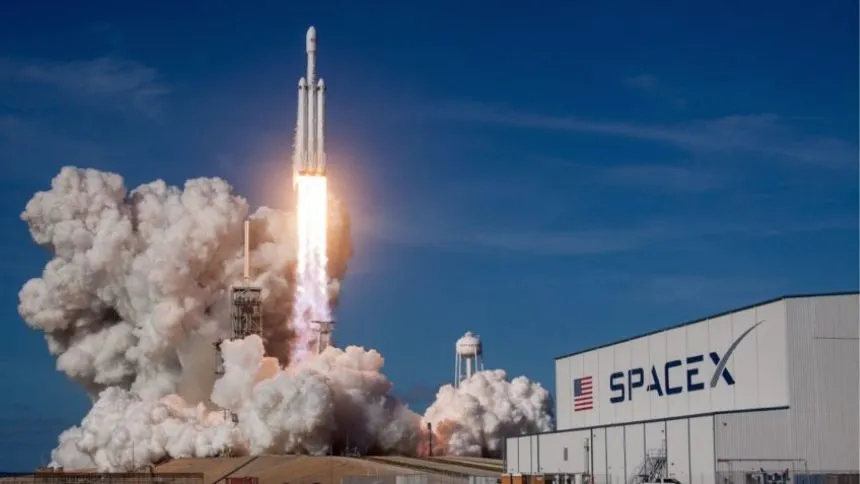

SpaceX has begun detailing to investors its IPO, which could go down in history for its size and design: seeking tens of billions of dollars on Wall Street, the company's main shareholders want it to debut on the stock exchange, but without relinquishing control.
Documents from the confidential IPO prospectus filed this month and obtained by Reuters news agency show that Elon Musk and a select group of executives and partners are expected to retain voting control of the company after the offering.
This would occur through a dual-class structure that will give Class B shares ten votes per share, while market investors will hold Class A shares, with one vote each. The stock market debut is being planned for the end of June.
In practice, SpaceX is attempting to replicate a formula already familiar among companies that go public in the US and are led by founders: raising capital in the market without effectively sharing power. The difference, in this case, is the scale. SpaceX is aiming for a valuation of approximately US$1.75 trillion and a capital raising of US$75 billion—which would make it the largest initial public offering in history.
Musk will remain as CEO, CTO, and chairman of a nine-member board. Although he received $54,080 in compensation last year, the prospectus indicates he could unlock billions of dollars in stock gains after the IPO. President and COO Gwynne Shotwell received $85.8 million in total compensation in 2025, while CFO Bret Johnsen received $9.8 million.
At the same time, the prospectus makes it clear that the company wants to limit the influence of those who enter the capital after the IPO. In addition to the structure of shares with super-voting rights, the documents point to mechanisms that could restrict shareholders' ability to interfere in board elections and even take certain disputes to court, by pushing conflicts to arbitration and limiting the jurisdiction for these discussions.
According to The Information , Musk also reinforced his shareholding in SpaceX before the IPO. He increased his stake in the company in 2025 by buying $1.4 billion in shares from current and former employees through his trust and, in addition, gained a potentially billion-dollar new package: 60 million extra shares, released in stages, if the company's market value rises from $1.1 trillion to as high as $6.6 trillion and if SpaceX moves forward with a plan to put data centers in space to sell computing capacity to AI developers.
In other words, even when going public, SpaceX is structuring the offering in a way that expands—not dilutes—Musk's power within the company.
On the business side, the company also wants to leverage the Musk brand appeal to attract individual investors. The plan is to reserve approximately 30% of the shares for retail investors and also open initial sales to individuals in markets such as the United Kingdom, the European Union, Australia, Canada, Japan, and South Korea.
The structure of the operation and the exact volume of the portion allocated to retail investors should be defined closer to the IPO launch. Morgan Stanley, Bank of America, Citigroup, JPMorgan, and Goldman Sachs are leading the operation as active coordinators of the order book, while 16 other banks, including BTG Pactual, are covering the institutional, retail, and international channels.
Convincing investors
This week, SpaceX is holding a three-day marathon of closed meetings with analysts at its facilities in Texas and Tennessee, in an attempt to convince the market to embrace a listing.
The itinerary put together by the company is unusual even by the standards of an operation of this size. The presentations begin with visits and briefings at Starbase, the launch base in Boca Chica, Texas. Afterwards, another group of analysts linked to institutional investors, such as asset managers and pension funds, would have a separate session.
On the third day, guests were invited to visit the “Macrohard” project at the Colossus data center in Memphis, Tennessee. To participate, attendees were required to hand over their electronic devices.
The agenda is part of the company's effort to sell an investment thesis that extends beyond the space business. This is because the offering prospectus also provides the market with the first more detailed picture of the group's financial health after the merger between SpaceX and xAI , an operation that brought together rockets, Starlink , the X platform, and the Grok chatbot under the same umbrella.
The numbers help explain why the company needs a robust narrative to justify such an ambitious valuation. The company ended 2025 with approximately $24.8 billion in cash, total assets of $92 billion, and liabilities of $50.8 billion.
For the year, it recorded a consolidated loss of US$4.94 billion on revenue of US$18.67 billion, reversing the profit of US$791 million recorded in 2024, when it had earned US$14.02 billion.
The main driver of this growth was investments in artificial intelligence. The company's capital expenditure jumped to US$20.74 billion in 2025, more than twice the level of the previous year and almost five times the amount from two years prior. More than half of this total was allocated to AI. This segment alone consumed US$12.7 billion, compared to US$5.6 billion in the previous fiscal year.
It was Starlink, the satellite internet arm, that absorbed a good portion of that cost. According to excerpts from the prospectus, the business generated US$4.42 billion in operating profit in 2025, helping to offset the increased losses from the incorporation of xAI.