

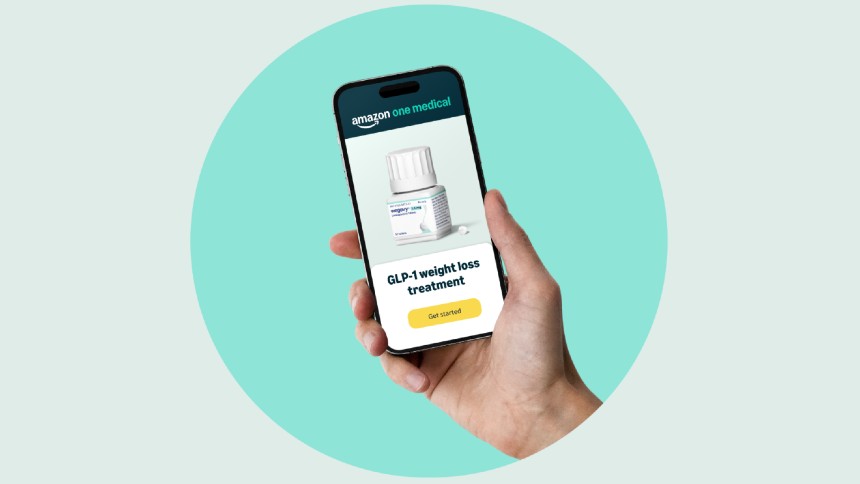

Amazon has decided to use the pen craze to take another step forward in its healthcare ambitions. On Tuesday, April 21, the company announced, through Amazon One Medical, the GLP-1 Management Program, which integrates obesity treatment into primary care, combining virtual and in-person consultations, prescription management, and medication delivery through Amazon Pharmacy.
The announcement goes beyond selling Wegovy or Zepbound. The company's proposal is to treat obesity as a chronic condition, with ongoing monitoring, exams, check-ins, and long-term management, and not as a one-time solution.
Amazon is trying to capture the entire patient journey — from screening to prescription renewal, from consultation to medication delivery — and transform that flow into another cog in an ecosystem that combines primary care, telemedicine, pharmacy, and logistics.
The company also used the launch to make its commercial policy more explicit. According to Amazon, prices with health insurance start at $25 per month. For those paying out of pocket, oral medications start at $149 per month, while injectables (such as Novo Nordisk 's Wegovy and Eli Lilly's Zepbound) start at $299 per month.
On-demand renewals start at $29 for text-based consultations and $49 for video consultations. It's a way of selling predictability in a market where price and access are still central to the competition.
But the competitive advantage that Amazon is trying to exploit lies less in price and more in convenience. The company reported that it already offers same-day delivery in nearly 3,000 American cities and intends to expand this coverage to 4,500 locations by the end of 2026. By bringing its logistics infrastructure into the clinical journey, the company reinforces a long-standing thesis within the group: using the network built in retail to gain ground in other layers of recurring consumption.
On the stock market, the announcement was interpreted as yet another sign that Amazon wants to advance its patient interface and put pressure on other links in the chain. On Tuesday, Amazon shares rose about 1.7%, while Eli Lilly fell 1.8%, Novo Nordisk retreated 3.1%, and Hims & Hers lost 4%.
The move suggests that the market viewed the retail giant's offensive as positive for its healthcare strategy and more challenging for companies already exposed to the LPG-1 race.
A long-term investment in the healthcare market.
This offensive didn't start now. Amazon's bet on pharmacies gained scale with the purchase of PillPack in 2018, a move that was already interpreted by the market at the time as a more aggressive entry by the company into the pharmaceutical retail sector.
Last year, the company began connecting this operation to its ambition in primary care. In October 2025, WeightWatchers announced a partnership with Amazon Pharmacy to deliver medications to its members, including injectable GLP-1 obesity treatments. The agreement reinforced a growing demand for convenient access to these products, including outside of major urban centers.
In the same move, Amazon began to bring the pharmacy closer to One Medical, a primary care network acquired by the company in 2023. In April of this year, Reuters reported that the company began stocking Eli Lilly's new weight-loss pill at kiosks installed in select clinics, in addition to expanding its fast delivery offering.
Thus, Tuesday's announcement consolidates pieces that Amazon has been putting together for years. What is now more clear is the attempt to use the commercial appeal of GLP-1 to attract patients to One Medical, increase Amazon Pharmacy's repeat business, and become the dominant player in one of the hottest healthcare categories in the US.
At the same time, Amazon's move is happening in a market where other retail giants are also trying to position themselves around the pen-based drug market. The launch of One Medical comes just days after Walmart expanded its own services related to GLP-1 users, signaling that the competition is shifting from the isolated drug to the surrounding care ecosystem.