

Owner of a fortune estimated at US$2.8 billion (approximately R$14 billion), Brazilian mega-investor Lirio Parisotto did not hold back in his criticism of the country's economic situation, ranging from the federal government's fiscal management and the debate surrounding the end of the 6x1 scale, to the new Desenrola program, the high level of interest rates, and its impact on the stock market.
Parisotto's portfolio includes shares in Axia Energia, Vale, Petrobras, Hypera Pharma, CSN, Celesc, Usiminas, and other companies through the Geração L Par fund. He also owns Innova, a petrochemical company that had revenues of R$ 5.6 billion last year.
According to the billionaire, the way for the Selic rate to move away from its high level – currently at 14.5% per year – and lessen its impact on companies' cost of capital lies in more efficient management by the federal government, with a direct focus on fiscal matters.
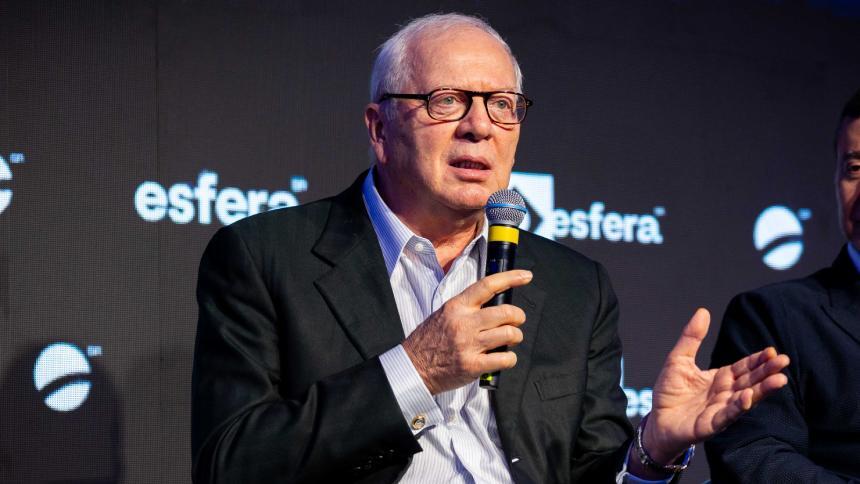
“Why do we have to pay almost 15%? Because of the disarray in public finances. If we had proper management, we would have reduced spending today. Then we would have a decent interest rate,” he stated, in response to a question from NeoFeed , after leaving a panel at the Esfera Brasil Forum, held in Guarujá, on the coast of São Paulo.
According to Parisotto, the high interest rates create an even more serious situation, in which those who control the resources have more power than "in the time of slavery," according to him.
"Those who are creditors are in charge. Those who are in debt are on their knees. And the Brazilian state is on its knees, borrowing and paying these high interest rates. This will only change with management, with a shock of confidence that will show that it is possible to spend less than is collected," he states.
In this sense, the mega-investor sees that today the B3 (Brazilian stock exchange) is "cheap" and that the potential value of the shares of listed companies could be greater. The key to achieving this lies precisely in better control of spending by the government.
“The price-to-earnings ratio, which is a global benchmark, is around 11x. But there is room to grow. The stock market is lagging behind. And it could grow by about 50%. With companies improving, this is automatic. But of course there are noises that affect the stocks.”
Among the contributing factors, in his view, are the lack of clarity regarding a more effective fiscal policy on the part of the current government, and the presidential race itself, which should be a platform for further discussion on improving governance.
“As the country improves, businesses will improve because it generates more consumption, more jobs, and guarantees more taxes. This is the virtuous circle that we need and that I have been waiting for since I was 20 years old, when I was a student, from the leftist opposition,” he says.
Below are the main points raised by the businessman:
Interest rate
Why do we have to pay almost 15% [today the Selic rate is at 14.5% per year]? Because of the disarray in public finances. If we had proper management, we would have reduced spending today. Then we would have a decent interest rate. Anything above inflation is income transfer. And there is no social work that can remove the concentration of wealth from those who invest. There is a huge transfer of wealth from the debtor to the creditor, which is worse than slavery. The creditor is in charge. The debtor is on their knees. And the Brazilian state is on its knees, borrowing and paying these high interest rates. This will only change with management, with a shock of confidence that will show that it is possible to spend less than is collected.
End of the 6x1 scale
Each sector will be affected differently. The most labor-intensive companies will suffer the most. We [Innova] already operate in four shifts, so it doesn't affect us at all. But, in the case of many other sectors, this issue needs to be discussed further.
B3 'cheap'
The stock market is a result of the companies that are currently operating in Brazil. The foundation of the capital market lies in these companies. And, as the country improves, the companies will improve because it generates more consumption, more jobs, and guarantees more taxes. This is the virtuous circle that we need and that I have been waiting for since I was 20 years old, when I was a student in the leftist opposition [today he is 72 years old]. I dreamed of a great Brazil. I hoped that we would have a developed country when I was still a student. And this frustrates me. Today there are cheap companies on the stock exchange, others not so much, and others that shouldn't even be there. The price/earnings ratio, which is a global benchmark, is around 11x. But there is room to grow. The stock market is lagging behind. And it could grow by about 50%. With companies improving, this is automatic. But of course there are noises that affect the stocks. Last year, [Ibovespa] rose 30%. And, in 2026, it is expected to rise by more than 20%. With these recent developments, the market has calmed down and should rise 5% or 6%. But I believe in a recovery.
New program Unravel
Today, more than 80% of the population is in debt. But the problem isn't this; it's the lack of financial education. If you eliminate the debt of someone with a negative credit history, someone listed on Serasa (a Brazilian credit bureau), in six months they'll have 60% of their total debt again. If you spend more than you earn, you'll inevitably have problems. This applies to individuals, businesses, cities, states, and the federal government. And I don't know if people earning more wouldn't become even more indebted. I see this in my company regarding payroll loans. Those who borrow the most aren't those with high or low salaries. Those who become most indebted are those with average salaries, around R$10,000. A public that isn't poor, but also isn't rich, but that tries to anticipate some desires.
Presidential elections
As a businessman and entrepreneur, I always dream of an entrepreneurial president. A president who is focused on management. Half of the country's money ends up in the hands of the government, at all levels, including state-owned companies. So, as a voter, I would like to see Brazil with good governance. I don't know who this candidate would be. We already know who's in the running. The other options are complicated. We're still at the beginning of the election period. A lot can change.